

Key Takeaways
| Point | Details |
|---|---|
| Agile Culture as Ethos | Agile culture is a profound ethos shift, not just a set of processes or tools, requiring a transition from traditional authority and certainty to collaboration and discovery. |
| Core Values of Agile | The Manifestor for Agile Software Development emphasizes prioritizing individuals, working solutions, and adaptability over rigid processes, guiding true organizational transformation. |
| Key Behaviours for Transformation | Successful agile transformation involves developing empowered teams, encouraging rapid delivery cycles, and fostering transparent communication to drive adaptability and responsiveness. |
| Challenges in Adoption | Organizations face significant challenges during agile transformation, including resistance from leadership and insufficient commitment to cultural change, which necessitate a focus on sustained, disciplined leadership development. |
Table of Contents
- Defining Agile Culture And Common Misconceptions
- Core Values And Principles Of Agile Culture
- Key Behaviours Driving Agile Transformation
- Organizational Benefits And Practical Applications
- Challenges, Pitfalls, And Successful Adoption Strategies
Defining Agile Culture and Common Misconceptions
An agile culture is a fundamental shift that transforms how organizations think, work, and adapt. According to McKinsey, true agility requires leaders to move from reactive strategies to creative approaches, shifting their perspective from certainty to discovery, authority to partnership, and scarcity to abundance. Common misconceptions often derail organizational agility. Many leaders mistakenly believe agile is simply about implementing new tools or conducting more frequent meetings. In reality, agile culture represents a profound transformation in organizational thinking. Cargo cultism in agile frameworks highlights how organizations can superficially mimic agile practices without understanding their deeper principles. Here’s a summary comparing common misconceptions about agile with the realities of an agile culture: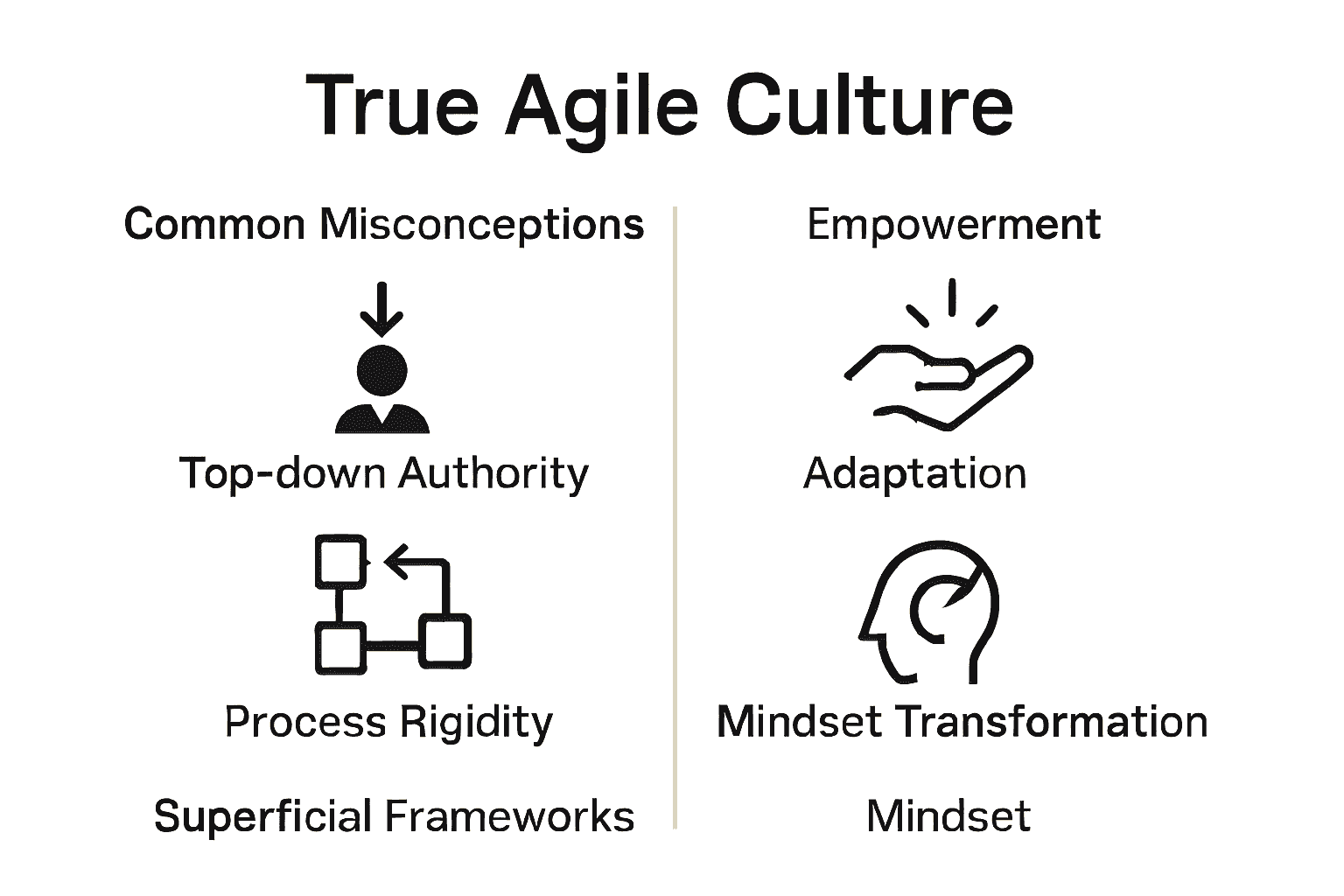
| Aspect | Common Misconceptions | True Agile Culture |
|---|---|---|
| Focus | Tools & meetings | Mindset transformation |
| Approach | Prescriptive processes | Adaptation & learning |
| Leadership | Top-down authority | Partnership & empowerment |
| Implementation | Copying frameworks | Principle-driven change |
| Outcome | Faster activity | Continuous improvement |
- Continuous learning and adaptation
- Embracing experimentation and calculated risk
- Prioritizing collaboration over individual performance
- Maintaining transparent communication
- Rapid iteration and feedback loops
Core Values and Principles of Agile Culture
Agile culture is fundamentally rooted in a set of core values and principles that transform how organizations approach work and collaboration. According to the original Agile Manifesto, these values emphasize human-centred approaches that prioritize individuals, interactions, and adaptability over rigid processes and comprehensive documentation. The four core Agile Manifesto values provide a comprehensive framework for organizational transformation:- Individuals and interactions over processes and tools
- Working solutions over comprehensive documentation
- Customer collaboration over contract negotiation
- Responding to change over following a fixed plan
Key Behaviours Driving Agile Evolution
Successful agile evolution hinges on fundamental behavioural shifts that challenge traditional organizational approaches. According to McKinsey, leaders must deliberately develop agile leadership mindsets that prioritize adaptability, collaboration, and continuous learning over rigid hierarchical structures. Key behaviours driving agile transformation include:- Developing empowered, small teams with autonomous decision-making capabilities
- Creating rapid delivery cycles that enable quick responses to market changes
- Focusing teams on delivering direct external customer value
- Encouraging transparent communication and continuous feedback

Organizational Benefits and Practical Applications
Agile evolution delivers substantial organizational benefits that extend far beyond traditional project management approaches. According to McKinsey research, organizations embracing agile methodologies experience significant improvements in growth, profitability, customer satisfaction, and employee engagement when leaders commit to fundamentally changing their operational mindsets. Practical applications of agile principles span multiple industries, challenging the misconception that agility is limited to software development:- Healthcare teams are improving patient care delivery processes
- Marketing departments are creating more responsive campaign strategies
- Construction projects enhancing collaborative planning
- Educational institutions redesigning learning experiences
- Manufacturing teams optimizing production workflows
Challenges, Pitfalls, and Successful Adoption Strategies
Agile evolution is not a simple switch; no evolution is simple, but it is a complex organizational journey fraught with potential pitfalls. The most significant transformation challenges emerge when organizations attempt to implement agile methodologies without fundamentally changing their leadership mindsets and cultural approaches. Common challenges organizations encounter include:- Resistance from traditional hierarchical leadership
- Insufficient understanding of agile principles
- Lack of sustained commitment to cultural change
- Inadequate training and support for teams
- Misalignment between agile teams and existing organizational structures
Turn Agile Culture Insights Into Real-World Results for Your Organization
Struggling to move beyond surface-level agile practices and achieve actual cultural change? If you have recognized the gaps between agile theory and its actual impact in your workplace, you are not alone. Many leaders face resistance, confusion, or stalled progress when building an agile organization. The commitment to evolving leadership mindsets, enabling empowered teams, and creating a responsive environment is essential. As this article highlights, organizations often fall into the trap of copying agile frameworks without addressing the deep-rooted need for behavioural change and leadership development. If you are ready to overcome these roadblocks and boost performance, now is your moment. Take your next step toward a resilient, high-performing culture with Berriault & Associates. We offer a people-focused, framework-agnostic approach, using proven tools such as Five Behaviors™ and Everything DiSC™ to unlock better teamwork and adaptive leadership. Discover how our tailored organizational agility solutions and comprehensive behavioural change programs can help you achieve real transformation, not just temporary improvements. Visit Berriault & Associates today and book a discovery call. The sooner you start, the faster your teams will thrive in a truly agile culture.Frequently Asked Questions
What is agile culture?
Agile culture is a fundamental mindset shift that transforms how organizations think, work, and adapt, focusing on continuous learning, collaboration, and rapid iteration rather than rigid processes.What are the core values of agile culture?
Agile culture isn’t just about sticky notes and sprints—it’s about how people treat each other and get work done. The core values that set agile teams apart are: People First, Always, Progress Over Perfection, Customer at the Centre, Embrace Change, and Don’t Fear It. Bottom line: Agile culture is about courage, respect, adaptability, and integrity. It’s about showing up for each other, learning as you go, and always keeping your eyes on what matters most—people and real results.
What are the key behaviours driving successful agile evolution?
It’s less about following a playbook and more about how people show up every day. Here are six key behaviours: Courageous Collaboration, Relentless Curiosity, Radical Transparency, Empowerment Over Permission, Obsessive Focus on Real Value, and Adaptability in Action. At the end of the day, it’s about building a culture where people feel safe to speak up, try new things, and keep moving forward—even when things get tough. That’s the heart of true agile evolution.
What are some common challenges organizations face during agile transformation?
Common challenges include resistance from traditional leadership, insufficient understanding of agile principles, lack of sustained commitment to cultural change, inadequate team training, and misalignment between agile teams and existing organizational structures.Recommended
- Building Agile Organizations: The Foundation of Success - Berriault and Associates Consulting Group
- What Does It Really Mean to Be an Agile Organization? - Berriault and Associates Consulting Group
- An evolution in leadership is upon us - Berriault and Associates Consulting Group
- Ethos Or Mindset: Why Values Matter More - Berriault and Associates Consulting Group