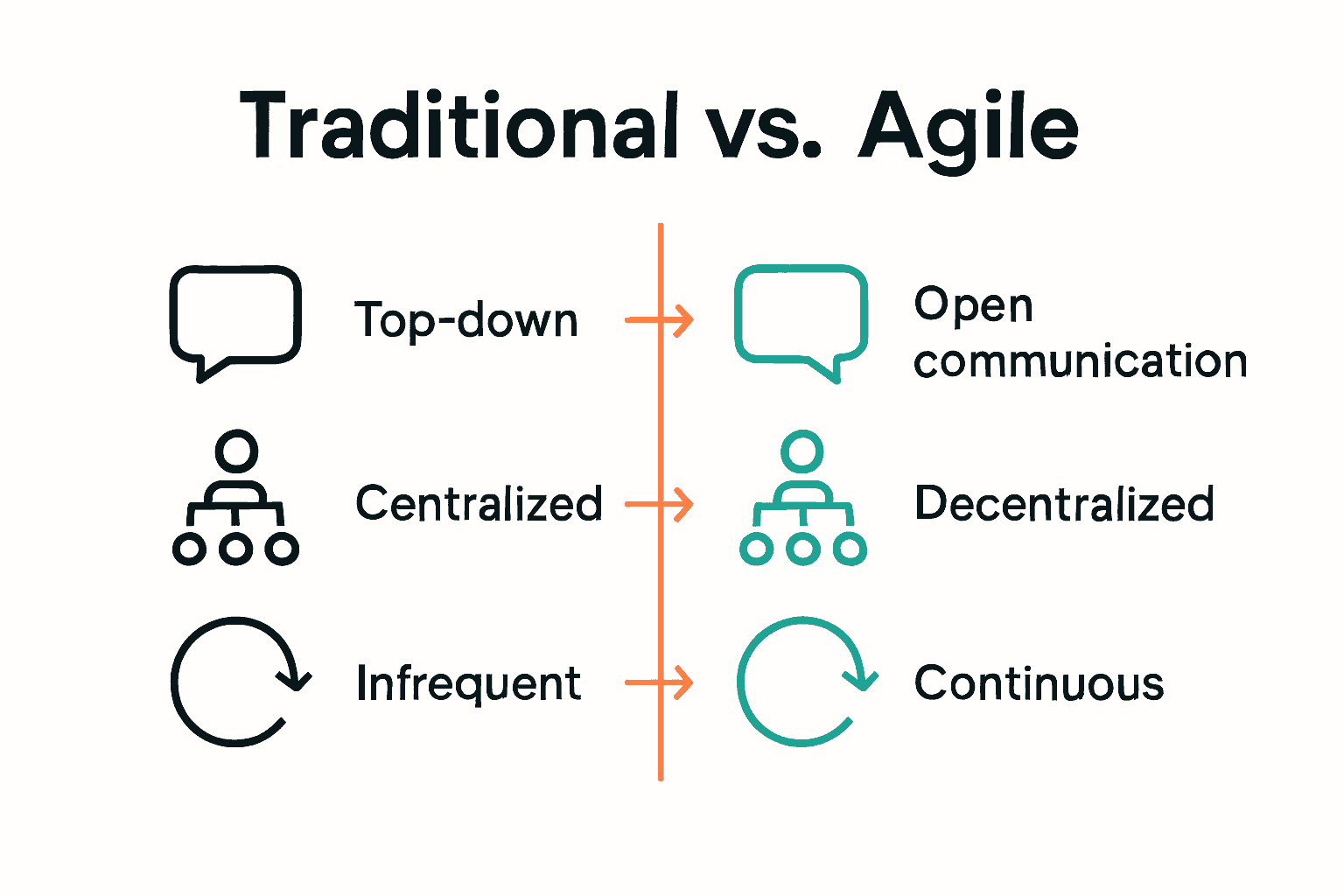
Did you know that over 70 percent of agile transformations fail to deliver lasting results? The rush toward agility has left many organizations struggling to move beyond old habits and embrace meaningful change. Understanding agile culture matters because it shapes how teams communicate, solve problems, and adapt when everything shifts overnight. By looking deeper into what defines true agility, you can discover how successful organizations foster environments that thrive on flexibility, transparency, and rapid innovation.
Key Takeaways
Point
Details
Agile Culture Transformation
Agile culture requires a fundamental shift in mindsets, embracing collaboration and continuous learning to drive success.
Leadership’s Role in Agility
Effective agile leadership is crucial, focusing on empowering teams and fostering transparency rather than micromanagement.
Core Agile Practices
Successful agile organizations prioritize rapid iteration, customer-centric problem solving, and collective accountability among teams.
Challenges of Agile Adoption
Common obstacles include rigid structures, poor leadership engagement, and treating agile as a quick fix rather than a comprehensive cultural change.
Agile culture represents a fundamental reimagining of how organizations operate, communicate, and adapt. At its core, it transforms traditional hierarchical structures into dynamic, responsive ecosystems where collaboration, flexibility, and continuous learning drive success.
According to research from the MoCA model, organizational cultural values play a critical role in successfully implementing agile methods. The study emphasizes that social and cultural factors must be deeply understood and intentionally adapted for agile transformation to take root. This isn’t just about implementing new processes—it’s about shifting mindsets and creating environments where teams can innovate rapidly and respond to change with unprecedented speed.
Modern agile cultures share several key characteristics:
Rapid iteration and continuous improvement
Transparent communication across all organizational levels
Empowered teams with decentralized decision-making
Customer-centric approach to problem solving
Embracing experimentation and learning from failure
Research highlighting seven key challenges in agile adoption underscores the complexity of this cultural shift. Understanding agile organizations requires recognizing that true transformation goes beyond superficial changes; it demands a profound reimagining of organizational behaviour, reward systems, and leadership paradigms. The most successful organizations aren’t just doing agile; they’re becoming agile.
Core Principles and Values of Agile Culture
At the heart of agile culture lie fundamental principles that transform traditional organizational thinking. These principles are practical blueprints for creating responsive, innovative environments that can navigate complex business landscapes with remarkable adaptability.
According to McKinsey, treating agile as a strategic priority goes far beyond isolated pilot projects. The research emphasizes investing in talent and embedding iterative experimentation directly into an organization’s DNA. This means creating systems that expect and systematically support continuous learning.
Core agile values typically encompass:
Collaborative teamwork that breaks down hierarchical barriers
Continuous improvement and learning
Customer-centricity and rapid value delivery
Transparency in communication and processes
Embracing change as an opportunity, not a threat
Building agile organizations requires understanding that these principles are interconnected. As research from the Miro blog highlights, common pitfalls like poor leadership engagement and overemphasis on tools can derail agile transformation. The most successful organizations recognize that agile is fundamentally about people, their interactions, growth, and collective ability to adapt and innovate.
Distinctive Behaviours and Team Dynamics
Agile team dynamics represent a radical departure from traditional hierarchical workplace interactions. Unlike conventional teams constrained by rigid structures, agile teams operate as fluid, adaptive ecosystems where collaboration and collective intelligence drive performance.
Research on cross-functional teams indicates that these self-directed groups with varied expertise are central to agile culture. They foster creativity, enable rapid decision-making, and promote ownership across different disciplines. A quantitative study exploring the 9-Factor Theory reveals an intriguing evolutionary pattern in team leadership: Scrum Masters initially provide significant guidance and psychological support, but gradually transfer leadership responsibilities directly to the team as it matures.
Key distinctive behaviours in agile teams include:
Radical transparency in communication and decision-making
Collective problem-solving approaches
Continuous feedback and iterative improvement
Shared accountability instead of individual blame
Rapid adaptation to changing circumstances
Understanding team dynamics goes beyond superficial interactions. Successful agile teams create an environment where psychological safety allows members to take risks, share innovative ideas, and challenge existing assumptions without fear of retribution. The magic happens when diverse talents align toward a common goal, transforming individual contributions into collective breakthroughs.
Here’s a comparison of behaviours in traditional vs. agile team environments:
Aspect
Traditional Teams
Agile Teams
Communication
Top-down
Controlled
Transparent
Open to all
Decision-Making
Centralized
Manager driven
Decentralized
Team empowered
Accountability
Individual
Assigned roles
Shared
Collective responsibility
Adaptability
Slow
Fixed roles
Rapid
Flexible roles
Feedback
Infrequent
End of cycle
Continuous
Iterative
Risk-Taking
Conservative
Avoid failure
Encouraged
Learn from failure
Roles of Leadership in Agile Environments
Agile leadership represents a profound shift from traditional command-and-control management to a more collaborative, empowering approach. Instead of micromanaging every detail, agile leaders create environments where teams can innovate, self-organize, and rapidly respond to changing business landscapes.
According to research on the Miro blog, leadership involvement is critical to the success of agile transformation. Weak leadership is a major failure driver; successful agility requires leaders who actively champion agile values, strategically allocate resources, and deliberately foster collaboration and team empowerment. A study on Scrum Master roles reveals a fascinating leadership evolution: leadership responsibilities initially reside with the Scrum Master but gradually shift toward enabling team self-organization.
Key leadership responsibilities in agile environments include:
Creating psychological safety for teams to experiment
Removing organizational barriers and impediments
Promoting transparent communication
Encouraging continuous learning and adaptation
Aligning team objectives with strategic organizational goals
The changing face of agile leadership demands a radical mindset transformation. Effective agile leaders act more like gardeners than traditional managers; they cultivate an environment where talent can grow, creativity can flourish, and teams can consistently deliver exceptional value. The most successful leaders understand that their primary role is not to control, but to connect, support, and unleash collective potential.
Common Challenges and Transformation Pitfalls
Agile transformation is rarely a smooth journey. Organizations often encounter significant obstacles that can derail even the most well-intentioned efforts to become more adaptive and responsive. These challenges are not just technical—they’re deeply rooted in organizational culture, leadership mindset, and systemic resistance to change.
According to Adaptovate research, common pitfalls include incomplete team restructuring, competing priorities, poor prioritization, and misapplication of agile frameworks. McKinsey further emphasizes critical missteps, such as limiting agile to isolated pilot projects, neglecting talent strategy, and failing to scale transformation across the entire organization. These challenges reveal that agile is not a simple methodology to implement but a profound organizational shift that requires holistic commitment.
Key transformation challenges include:
Rigid organizational structures that resist change
Insufficient leadership understanding and engagement
Inadequate investment in talent development
Treating agile as a quick fix rather than a cultural transformation
Maintaining traditional performance management approaches
Understanding organizational agility challenges requires acknowledging that transformation is not a destination, but a continuous journey of adaptation. Successful organizations recognize that overcoming these pitfalls demands patience, persistent leadership support, and a genuine commitment to fundamentally reimagining how work gets done.
Ready to Make Agile Culture Real — Not Just Aspirational?
If your organization is struggling to go beyond agile buzzwords, you are not alone. Many leaders recognize the need for empowered teams, adaptive leadership, and authentic collaboration, but old mindsets, rigid hierarchies, and fragmented transformations continue to hold them back. The truth is, developing a sustainable agile culture takes more than process changes. It demands new behaviours, a focus on psychological safety, and an environment where learning and trust flourish.
Let our experts at Berriault & Associates show you how to turn insight into action. Explore how we use proven tools like Five Behaviors™ and Everything DiSC™ to deliver people-centred solutions. Don’t let incomplete transformations or stalled progress cost you growth. Book a discovery call now and experience how tailored leadership development and agile team programs can unlock the organizational agility you need to thrive. Your agile journey starts with the next step you take today.
Frequently Asked Questions
What is agile culture?
Agile culture is a transformative approach that emphasizes collaboration, flexibility, and continuous learning, reshaping traditional organizational structures into dynamic ecosystems that quickly adapt to change.
What are the core values of an agile culture?
Core values of an agile culture include collaborative teamwork, customer-centricity, continuous improvement, transparent communication, and embracing change as an opportunity.
What challenges do organizations face when adopting agile practices?
Common challenges include rigid organizational structures, insufficient leadership engagement, inadequate talent development, and treating agile as a quick fix rather than a comprehensive cultural transformation.
How does leadership play a role in an agile environment?
Leadership in agile environments focuses on creating psychological safety, removing barriers, promoting transparency, and aligning team objectives with strategic goals, fostering a culture of empowerment and innovation.