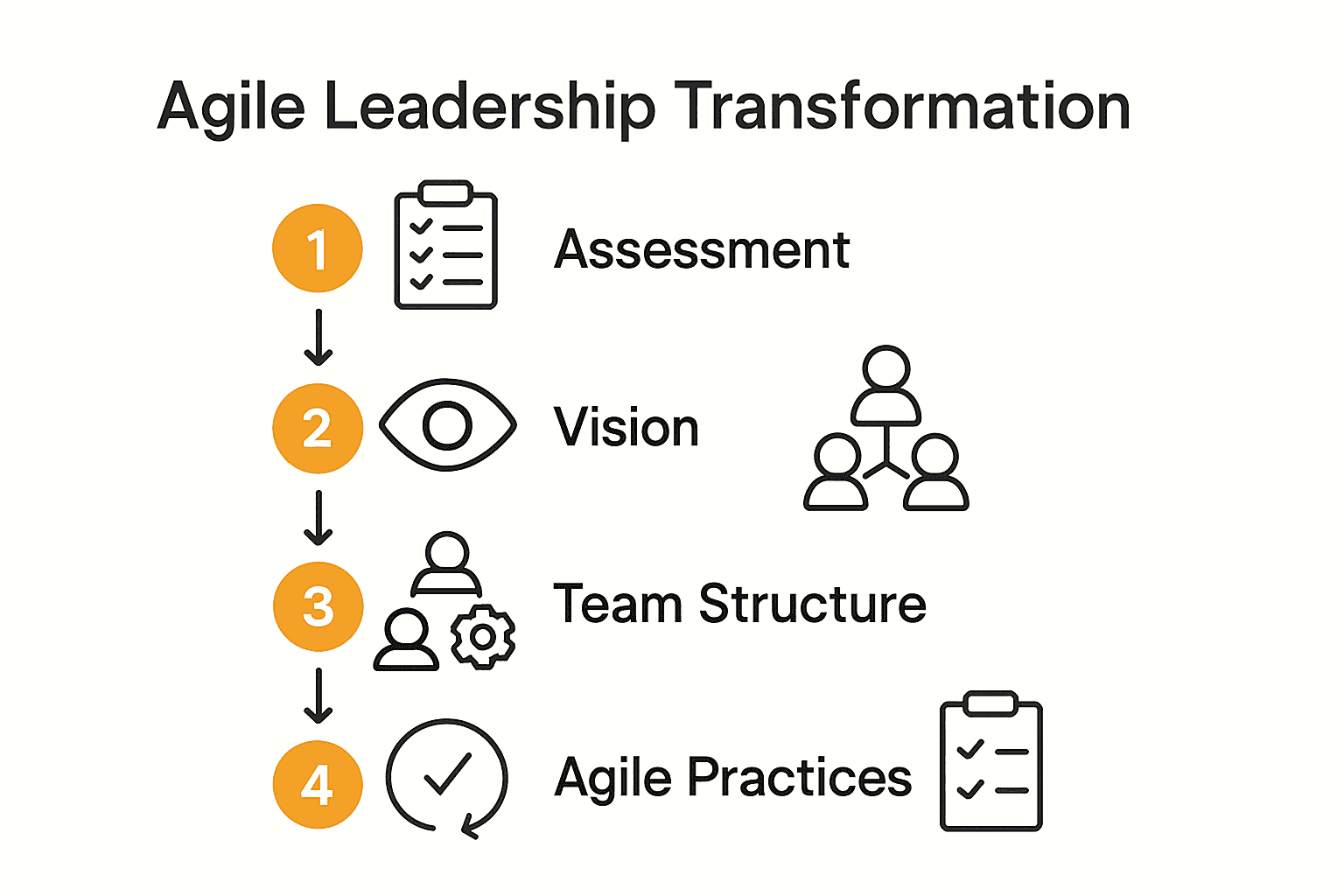
Did you know that around 70 percent of organizational change initiatives fall short of their goals due to cultural and leadership barriers? Adopting agile leadership is not just a trend; it makes a real difference in how teams respond to fast-moving challenges and customer needs. When organizations understand their starting point and reshape both their mindset and their structure, they set the stage for innovation, talent development, and lasting results.
Evaluate cultural and leadership factors to ensure effective agile transformation. Conduct an honest diagnostic across readiness areas.
2. Define Clear Agile Vision
Create an inspiring vision that articulates the purpose and benefits of agile leadership to guide organizational changes.
3. Develop Collaborative Team Structures
Redesign team structures to enhance collaboration, shared leadership, and accountability among team members.
4. Implement Agile Practices
Establish feedback mechanisms and agile ceremonies to promote adaptability and continuous improvement within teams.
5. Evaluate Leadership Impact Continuously
Establish regular evaluation processes to assess leadership effectiveness and identify areas for ongoing growth and adaptation.
Step 1: Assess Organizational Readiness for Agile Leadership
In this crucial step, you will evaluate your organization’s preparedness for an agile leadership transformation. Understanding your current cultural landscape and organizational capabilities is fundamental before launching any meaningful change initiative.
According to research from the CLEAR model, culture and leadership are core components determining transformation success. Your assessment will focus on identifying systemic readiness factors across multiple dimensions. Start by conducting a comprehensive organizational diagnostic that examines five critical areas:
Here’s a summary of the five critical readiness areas and their assessment focus:
Can teams work cross-functionally and autonomously?
Psychological safety
Information sharing
Shared goals
Cultural Alignment
Leadership Capabilities
Change Resilience
Knowledge Readiness
Collaborative Potential
Begin with an honest cultural assessment. This means mapping your existing organizational behaviours against agile principles. Look for signs of hierarchical rigidity, communication silos, and resistance to experimentation. Are your teams comfortable with transparency? Do leaders demonstrate openness to feedback?
Pro Tip: Use anonymous surveys and focus groups to gather unfiltered insights about your organizational climate.
Next, evaluate leadership capabilities. According to MDPI research, successful agile transformations require leaders who can model adaptability and support systemic change. Assess your current leadership team’s flexibility, learning orientation, and comfort with decentralized decision making.
Knowledge gaps are another critical factor. Determine the current understanding of agile methodologies across different organizational levels. Are training programs needed? How will you support continuous learning?
Finally, prepare for potential barriers. Resistance is natural during transformative processes. Develop a change management strategy that anticipates and addresses potential organizational immune responses to new ways of working.
Up next: Creating a strategic roadmap for agile leadership implementation that builds on your readiness assessment insights.
Step 2: Define Clear Agile Vision and Leadership Principles
In this critical step, you will craft a compelling, actionable vision that transforms your organization’s leadership and team dynamics. Your goal is to create a north star that guides every strategic decision and behavioural shift.
According to research from Agile Academy, building a strong guiding coalition is essential. This means assembling a core team of influential leaders who can articulate and champion the agile transformation journey.
Start by developing a strategic vision that answers three fundamental questions:
Why are we pursuing agile leadership?
What specific outcomes do we want to achieve?
How will this transformation benefit our organization?
Research from Faster Capital emphasizes the importance of defining clear, measurable objectives. These might include improving team collaboration, reducing time-to-market, or enhancing employee engagement and innovation capacity.
Pro Tip: Your vision statement should be concise yet inspiring communicating both the emotional and rational reasons for change.
Translate your vision into concrete leadership principles. These principles should reflect core agile values such as transparency, continuous learning, empowerment, and adaptive thinking. Consider principles like:
Prioritize team autonomy over micromanagement
Embrace experimentation and learning from failures
Promote open communication and psychological safety
Make decisions based on data and rapid feedback
Communicate this vision relentlessly. Use multiple channels, including town halls, team meetings, written documentation, and informal conversations. Consistency is key to building organizational understanding and commitment.
Up next: Designing an implementation strategy that turns your agile vision from concept to reality.
Step 3: Develop Collaborative and Empowered Team Structures
In this step, you will redesign your team’s organizational structure to foster genuine collaboration and shared leadership. Your goal is to create an environment where team members can take initiative, make decisions, and collectively drive project success.
According to research on shared leadership, this approach is a form of collective responsibility in which team members actively influence and lead one another toward common goals.
Begin by deconstructing traditional hierarchical models. The distributed leadership perspective views leadership as a social process distributed across people and contexts rather than concentrated in a single role.
Key strategies for developing collaborative team structures include:
Flatten traditional reporting lines
Create cross-functional teams
Implement rotating leadership roles
Establish clear decision-making protocols
Design flexible work arrangements
Pro Tip: Successful collaborative structures require explicit agreements about accountability and mutual support.
Focus on building team competencies that support self-organization. This means investing in communication skills, conflict-resolution training, and fostering psychological safety so people feel comfortable sharing ideas and taking calculated risks.
Design transparent information systems that enable real-time collaboration. Use collaborative tools that will allow seamless knowledge sharing, joint problem-solving, and collective decision-making.
Encourage informal leadership by recognizing and rewarding behaviours that demonstrate team collaboration.
Highlight instances where team members step up to support collective goals beyond their formal job descriptions.
Up next: Implementing practical mechanisms that transform your collaborative team structure from concept to operational reality.
Step 4: Implement Agile Practices and Feedback Mechanisms
In this critical step, you will establish robust feedback mechanisms that drive continuous improvement and maintain organizational adaptability. Your goal is to create a system that enables real-time learning and rapid adjustment.
According to research from People First HR Magazine, effective agile practices rely on establishing comprehensive feedback loops across multiple dimensions of organizational activity.
Start by implementing key agile events that create structured opportunities for communication and reflection:
Daily stand-up meetings
Weekly sprint planning sessions
Biweekly sprint reviews
Monthly retrospective discussions
Quarterly strategic alignment conversations
Each of these events serves a specific purpose in creating transparency and enabling collective problem-solving. Daily stand-ups help teams synchronize efforts and quickly address emerging challenges. Sprint reviews allow stakeholders to provide direct input on project progress.
Pro Tip: Ensure these meetings remain concise and action oriented. Time box each session to maintain focus and productivity.
Design performance metrics that capture both quantitative results and qualitative team dynamics. These might include cycle time, customer satisfaction scores, team engagement levels, and innovation indicators.
Create multiple feedback channels. While formal meetings are important, also encourage informal communication platforms that allow spontaneous sharing of insights and concerns. This could involve digital collaboration tools, open communication channels, and regular informal check-ins.
Cultivate a culture of psychological safety where team members feel comfortable providing honest feedback without fear of retribution. This means actively listening, responding constructively, and demonstrating that all perspectives are valued.
Up next: Developing strategies to sustain and evolve your agile practices through continuous learning and adaptation.
Step 5: Evaluate and Refine Leadership Impact Continuously
In this final transformative step, you will establish a systematic approach to measuring and improving your leadership effectiveness. Your goal is to create a dynamic feedback mechanism that allows ongoing learning and adaptation.
According to a comprehensive meta-analysis from JEMI Research, agile leadership directly impacts innovation efficiency, employee performance, and broader organizational outcomes.
Develop a multidimensional evaluation framework that captures leadership impact across several key dimensions:
Team performance metrics
Employee engagement scores
Innovation and adaptability indicators
Cultural transformation progress
Individual leadership capability assessments
Research from McKinsey suggests shifting leadership mindsets from reactive to creative and from authority to partnership.
Pro Tip: Create a personal leadership development portfolio that tracks your growth and reflects on transformational moments.
Implement 360-degree feedback mechanisms that gather perspectives from team members, peers, and supervisors. This provides a holistic view of your leadership effectiveness beyond traditional top-down assessments.
Conduct regular self-reflection sessions where you critically examine your leadership approaches. Ask yourself challenging questions about your adaptability, communication style, and capacity to support team growth.
Establish quarterly leadership impact reviews. These sessions should include quantitative performance data and qualitative insights about your evolving leadership capabilities.
Remember that continuous improvement is not about perfection but consistent growth. Be patient with yourself and view each challenge as an opportunity to refine your leadership approach.
Up next: Sustaining your agile leadership journey through ongoing learning and adaptive strategies.
Unlock Agile Leadership Success with Expert Guidance
Evolving your team through agile leadership is no simple feat. The challenges of assessing organizational readiness, defining a clear agile vision, and fostering empowered, collaborative teams can feel overwhelming. If you recognize the need to move beyond silos, build trust, and embed continuous feedback but aren’t sure how to start or sustain this journey, you are not alone. The path to adaptable leadership and effective team transformation requires a strategic partner who understands these precise pain points and offers customizable, people-centred solutions.
Explore tailored programs and coaching at Berriault & Associates designed to meet your unique needs. Our approach integrates proven frameworks like Five Behaviors™ and Everything DiSC™ to enhance leadership capabilities and team dynamics in any environment. Take the next step toward agile transformation by connecting with our experts. Visit https://berriaultandassociates.com to book a discovery call, tap into educational resources, and start building the adaptive leadership your organization deserves today.
Frequently Asked Questions
How do I assess my organization’s readiness for agile leadership transformation?
Start by conducting a comprehensive organizational diagnostic that evaluates cultural alignment, leadership capabilities, change resilience, knowledge readiness, and collaborative potential. Utilize surveys or focus groups within the next 30 days to gather honest insights into your current state.
What specific outcomes should our agile leadership vision aim to achieve?
Your agile leadership vision should focus on improving team collaboration, reducing time-to-market, and enhancing employee engagement. Clearly define these objectives so your team can track progress and alignment throughout the transformation.
How can we redesign our team structures to support agile practices?
To foster collaboration and shared leadership, start by flattening traditional hierarchies and creating cross-functional teams. Implement these changes within the next quarter and establish rotating leadership roles to empower team members.
What feedback mechanisms should we implement for continuous improvement in agile practices?
Adopt key agile ceremonies such as daily stand-ups, bi-weekly sprint reviews, and monthly retrospectives. Schedule these regularly to establish robust feedback loops that promote real-time learning and allow for quick adjustments.
How can I measure the impact of agile leadership on my team?
Develop a framework with key performance indicators that include team performance metrics, employee engagement scores, and progress on cultural transformation. Review this data quarterly to evaluate leadership effectiveness and make informed adjustments for continuous improvement.
What steps can I take to ensure ongoing learning and adaptation in agile leadership?
Establish a culture of psychological safety where team members feel comfortable sharing feedback. Conduct regular self-reflection sessions and 360-degree feedback evaluations to foster a mindset of continuous growth and improvement in leadership approaches.


 Start by conducting a comprehensive organizational diagnostic that examines five critical areas:
Here’s a summary of the five critical readiness areas and their assessment focus: