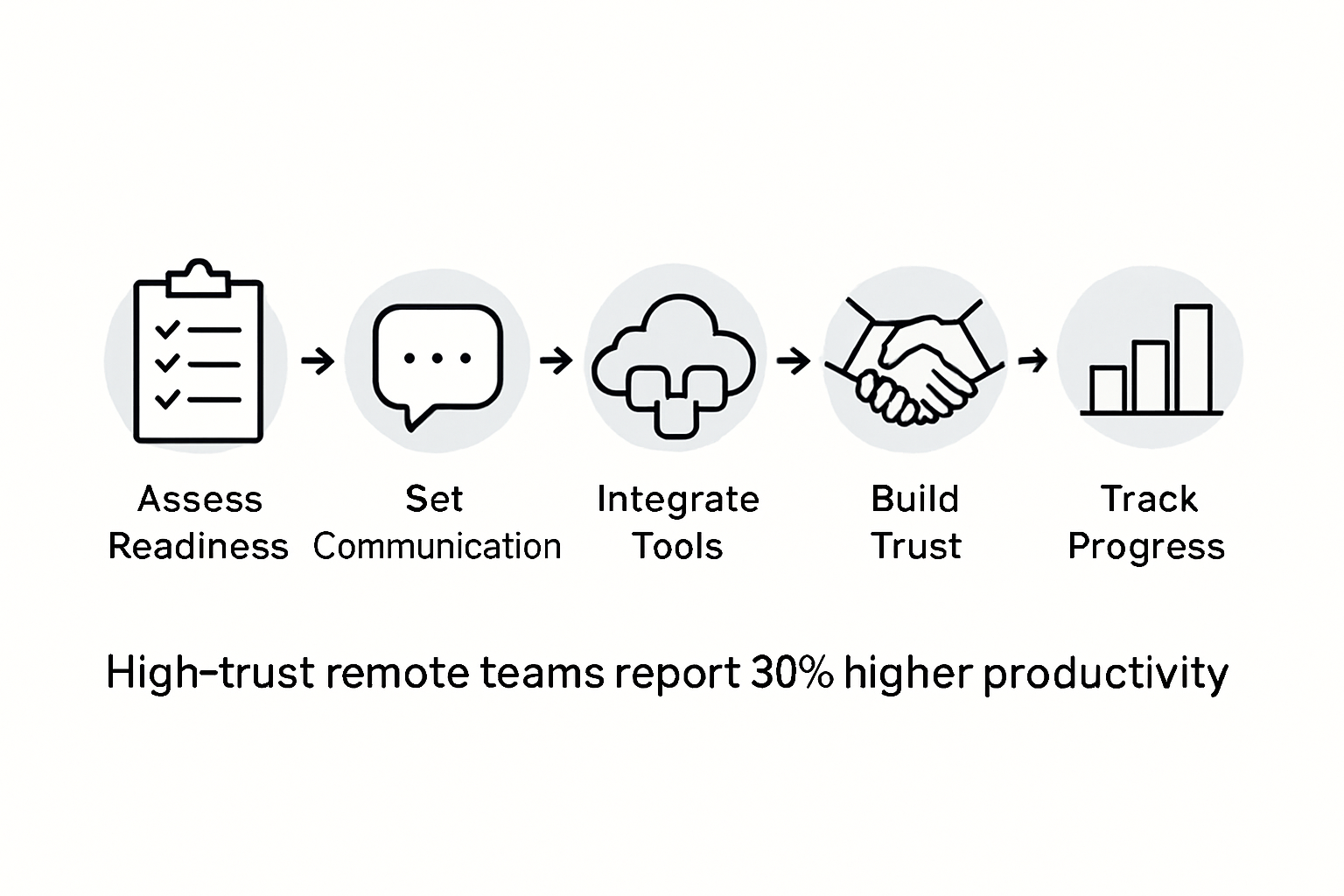
Over one in three companies report that transitioning to remote teamwork has impacted productivity, trust, and collaboration. As remote work reshapes daily routines, leaders need a strategic approach to help their teams excel from any location. This guide delivers actionable steps to assess your American team’s readiness, establish clear communication, choose digital tools, build trust, and track progress, giving you a clear roadmap for effective remote agile collaboration.
Conduct a team assessment survey to identify strengths and gaps in remote collaboration capabilities.
2. Establish Clear Communication Protocols
Define robust guidelines for communication channels, specifying expectations for response times and interaction types.
3. Implement Effective Digital Tools
Select and gradually introduce collaborative digital tools tailored to your team’s workflow needs.
4. Foster Trust and Psychological Safety
Create an environment where team members feel safe to share ideas and challenges, enhancing team cohesion.
5. Track Progress and Gather Feedback
Set up systems to monitor performance and facilitate continuous feedback to adapt and improve remote collaboration.
Step 1: Assess Team’s Remote Readiness and Needs
Assessing your team’s remote collaboration capabilities is the foundational step in transforming your agile workflow. This process helps you understand existing strengths and potential gaps in your team’s remote work infrastructure.
Start by conducting a comprehensive team assessment survey that evaluates multiple dimensions of remote readiness. Your survey should explore technological capabilities, communication patterns, individual work preferences, and psychological preparedness for distributed collaboration. Key areas to probe include proficiency with digital tools, independent work skills, comfort with communication, and personal motivation for remote engagement.
Quick tip: Design your assessment to be anonymous and provide clear instructions. Team members are more likely to give honest feedback when they feel psychologically safe sharing their genuine experiences and challenges. Consider using a mix of quantitative rating scales and open-ended questions to capture nuanced insights into your team’s unique remote dynamics.
Once you complete the assessment, you’ll have a clear roadmap for targeted improvements in your remote collaboration strategy. The next step involves analyzing survey results and developing a customized adaptation plan that addresses your team’s specific needs and potential friction points.
Step 2: Establish Clear Communication Protocols
Defining robust communication protocols is crucial for keeping your remote agile team aligned and productive. You will create a comprehensive framework to ensure smooth information exchange and set clear expectations for team interactions.
Begin by developing communication guidelines that specify expectations for different communication channels. Research demonstrates the importance of establishing both synchronous and asynchronous communication methods. Teams should define specific channels for different types of interactions, such as instant messaging for quick questions, video calls for complex discussions, and email for formal documentation. Detailed communication rhythms help reduce miscommunication and provide structure for remote teams.
Pro tip: Include response time expectations for each communication channel. For example, instant messages might require a response within two hours, while email threads could have a 24-hour turnaround window. This transparency helps team members manage their communication effectively and reduces potential frustration from unclear expectations.
By implementing these communication protocols, you create a predictable and efficient communication ecosystem that supports your remote team’s collaboration and overall performance. The next step involves training your team on these new communication guidelines and ensuring everyone understands and commits to the established protocols.
Step 3: Implement Collaborative Digital Tools
Transforming your remote team’s digital infrastructure requires strategic tool selection and thoughtful implementation. Your goal is to create a seamless technological ecosystem that supports efficient communication and collaboration across distributed team members. Organizational readiness assessment plays a critical role in selecting the right collaborative digital tools. Start by identifying your team’s specific workflow needs and evaluating tools that offer integrated project management, real-time communication, document sharing, and task tracking capabilities. Look for platforms that provide robust features such as instant messaging, video conferencing, screen sharing, collaborative document editing, and transparent task assignment.
Pro tip: Prioritize tools with strong security protocols and integration capabilities. Select platforms that enable seamless data transfer across applications and offer comprehensive access controls. Implement a gradual rollout strategy by introducing tools in phases, allowing team members time to learn and adapt to new workflows.
By carefully implementing collaborative digital tools, you create a dynamic virtual workspace that enhances team productivity and maintains connection across physical distances. The next step is to provide comprehensive training to ensure your team can leverage these tools effectively and confidently.
Step 4: Foster Trust and Psychological Safety
Building a resilient remote team requires intentional strategies to cultivate trust and psychological safety across digital spaces. Your primary objective is creating an environment where team members feel secure sharing ideas, taking risks, and collaborating authentically. Team coordination research reveals that group cohesion becomes paramount in remote settings, with effective communication serving as the foundation for maintaining team trust. Focus on creating transparent communication channels, encouraging vulnerable and honest conversations, and demonstrating consistent reliability in your interactions. Innovative approaches like gamification can also help enhance team members' well-being and strengthen interpersonal connections by introducing playful elements that reduce professional barriers.
Pro tip: Schedule regular check-ins that go beyond work tasks. Create space for team members to share personal experiences, challenges, and informal conversations that help build genuine relationships. Consider implementing virtual coffee breaks, team wellness challenges, or impromptu pair-ups that help people connect on a human level.
By systematically nurturing psychological safety, you transform your remote team from a collection of individuals into a cohesive collaborative unit. The next step involves developing ongoing feedback mechanisms that continue to reinforce trust and open communication.
Step 5: Track Progress and Gather Team Feedback
Successful remote collaboration requires robust systems for monitoring team performance and capturing continuous insights. Your goal is to create transparent mechanisms that provide real-time visibility into project advancement while simultaneously gathering meaningful team perspectives.
Research on remote work adaptation demonstrates that communication challenges necessitate deliberate adjustments to meeting structures and information-sharing practices. Implement regular sprint retrospectives using digital collaboration tools that allow structured feedback collection. Develop comprehensive tracking dashboards that capture both quantitative metrics, such as task completion rates, and qualitative insights, such as team sentiment and individual experiences. Inter-team collaboration studies highlight the critical importance of balancing intra- and inter-team communication dynamics to maintain overall team effectiveness. Pro tip: Design feedback mechanisms that feel psychologically safe and non-threatening. Anonymize surveys when possible and create multiple channels for input, including written surveys, one-on-one discussions, and group reflection sessions. Rotate facilitation responsibilities to ensure every team member has opportunities to contribute and shape the team's collaborative approach.
By systematically tracking progress and gathering nuanced team feedback, you create a dynamic adaptive environment that continuously evolves based on real-world team experiences. The final step involves synthesizing these insights to drive meaningful improvements in your remote collaboration strategy.
Elevate Your Agile Team’s Remote Collaboration Today
Improving remote collaboration for agile teams requires more than just tools and protocols. The real challenge lies in building trust, fostering psychological safety, and aligning your team around clear communication strategies. If your team struggles to adapt to remote workflows or maintain engagement across digital spaces, this is the moment to act. The insights in this article highlight key steps such as assessing your team’s readiness, implementing effective communication rhythms, and leveraging collaborative digital tools, all of which are crucial to transforming your remote agile process
Partnering with Berriault & Associates means gaining access to tailored programs that support behavioural change and agile transformation through proven methods like Five Behaviors™ and Everything DiSC™. Our people-centred approach focuses on sustainable growth and adaptive leadership that will help strengthen your remote team’s cohesion and performance. Take the first step to boost your team’s effectiveness by visiting our website and booking a discovery call. Explore how our customized training and coaching services can elevate your remote collaboration and foster a thriving organizational culture in remote, onsite, or hybrid environments.
Discover practical solutions and expert guidance for remote agile teams at Berriault & Associates. Don’t wait until communication breakdowns and trust gaps slow your progress. Start transforming your team today.
Frequently Asked Questions
How can I assess my team’s readiness for remote collaboration?
To assess your team’s readiness for remote collaboration, conduct a comprehensive team assessment survey that evaluates technology use, communication habits, and individual preferences. Focus on creating a mix of quantitative and open-ended questions to gather meaningful insights into your team’s unique dynamics. Aim to complete this assessment within one month to guide your subsequent steps.
What communication protocols should I establish for my remote agile team?
Establish clear communication protocols by defining expectations for different communication channels such as instant messaging, video calls, and email. Include response time guidelines to ensure everyone understands how quickly they should reply, for example, aiming for a two-hour response time for messages.%0A
How do I choose the right digital tools for remote collaboration?
Choose the right digital tools for remote collaboration by evaluating your team’s specific workflow needs. Look for platforms that offer integrated project management, communication features, and document sharing. Aim to implement these tools gradually, introducing one or two tools at a time to ensure everyone can adapt smoothly.
What are effective ways to foster trust in a remote team?
Foster trust in a remote team by prioritizing transparent communication and scheduling regular check-ins that allow team members to share personal experiences. Consider implementing virtual coffee breaks or team-bonding activities to build relationships and foster psychological safety among team members.
How can I track my team’s progress in remote collaboration?
Track your team’s progress by implementing regular sprint retrospectives and developing tracking dashboards to measure task completion rates and team sentiment. Use anonymous surveys and feedback sessions to gather team insights, aiming for a bi-weekly review process to facilitate continuous improvement in collaboration.
What should I do to gather team feedback effectively?
Gather team feedback effectively by creating safe channels for input, such as anonymous surveys and open discussions. Ensure feedback mechanisms feel non-threatening and rotate facilitation responsibilities to allow all team members to contribute. Conduct these feedback sessions regularly, ideally every month, to promote open communication.


 Organizational readiness assessment plays a critical role in selecting the right collaborative digital tools. Start by identifying your team’s specific workflow needs and evaluating tools that offer integrated project management, real-time communication, document sharing, and task tracking capabilities. Look for platforms that provide robust features such as instant messaging, video conferencing, screen sharing, collaborative document editing, and transparent task assignment.
Pro tip: Prioritize tools with strong security protocols and integration capabilities. Select platforms that enable seamless data transfer across applications and offer comprehensive access controls. Implement a gradual rollout strategy by introducing tools in phases, allowing team members time to learn and adapt to new workflows.
By carefully implementing collaborative digital tools, you create a dynamic virtual workspace that enhances team productivity and maintains connection across physical distances. The next step is to provide comprehensive training to ensure your team can leverage these tools effectively and confidently.
 Pro tip: Design feedback mechanisms that feel psychologically safe and non-threatening. Anonymize surveys when possible and create multiple channels for input, including written surveys, one-on-one discussions, and group reflection sessions. Rotate facilitation responsibilities to ensure every team member has opportunities to contribute and shape the team's collaborative approach.
By systematically tracking progress and gathering nuanced team feedback, you create a dynamic adaptive environment that continuously evolves based on real-world team experiences. The final step involves synthesizing these insights to drive meaningful improvements in your remote collaboration strategy.