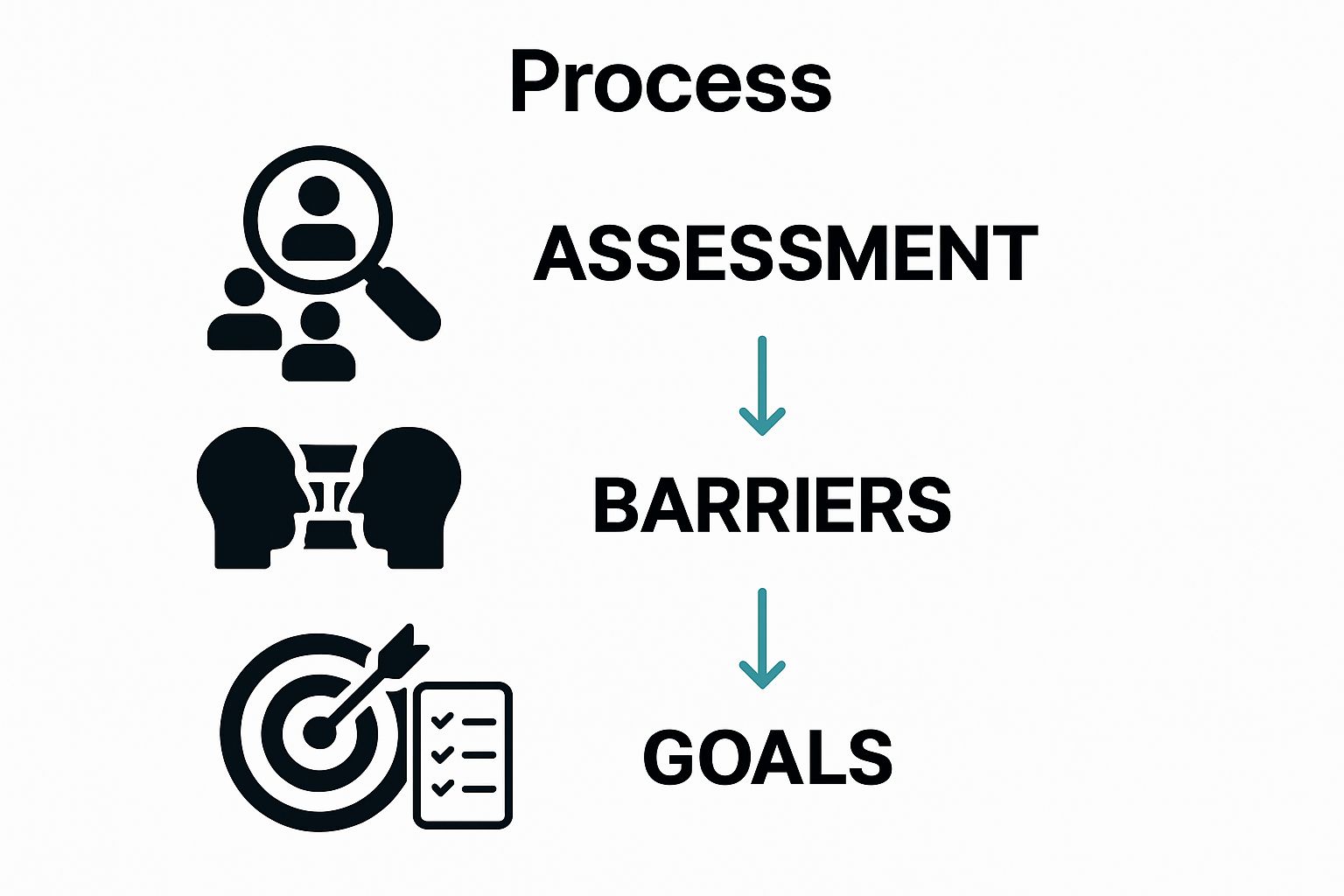
Every team wants flawless communication and easy collaboration that just works. Yet nearly 70 percent of employees say they experience communication breakdowns at least once a week. Surprising, right? Most organizations think more meetings or new software will fix the issue, but the real answer hides in a careful step-by-step transformation that few teams ever try.
Gather qualitative and quantitative data to understand current communication practices and identify areas for improvement.
2. Identify specific communication barriers
Categorize and analyze the obstacles to effective communication, including psychological and structural barriers.
3. Set SMART communication goals
Define Specific, Measurable, Achievable, Relevant, and Time-bound goals based on assessment findings and identified barriers.
4. Implement suitable communication tools
Select and integrate digital communication platforms that facilitate transparency, collaboration, and efficiency in your team.
5. Train team members on communication skills
Provide comprehensive training that enhances individual communication skills and fosters a culture of effective interaction.
Step 1: Assess Current Communication Practices
Improving team communication begins with an honest and comprehensive assessment of your current practices. This critical first step helps you understand your organization's existing communication landscape and identify specific areas for improvement. Think of this assessment as a communication health check that provides a clear baseline for your transformation journey.
To start, gather qualitative and quantitative data about how communication currently operates in your team. Schedule individual and group interviews with team members across different roles and levels. These conversations should focus on understanding their experiences, challenges, and perceptions of current communication processes. Ask open-ended questions that reveal communication bottlenecks, misunderstandings, and potential friction points.
In parallel with these interviews, design a structured communication survey to capture measurable insights. Learn more about creating effective communication assessments in our guide on building communication skills. The survey should explore key dimensions, including communication frequency, clarity, channel effectiveness, and interpersonal dynamics. Include both quantitative rating scales and qualitative comment sections to capture nuanced feedback.
Key survey areas to explore include:
Perceived effectiveness of current communication channels
Frequency and quality of team meetings
Clarity of messaging and information sharing
Comfort levels in expressing ideas and concerns
Barriers to open and transparent communication
Analyze the collected data systematically to identify patterns and recurring themes. Pay special attention to disconnects between leadership perceptions and team member experiences. Triangulate information from interviews, surveys, and performance metrics to develop a comprehensive understanding of your team’s communication ecosystem.
Successful completion of this assessment means you have a clear, data-driven picture of your team’s communication strengths and weaknesses. The insights gathered will serve as the foundation for targeted improvement strategies in subsequent steps of your communication enhancement journey.
Step 2: Identify Communication Barriers
After completing your initial assessment, the next crucial step is identifying the specific communication barriers preventing effective team collaboration. These barriers are often complex and multifaceted, requiring a nuanced and systematic approach to uncover and address. Understanding these obstacles is essential for developing targeted strategies that will transform your team’s communication dynamics.
Begin by categorizing communication barriers into distinct types. Psychological barriers often stem from individual personalities, communication styles, and levels of emotional intelligence. Some team members might struggle with expressing themselves clearly, while others may have deep-seated fears about speaking up or challenging existing ideas. For deeper insights into communication effectiveness, explore our comprehensive leadership guide.
Structural barriers represent organizational constraints that impede smooth communication. These might include hierarchical structures that discourage open dialogue, siloed departments that limit cross-functional interaction, or technological limitations in communication platforms. Examine your current organizational design and communication infrastructure critically. Are there unnecessary layers of approval that slow information flow? Do remote or distributed team members face additional communication challenges?
Critical communication barrier indicators to watch for include:
Repeated misunderstandings or project delays
Low team engagement during meetings
High employee turnover rates
Frequent conflicts or unresolved tensions
Lack of transparent information sharing
Conduct focused workshops and facilitated discussions designed to surface these barriers openly and constructively. Create psychologically safe environments where team members can candidly share their communication challenges without fear of retribution. Utilize professional facilitators if internal dynamics make transparent dialogue difficult.
Successfully identifying communication barriers means you have a clear, comprehensive map of the obstacles preventing effective team interaction.
Below is a comparison table that organizes key types of communication barriers identified in teams, along with examples and their potential impact on collaboration.
Barrier Type
Example
Potential Impact
Psychological
Fear of speaking up or challenging existing ideas
Reduces open dialogue, limits innovation
Psychological
Emotional intelligence gaps
Causes misunderstandings, hampers empathy
Structural
Hierarchical structures
Discourages open feedback
Structural
Departmental silos
Limits cross-functional collaboration
Structural
Outdated communication technology
Slows information flow, creates delays
Environmental
Remote or distributed team locations
Challenges in coordination and cohesion
Cultural
Differences in communication styles and norms
Increases chances of misinterpretation
Step 3: Establish Clear Communication Goals
With a comprehensive understanding of your current communication landscape and the identified barriers, the next critical step is to establish clear, actionable communication goals. These goals serve as a strategic roadmap, transforming your insights into purposeful, measurable communication improvement strategies. Think of these goals as the north star guiding your team’s communication transformation.
Begin by translating your assessment findings into specific, SMART communication objectives: Specific, Measurable, Achievable, Relevant, and Time-bound. These goals should directly address the barriers and challenges uncovered in previous steps. For a deeper exploration of communication effectiveness strategies, check out our comprehensive leadership communication guide.
Consider developing goals across multiple dimensions. Some objectives might focus on quantitative improvements, such as reducing email response times or increasing meeting efficiency. Others should focus on qualitative enhancements, such as improving team psychological safety, encouraging more open dialogue, or developing more inclusive communication practices.
Critical communication goal areas to consider include:
Reducing communication-related project delays
Increasing cross-departmental collaboration
Improving information transparency
Enhancing team member engagement
Standardizing communication protocols
Collaborate with team members when defining these goals to ensure buy-in and alignment. Host interactive workshops where everyone can contribute insights and perspectives. This collaborative approach transforms goal-setting from a top-down mandate into a collective commitment to communication excellence.
Ensure each goal includes clear metrics and a defined assessment timeline. Develop a tracking mechanism that allows regular progress evaluation. This might involve quarterly climate surveys on communication, periodic performance reviews, or structured feedback sessions. The key is creating a dynamic, responsive system that can adapt as your team’s communication needs evolve.
Successfully establishing communication goals means you have a clear, actionable blueprint that translates abstract communication challenges into concrete, measurable objectives.
This checklist table summarizes essential communication goal areas teams should consider and recommended methods for tracking their achievement.
Communication Goal Area
Tracking Method
Reduce communication-related project delays
Project timelines, delay frequency logs
Increase cross-departmental collaboration
Cross-team project records
Improve information transparency
Team feedback surveys
Enhance team member engagement
Engagement surveys, participation rates
Standardize communication protocols
Protocol adoption audits
Boost meeting efficiency
Meeting duration and effectiveness reports
Raise psychological safety
Anonymous culture surveys
Step 4: Implement Communication Tools and Strategies
Implementing the right communication tools and strategies is crucial for transforming your team’s interaction dynamics. This step moves your communication improvement plan from a theoretical framework to practical execution. The goal is to select and integrate tools that enhance transparency, efficiency, and collaboration across your entire organization. Explore our insights on creating seamless communication strategies by understanding that technology alone cannot solve communication challenges. Instead, focus on creating a holistic approach that combines digital tools with intentional communication practices. Begin by evaluating communication platforms that align with your team’s specific needs, work style, and organizational culture.
Choose digital collaboration tools that offer multiple communication channels. These might include instant messaging platforms, video conferencing software, project management systems, and shared document repositories. Critically, ensure these tools integrate seamlessly and provide a consistent user experience across different devices and work environments. Consider platforms that support both synchronous and asynchronous communication, enabling team members to interact as they prefer and when they prefer.
Essential communication tool considerations include:
Cross-platform compatibility
Security and data protection features
Scalability for team growth
User-friendly interface
Customization options
Structured communication research suggests implementing standardized communication protocols alongside technological tools. Develop clear guidelines about communication expectations, response times, and preferred channels for different types of interactions. These protocols help prevent information overload and create predictable communication rhythms.
Beyond technological solutions, invest in team communication training. Help team members develop skills in using new tools effectively, understanding communication preferences, and practicing active listening. This human-centred approach ensures that technological investments translate into meaningful improvements in interaction.
Successfully implementing communication tools means creating an integrated ecosystem that supports transparent, efficient, and engaging team collaboration. The right combination of technology, protocols, and skills will transform how your team communicates and works together.
Step 5: Train Team Members on Effective Communication
Training team members on effective communication transforms individual skills into collective organizational strength. This step goes beyond simple information transfer, focusing on developing nuanced communication competencies that foster genuine understanding, collaboration, and mutual respect. The goal is to create a learning environment where communication becomes a strategic skill rather than an assumed ability. Comprehensive communication training should address multiple dimensions of interpersonal interaction. Design workshops that blend theoretical knowledge with practical skill-building exercises. These sessions must cover active listening techniques, emotional intelligence, nonverbal communication awareness, and conflict resolution strategies. Learn more about developing robust communication skills through our specialized training approaches.
Recognize that different team members have varying communication preferences and learning styles. Develop a multilayered training approach that includes interactive workshops, digital learning modules, peer coaching, and individual communication assessments. Personalization is key to ensuring each team member can meaningfully engage with and internalize communication improvement strategies.
Critical training focus areas include:
Developing active listening skills
Understanding communication style diversity
Managing emotional responses during difficult conversations
Providing and receiving constructive feedback
Practicing inclusive communication techniques
Research highlights the importance of ongoing communication skill development in creating high-performing teams. Implement a continuous learning model that provides regular opportunities for skill refinement. This might involve quarterly refresher workshops, monthly communication skill challenges, or peer learning circles where team members can share insights and strategies.
Encourage a culture of psychological safety where team members feel comfortable experimenting with new communication approaches. Create structured opportunities for reflection in which individuals can analyze their communication patterns, receive feedback, and develop personalized improvement plans.
Successfully training team members means creating a dynamic learning ecosystem where communication skills are continuously nurtured, evaluated, and refined. The result is a team that communicates with greater empathy, clarity, and effectiveness.
Step 6: Evaluate and Adjust Communication Approaches
Evaluating and adjusting communication approaches is the critical final step that transforms your communication improvement strategy from a static plan to a dynamic, responsive system. This ongoing process ensures your team’s communication continues to evolve and meet changing organizational needs. Think of it as a continuous improvement cycle that keeps your communication practices agile and effective. Systematic evaluation requires establishing clear, measurable metrics that go beyond surface-level assessments. Develop a comprehensive tracking mechanism that captures both quantitative and qualitative indicators of communication performance. Explore our detailed approach to communication effectiveness in our leadership guide, which emphasizes holistic assessment.
Implement regular communication audits that involve multiple data collection methods. These might include anonymous team surveys, one-on-one interviews, performance review insights, and objective metrics like project completion rates, response times, and cross-team collaboration effectiveness. Create a feedback loop that allows team members to provide candid input about communication challenges and potential improvements.
Key evaluation metrics to track include:
Team engagement levels
Information transfer accuracy
Conflict resolution speed
Cross-departmental collaboration efficiency
Employee satisfaction with communication processes
Research underscores the importance of continuous communication checkpoints in maintaining organizational effectiveness. Schedule quarterly review sessions where leadership and team representatives analyze communication performance data. These sessions should be constructive, focusing on identifying patterns, celebrating improvements, and developing targeted adjustment strategies.
Remember that communication improvement is not a linear process. Be prepared to experiment, pivot, and adapt your approaches based on ongoing feedback and changing team dynamics. Cultivate a culture of psychological safety where communication refinement is seen as a collaborative, positive endeavour rather than a criticism of current practices.
Successfully evaluating and adjusting communication approaches means creating a responsive, self-improving communication ecosystem. Your team will develop increased adaptability, resilience, and collective communication intelligence through this ongoing refinement process.
Transform Communication Gaps Into Team Strength With Expert Support
Are communication barriers and unclear team goals holding your organization back from true collaboration? In our article, you uncovered the risks of unresolved misunderstandings, lack of transparency, and the struggle to implement effective communication tools. If your team feels stuck or progress stalls because old habits and structural obstacles persist, now is the time to take real action that delivers results.
Let Berriault & Associates help you bridge those gaps with practical, people-first solutions. Our tailored consulting programs combine proven tools like Five Behaviors™ and Everything DiSC™ to turn your current challenges into lasting strengths. Visit Berriault & Associates to schedule a discovery call and see how our customized approach to team performance and leadership development can transform how your team collaborates. Take charge of your team’s future today by connecting with experts dedicated to sustainable, measurable change.
Frequently Asked Questions
How can I assess my team’s current communication practices?
To assess your team’s current communication practices, gather both qualitative and quantitative data through individual and group interviews with team members. This will help you identify challenges and areas for improvement, creating a baseline for your communication transformation.
What are common communication barriers within teams?
Common communication barriers can include psychological factors, such as fear of speaking up, and structural issues, such as hierarchical constraints. Identify these barriers through focused workshops and discussions that foster a safe environment for team members to share their concerns.
What should I consider when setting communication goals?
When setting communication goals, ensure they are SMART: Specific, Measurable, Achievable, Relevant, and Time-bound. For instance, you could aim to reduce email response times by 30% within the next quarter, addressing specific challenges identified in your assessment.
How can I choose the right communication tools for my team?
Choose communication tools that fit your team’s needs by evaluating factors such as ease of use, integration capabilities, and support for various communication styles. For example, select a project management tool that allows both asynchronous updates and real-time collaboration to enhance team interaction.
What types of training should I provide for improving team communication?
Provide training that covers essential skills like active listening, emotional intelligence, and conflict resolution. Offer a mix of workshops and digital learning modules to accommodate diverse learning styles and ensure all team members improve their communication effectively.
How can I measure the effectiveness of my communication strategies?
To measure the effectiveness of your communication strategies, implement regular communication audits using surveys and performance metrics. Track engagement levels and information transfer accuracy to identify patterns and areas for continuous improvement.