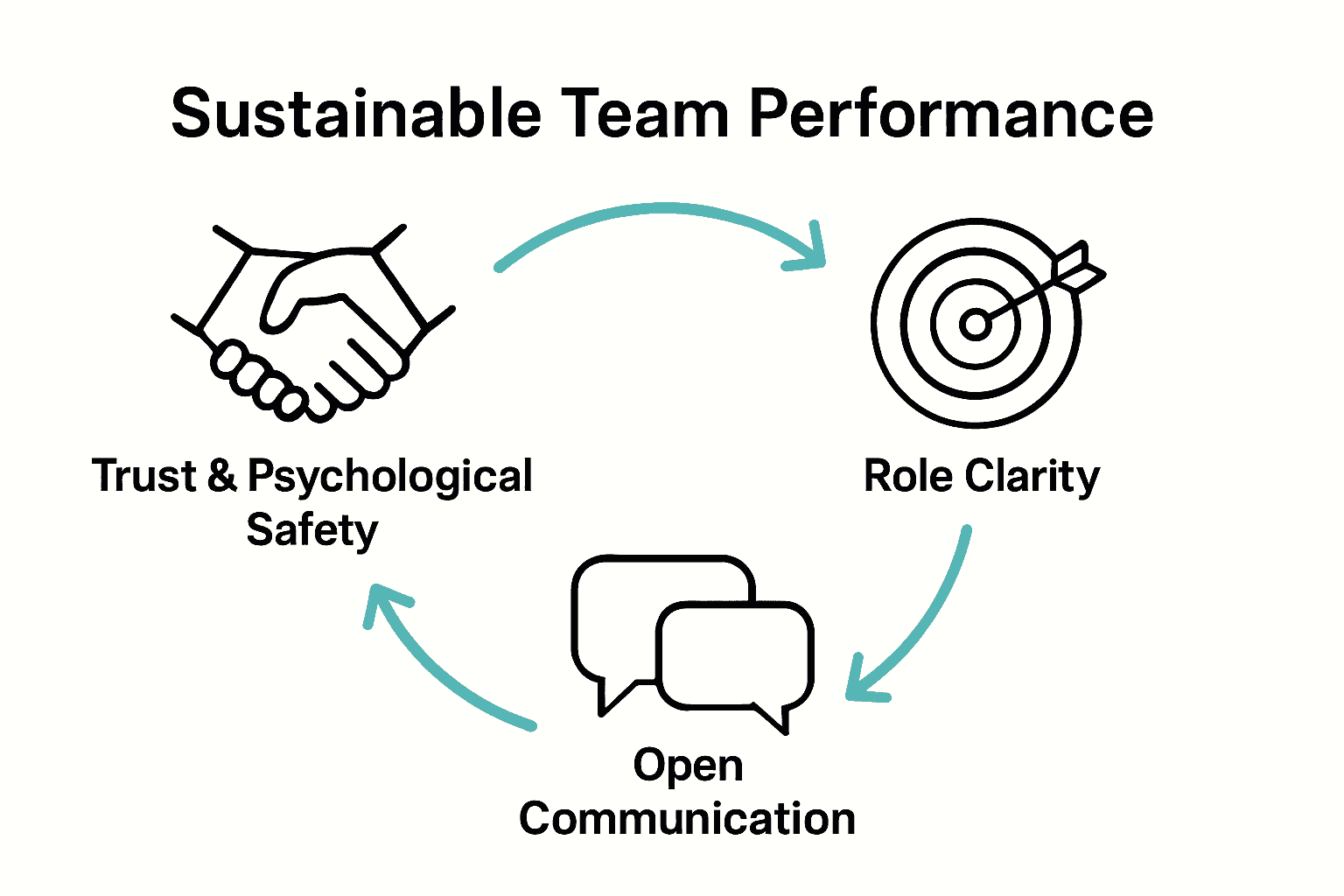
Nearly 90 percent of high-performing American teams share one thing in common: a deliberate focus on team dynamics and psychological safety. In workplaces across the country, groups that nurture trust, clear roles, and open communication consistently outpace the rest. Whether you lead a growing startup or manage a seasoned corporate team, understanding these elements is essential for building lasting success. Discover practical steps to help your team become more resilient, connected, and high-performing.
Collect data through structured interviews and surveys to gain an unbiased view of team performance.
2. Build Trust and Psychological Safety
Foster an environment of open dialogue and vulnerability to enhance team collaboration and support.
3. Clarify Roles and Shared Goals
Develop a team charter that defines individual roles and collective objectives to enhance alignment and reduce conflict.
4. Facilitate Open Communication
Establish ground rules for respectful interactions that promote active listening and non-judgmental feedback.
5. Reinforce Continuous Feedback
Create a culture of ongoing feedback and accountability that encourages learning and growth rather than judgment.
Step 1: Assess Current Team Dynamics Objectively
Objectively evaluating your team’s current dynamics is the critical first step in creating sustainable performance. This process involves systematically analyzing how your team collaborates, communicates, and performs under various conditions.
According to research from AnnualReviews, teamwork serves as the linchpin driving organizational performance. To assess team dynamics effectively, start by gathering comprehensive data through multiple channels. This means conducting structured interviews, administering anonymous surveys, and observing team interactions in real work scenarios.
Practical assessment requires a multifaceted approach. PubMed research highlights the critical role of trust in team performance, particularly in virtual environments. Begin by mapping out current communication patterns, identifying potential trust barriers, and understanding individual team member strengths and potential friction points.
A strategic assessment should focus on key dimensions such as:
Communication effectiveness
Conflict resolution mechanisms
Shared understanding of team goals
Individual and collective accountability
Interpersonal trust levels
Remember that objectivity is key. Avoid making assumptions and rely on concrete data and observable behaviours. Your goal is to create a clear, unbiased snapshot of your team’s current operational dynamics.
Once you complete this assessment, you will have a solid foundation for targeted interventions and performance improvement strategies.
Step 2: Build Trust and Psychological Safety
Building trust and psychological safety is the foundation of high-performing teams. This critical step transforms group dynamics from transactional interactions to collaborative environments where team members feel genuinely supported and empowered.
According to CIPD research, trust and psychological safety are essential for enhancing teamwork, coordination, and communication. Start by creating an environment where team members can speak up without fear of negative consequences. This means actively encouraging open dialogue, validating different perspectives, and demonstrating genuine curiosity about individual experiences and insights.
Building psychological safety requires consistent leadership behaviours. PubMed research highlights the importance of intentional training and coaching approaches in developing trusting relationships. Leaders must model vulnerability by sharing their own challenges, admitting mistakes, and showing that learning is valued more than appearing perfect.
Key strategies for building trust include:
Practicing radical transparency
Demonstrating consistent reliability
Actively listening without judgment
Recognizing and celebrating individual contributions
Providing constructive feedback with empathy
Remember that trust is not built overnight. It requires sustained effort, genuine commitment, and a willingness to be authentic. Small, consistent actions matter more than grand gestures.
As you implement these trust-building techniques, you will gradually create a team environment where innovation, collaboration, and high performance can flourish naturally.
Step 3: Clarify Team Roles and Shared Goals
Clarifying team roles and shared goals is the strategic foundation that transforms a group of individuals into a high-performing, cohesive unit. This critical step ensures every team member understands their unique contribution and how it connects to the broader organizational objectives.
Research from Cambridge highlights the essential competencies that support high-performance teams, emphasizing the importance of explicit role definition and goal alignment. Begin by hosting a collaborative session where team members can discuss and document their specific responsibilities, strengths, and potential overlap areas. This transparency prevents confusion, reduces potential conflicts, and creates a shared understanding of each individual’s unique value.
The PAR research underscores how clarifying roles contributes to creating inclusive, psychologically safe environments. To achieve this, develop a comprehensive team charter that outlines not just individual roles, but also collective goals, communication protocols, and performance expectations. This document becomes your team’s north star, guiding collaborative efforts.
Key strategies for role and goal clarification include:
Conducting individual and group goal-setting workshops
Creating a visual team responsibility matrix
Establishing clear performance metrics
Implementing regular role review and refinement sessions
Encouraging open dialogue about role expectations
Warning: Avoid micromanaging during this process. The goal is to provide clarity and autonomy, not to create restrictive boundaries that stifle creativity and individual initiative.
As you implement these role clarification techniques, you will build a more aligned, motivated, and high-performing team ready to tackle complex challenges with precision and collective energy.
Step 4: Facilitate Open and Constructive Communication
Facilitating open and constructive communication is the lifeline of high-performing teams. This step transforms communication from a transactional exchange to a collaborative dialogue that drives innovation and mutual understanding.
According to CIWEM, creating psychological safety is fundamental to enabling genuine team communication. Start by establishing communication ground rules that prioritize respect, active listening, and non-judgmental responses. This means creating structured opportunities for team members to share ideas without fear of ridicule or professional repercussions. Implement practices such as round-robin discussions, anonymous suggestion platforms, and dedicated time for open dialogue.
Research from UWM emphasizes the critical role of non-judgmental communication in building team trust. Leaders must model the communication behaviours they want to see by demonstrating vulnerability, admitting mistakes, and showing genuine curiosity about different perspectives. This approach signals that diverse viewpoints are not just tolerated but actively welcomed.
Key strategies for constructive communication include:
Practicing active and empathetic listening
Using neutral language that focuses on observations
Creating safe spaces for disagreement
Encouraging questions and curiosity
Providing balanced and specific feedback
Warning: Avoid turning communication sessions into complaint forums. The goal is collaborative problem solving, not endless venting.
As you implement these communication techniques, you will gradually build a team culture where honest dialogue becomes the norm, driving both individual growth and collective performance.
Step 5: Reinforce Continuous Feedback and Accountability
Reinforcing continuous feedback and accountability transforms team dynamics from reactive interactions to proactive growth opportunities. This critical step creates a culture where learning and improvement become the natural rhythm of team performance.
According to SBAM, creating a psychologically safe environment is fundamental to effective continuous feedback. Implement a structured yet flexible feedback system that goes beyond annual reviews. This means establishing regular check-ins, creating multiple feedback channels, and training team members to provide constructive input that focuses on behaviours and outcomes rather than personal criticism.
Research from App emphasizes viewing mistakes as critical learning opportunities. Leaders should model accountability by transparently sharing their own growth areas and demonstrating how feedback drives personal and collective improvement. Encourage team members to view feedback not as judgment, but as a collaborative tool for professional development.
Key strategies for reinforcing accountability include:
Establishing clear performance expectations
Creating transparent metrics for success
Implementing peer and self-assessment processes
Celebrating growth and improvement
Developing individual development plans
Warning: Feedback should never feel punitive. The goal is growth, not gotcha moments.
As you integrate these accountability practices, you will cultivate a team culture that values continuous learning, mutual support, and collective achievement.
Step 6: Evaluate Progress and Adapt Strategies
Evaluating progress and adapting strategies is the critical final step in creating sustainable team performance. This process transforms static planning into a dynamic, responsive approach that allows teams to continuously refine their collaborative methods.
Research from PubMed highlights the crucial relationship between trust and team performance, particularly in virtual environments. Begin by establishing a robust evaluation framework that goes beyond traditional metrics. This means creating holistic assessment tools that capture not only quantitative outcomes but also qualitative aspects of team dynamics, such as communication quality, trust levels, and collaborative effectiveness.
Another PubMed study emphasizes the importance of adaptive strategies in implementation teams. Design a flexible review process that allows for real-time adjustments. This involves quarterly strategy reviews, where the team collectively examines performance data, discusses challenges, and collaboratively redesigns approaches that are not delivering expected results.
Key strategies for practical evaluation and adaptation include:
Implementing regular performance pulse checks
Using both quantitative and qualitative assessment methods
Encouraging transparent discussions about team challenges
Creating mechanisms for rapid strategy iteration
Maintaining a growth mindset toward continuous improvement
Warning: Avoid analysis paralysis. The goal is actionable insights, not endless data collection.
As you integrate these evaluation practices, you will build a team culture that is resilient, responsive, and committed to ongoing learning and performance enhancement.
Unlock Your Team’s True Potential for Sustainable Success
Struggling to foster trust and clarity within your team can hold back your organization’s growth. This article highlights how building psychological safety, clarifying roles, and nurturing open communication are essential steps toward lasting high performance. If you recognize these challenges in your own team, you are not alone. The frustration of unclear roles or hesitating voices can feel overwhelming, but transforming these dynamics is possible with the proper guidance.
At Berriault & Associates, we specialize in turning these pain points into strengths through tailored programs designed to boost organizational agility and leadership capacity. Our people-centred approach uses proven tools like Five Behaviors™ and Everything DiSC™ to create customized learning experiences that embed trust, accountability, and collaboration deeply within your team culture. Whether your team works remotely, onsite, or in a hybrid model, we help you create an adaptive environment where lasting behavioural change thrives.
Take the first step to elevate your team dynamics today. Visit our main site to explore how our solutions can be tailored to your unique challenges. Discover how professional coaching and flexible training can build the foundation your team needs for sustained performance by booking a discovery call now. Your team’s transformation starts here with clear goals and reliable trust.
Frequently Asked Questions
How can I effectively assess my team’s current dynamics?
To assess your team’s current dynamics, gather data through structured interviews, anonymous surveys, and direct observations during work scenarios. Aim to identify areas like communication effectiveness and trust levels within 30 days to create a clear picture of team dynamics.
What are practical steps to build trust within my team?
To build trust within your team, encourage open dialogue and model vulnerability by sharing your own challenges. Start by practicing radical transparency and actively listening to team members’ concerns over the next few weeks.
How do I clarify team roles and goals?
To clarify team roles and shared goals, hold a collaborative session where team members discuss and document their specific responsibilities. Aim to finalize this team charter within two weeks, ensuring everyone understands their contributions to collective objectives.
What techniques can I use to enhance communication in my team?
Enhancing communication requires establishing ground rules for respectful dialogue and encouraging active listening. Implement regular round table discussions where everyone can contribute ideas without fear of negative feedback, creating a safe space for open communication.
How can I reinforce accountability within my team?
Reinforce accountability by setting clear performance expectations and implementing regular feedback sessions. Establish a peer assessment process within the next month to ensure everyone is aware of their contributions and areas for improvement.
What methods can I use to evaluate team progress?
To evaluate team progress, create a framework that includes both quantitative and qualitative assessments. Conduct performance pulse checks every quarter to discuss achievements and challenges, allowing for real-time adjustments to strategies.