Most organizations face daunting levels of uncertainty that demand more than basic leadership skills. Studies show that nearly 60 percent of executives believe leadership resilience is now the top factor enabling companies to survive tough times. As workplaces become more unpredictable, understanding how resilient leaders drive stability and growth becomes essential. This article reveals the key qualities and strategies behind strong leadership resilience and why these traits give American teams a competitive edge.
Leaders must possess resilience to navigate complexity and uncertainty, transforming challenges into opportunities for growth.
Core Characteristics
Key traits of resilient leaders include emotional intelligence, adaptive problem-solving, and transparent communication, which foster effective team dynamics.
Approaches to Resilience
Employing diverse strategies, such as proactive, reactive, and emotional resilience, allows leaders to effectively address challenges and enhance organizational adaptability.
Team Resilience Strategies
Building team resilience involves establishing communication, fostering psychological safety, and cultivating a growth mindset to enhance collective problem-solving.
Defining Leadership Resilience in Modern Organizations
Leadership resilience is the critical capacity to navigate complexity, uncertainty, and challenges with grace and strategic adaptability. At its core, resilience transforms potential organizational obstacles into opportunities for growth and transformation.
Resilient leaders possess a unique set of psychological and behavioural capabilities that enable them to persist through adversity. Leadership challenges demand more than traditional management skills; they require individuals who can respond dynamically to unpredictable environments. The ability to bounce back after disappointment isn’t just a personal trait; it’s a strategic organizational imperative.
True leadership resilience goes beyond mere survival. Leaders who embody resilience demonstrate an extraordinary capacity to maintain composure, think strategically, and inspire teams even under significant pressure. These professionals exhibit what researchers describe as a fundamental ease with life’s complexities, showing resolute purpose and a positive outlook while simultaneously understanding their own strengths and limitations. Leadership agility is paramount for creating adaptive organizational cultures that can respond rapidly to changing market conditions.
Key characteristics of resilient leaders include:
Emotional self-regulation
Adaptive problem-solving skills
Transparent communication
Continuous learning mindset
Proactive risk management
Capacity to transform setbacks into strategic opportunities
Ultimately, leadership resilience represents a sophisticated blend of psychological strength, strategic thinking, and emotional intelligence that enables organizations to thrive amid uncertainty.
Core Traits of Resilient Leaders
Emotional intelligence stands at the core of leadership resilience, transforming how leaders navigate complex organizational landscapes. Well-being and empathy are non-negotiable skills that enable leaders to connect deeply with their teams and manage challenging situations effectively. Resilient leaders demonstrate extraordinary psychological capabilities that extend far beyond traditional management approaches. These professionals possess high emotional intelligence, characterized by exceptional self-awareness, self-regulation, and the ability to understand and manage complex interpersonal dynamics. Their adaptive problem-solving skills allow them to approach challenges with strategic flexibility, transforming potential obstacles into opportunities for growth and organizational development.
The research highlights critical components of resilient leadership, including the capacity to maintain composure under pressure and navigate uncertainty with grace. Leaders who embody resilience consistently demonstrate:
Advanced emotional self-management
Strategic critical thinking skills
Capacity for rapid learning and adaptation
Strong communication and interpersonal skills
Proactive approach to organizational challenges
Ability to inspire and motivate teams during turbulent periods
Ultimately, resilient leadership transcends individual performance, becoming a catalyst for creating adaptive organizational cultures that can thrive amid complexity and constant change.
Types of Leadership Resilience Approaches
Leadership resilience is not a monolithic concept but a dynamic framework with multiple strategic approaches. Collaborative leadership practices provide critical insights into how leaders can develop nuanced resilience strategies that adapt to complex organizational environments.
Change-resilient leaders demonstrate a remarkable ability to confront challenges with strategic resourcefulness. They innovate during adversity, diverting organizational resources effectively and maintaining strong interpersonal networks that support adaptive decision-making. These leaders approach obstacles with a fierce resolve, transforming potential setbacks into opportunities for organizational growth and individual development.
Organizational research identifies several distinctive approaches to leadership resilience:
Proactive Resilience: Anticipating and preparing for potential challenges
Reactive Resilience: Rapidly responding and adapting to unexpected disruptions
Relational Resilience: Building and maintaining supportive professional networks
Emotional Resilience: Managing personal and team emotional responses
Innovative Resilience: Continuously creating novel solutions to complex problems
Ultimately, effective leadership resilience requires a holistic approach that integrates multiple strategies, enabling leaders to navigate increasingly complex and unpredictable organizational landscapes with confidence and strategic intelligence.
Building and Sustaining Resilience in Teams
Team resilience emerges from a complex interplay of individual capabilities and collective strategies. Team dynamics play a critical role in creating an environment where psychological safety and adaptive thinking can flourish, enabling groups to navigate challenges more effectively. Resilient teams are characterized by their ability to engage in personal and collective renewal. Leaders who support team resilience understand the importance of creating interludes for reflection, celebrating successes, and providing structured opportunities for emotional and intellectual recharging. These teams develop robust support systems that help members bounce back from setbacks, turning potential obstacles into opportunities for growth and learning.
Key strategies for building team resilience include:
Establishing clear communication channels
Developing shared mental models
Encouraging vulnerability and open dialogue
Creating psychological safety
Implementing regular reflection and learning practices
Ultimately, sustainable team resilience requires a holistic approach that integrates individual well-being, interpersonal trust, and organizational support, creating a dynamic ecosystem that adapts and thrives amid constant change.
Common Barriers and How to Overcome Them
Leadership resilience confronts numerous organizational challenges that can undermine team performance and adaptability. Breaking down hidden biases in team culture represents a critical first step in addressing systemic barriers that impede resilient leadership.
One significant barrier leaders encounter is the sense of powerlessness that emerges during complex organizational challenges. Resilient leaders combat this by asserting control over their priorities, recognizing even small wins, and creating structured approaches to navigate uncertainty. They understand that feeling overwhelmed is not a weakness, but an opportunity to develop more sophisticated coping mechanisms and adaptive strategies.
Common barriers to leadership resilience include:
Persistent communication breakdowns
Unaddressed organizational trauma
Rigid hierarchical structures
Limited psychological safety
Fear of failure and risk aversion
Insufficient emotional intelligence
Lack of continuous learning opportunities
Burnout and chronic stress
Ultimately, overcoming these barriers requires a proactive, holistic approach that integrates individual development, organizational culture transformation, and strategic leadership practices, enabling teams to transform challenges into opportunities for growth and innovation.
Strengthen Your Leadership Resilience for Adaptive Success
Facing the challenges of uncertainty and constant change requires more than just traditional leadership skills. This article highlights the vital role of leadership resilience in transforming obstacles into strategic opportunities through emotional intelligence, adaptive problem-solving, and proactive risk management. If your organization struggles with communication breakdowns, burnout, or rigid structures that hinder growth, it is time to build a culture that supports resilient leaders and teams.
Discover tailored solutions at Berriault & Associates that focus on enhancing leadership agility and team dynamics. Our customized programs utilize proven tools such as Five Behaviors™ and Everything DiSC™ to foster emotional self-regulation, transparent communication, and continuous learning mindsets. Don’t let barriers like fear of failure or a sense of powerlessness hold your organization back. Visit https://berriaultandassociates.com to book a discovery call today and start empowering your leaders to thrive amid complexity and change.
Explore how we integrate leadership development with organizational agility to create lasting impact. Take the first step toward transforming challenges into growth opportunities right now.
Frequently Asked Questions
What is leadership resilience?
Leadership resilience is the ability to navigate challenges and uncertainties with strategic adaptability and emotional intelligence, turning obstacles into opportunities for growth.
What are the core traits of resilient leaders?
Core traits of resilient leaders include emotional self-regulation, adaptive problem-solving, transparent communication, continuous learning, proactive risk management, and the capacity to turn setbacks into strategic opportunities.
How can organizations build and sustain resilience in teams?
Organizations can build team resilience by establishing clear communication, fostering a growth mindset, encouraging vulnerability, creating psychological safety, and implementing regular reflection and learning practices.
What are common barriers to leadership resilience, and how can they be overcome?
Common barriers include communication breakdowns, limited psychological safety, and fear of failure. To overcome these challenges, leaders should focus on proactive development, fostering an adaptive organizational culture, and enhancing emotional intelligence.


 Resilient leaders demonstrate extraordinary psychological capabilities that extend far beyond traditional management approaches. These professionals possess high emotional intelligence, characterized by exceptional self-awareness, self-regulation, and the ability to understand and manage complex interpersonal dynamics. Their adaptive problem-solving skills allow them to approach challenges with strategic flexibility, transforming potential obstacles into opportunities for growth and organizational development.
The research highlights critical components of resilient leadership, including the capacity to maintain composure under pressure and navigate uncertainty with grace. Leaders who embody resilience consistently demonstrate:
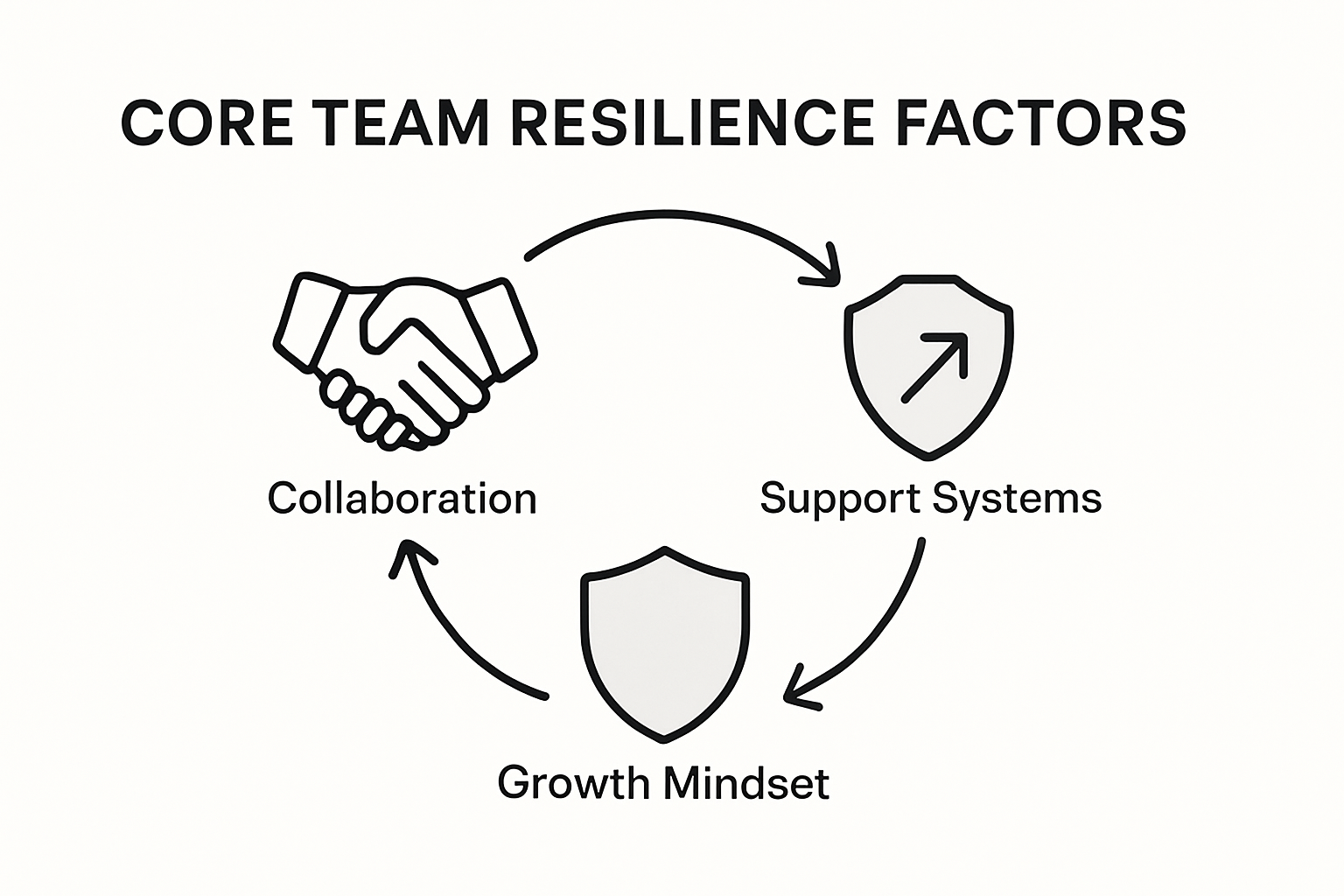 Resilient teams are characterized by their ability to engage in personal and collective renewal. Leaders who support team resilience understand the importance of creating interludes for reflection, celebrating successes, and providing structured opportunities for emotional and intellectual recharging. These teams develop robust support systems that help members bounce back from setbacks, turning potential obstacles into opportunities for growth and learning.
Key strategies for building team resilience include: