Over 70 percent of change initiatives fail to meet their goals because organizations underestimate the human side of transformation. When companies push for rapid shifts without supporting their people, resistance and confusion often take over. Coaching provides a proven way to bridge this gap, helping individuals and teams navigate emotional and practical challenges. By understanding the true role of coaching in change, leaders can unlock sustainable results and a smoother path to lasting improvement.
Change is about human transformation. Coaching emerges as a critical catalyst in organizational change initiatives, bridging the gap between organizational vision and individual adaptation. According to IAFOR, sustained change requires coaching as an integral part of the process, highlighting its profound importance beyond traditional management approaches.
At its core, coaching in change initiatives serves three fundamental roles: facilitator, translator, and navigator. As a facilitator, coaches help individuals understand and internalize organizational transitions. They create safe spaces for employees to explore uncertainties, voice concerns, and develop adaptive strategies. The Erickson research underscores this, revealing how coaching addresses organizational hurdles by ameliorating team interactions and driving innovation.
The strategic value of coaching during change manifests through several key mechanisms:
Providing personalized support during uncertainty
Building individual and collective resilience
Translating organizational objectives into meaningful personal narratives
Creating accountability for behavioural and performance shifts
Developing new skill sets required by emerging organizational models
Effective coaches recognize that change is not a linear process but a complex emotional journey. They blend psychological insight with strategic understanding, helping leaders and teams navigate transitions with empathy, clarity, and purpose.
By focusing on individual growth within the broader organizational context, coaching transforms change from a potential source of anxiety into an opportunity for professional and personal development.
Leaders seeking to implement robust change initiatives should view coaching not as an optional enhancement, but as a fundamental strategy for successful organizational transformation. What Is Leadership Coaching? Complete Overview provides deeper insights into how targeted coaching approaches can accelerate and sustain meaningful change across complex organizational landscapes.
Types of Coaching Relevant to Organizational Change
Organizational change requires nuanced coaching approaches tailored to specific transformation needs. Business coaching emerges as a critical strategy for navigating complex transitions, with PMC research highlighting its pivotal role in enhancing business efficiency and supporting organizational metamorphosis.
Four primary coaching types prove particularly relevant during organizational change initiatives:
Executive Coaching: Focused on senior leadership development and strategic alignment
Team Coaching: Targeting collective performance and interpersonal dynamics
Performance Coaching: Addressing individual skill gaps and behavioural shifts
Transformational Coaching: Supporting holistic organizational and personal growth
Each coaching type serves a distinct purpose in the change ecosystem. Executive coaching operates at the strategic level, helping leaders design and implement a change vision. Team coaching breaks down silos, facilitates collaboration, and creates shared understanding during transitions. Performance coaching focuses on individual competency development, ensuring employees have the skills to adapt to new organizational models.
Transformational coaching represents the most comprehensive approach, integrating psychological and strategic dimensions. It goes beyond skill development to address more profound mindset shifts, emotional resilience, and the personal growth required during significant organizational changes. Signs You Have the Right Agile Coach: Key Indicators provides additional insights into selecting coaches who can navigate complex change landscapes effectively.
Successful organizational transformation demands a nuanced, multi-layered coaching strategy. Leaders must recognize that change is not a one-size-fits-all process but a dynamic journey requiring flexible, human-centred approaches that address individual and collective needs simultaneously.
Key Phases of Coaching During Change Processes
Organizational change is not a linear journey but a complex, multifaceted transformation requiring strategic coaching interventions. PMC research illuminates how coaching leadership critically enhances knowledge management and change-oriented behaviour across distinct phases of organizational transition.
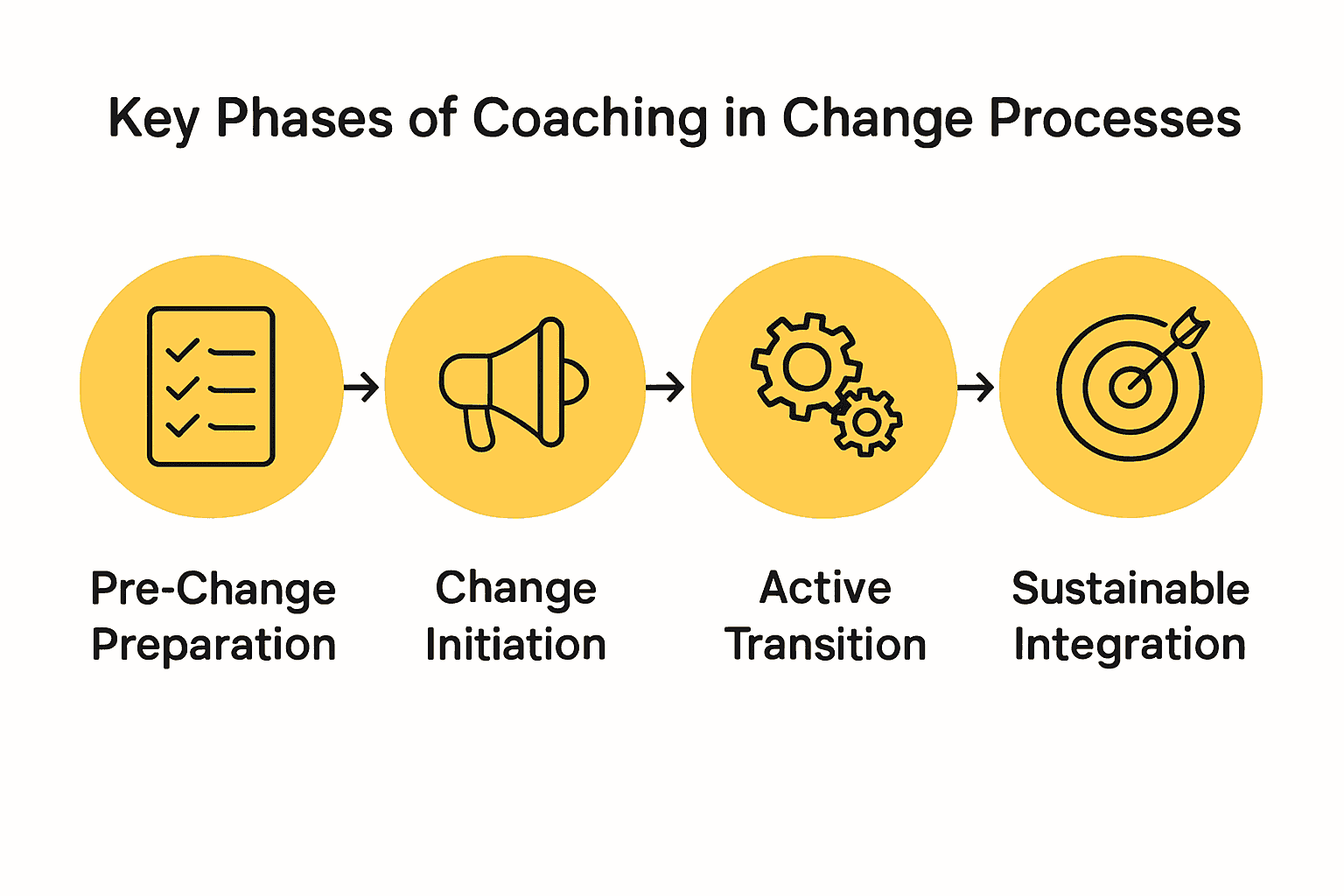
The coaching change process typically unfolds through four interconnected phases:
Pre-Change Preparation
Assessing organizational readiness
Identifying potential resistance points
Developing initial change communication strategies
Building individual and collective psychological resilience
Change Initiation
Creating transparent communication channels
Supporting leaders in articulating a change vision
Helping teams understand strategic rationale
Mitigating initial anxiety and uncertainty
Active Transition
Providing personalized support mechanisms
Facilitating skill development workshops
Addressing emerging performance challenges
Maintaining momentum and motivation
Sustainable Integration
Reinforcing new behavioural patterns
Establishing long-term accountability structures
Continuous learning and adaptation
Embedding change into organizational culture
Each phase demands unique coaching approaches that balance emotional intelligence with strategic thinking. Coaches must skillfully navigate individual psychological landscapes while maintaining alignment with broader organizational objectives. Implementing a Strategic Approach to Leadership Challenges offers additional insights into translating coaching strategies into actionable leadership frameworks.
Successful change management is not about implementing a rigid process, but creating a dynamic, responsive environment where individuals feel supported, understood, and empowered to embrace transformation. The most effective coaches recognize that change is fundamentally a human experience - requiring empathy, patience, and a nuanced understanding of individual and collective potential.
Core Skills and Approaches for Effective Change Coaching
Change coaching demands a sophisticated blend of psychological insight, strategic thinking, and interpersonal skills. According to PMC research, effective coaching leadership fundamentally enhances employees’ self-efficacy and behavioural autonomy by providing targeted resource support and constructive feedback.
Five core competencies define exceptional change coaching:
Emotional Intelligence: Reading unspoken team dynamics
Adaptive Listening: Understanding individual and collective resistance
Systemic Thinking: Connecting individual behaviours to organizational goals
Resilience Facilitation: Building psychological safety during uncertainty
Successful change coaches operate as both strategic partners and empathetic guides. They balance analytical rigour with genuine human connection, creating environments where individuals feel empowered to explore personal and professional transformations. This approach requires moving beyond traditional directive methodologies to embrace more collaborative, insight-driven coaching techniques.
Practical skill development involves mastering nuanced communication strategies that address both cognitive and emotional dimensions of change. Coaches must learn to ask provocative questions that challenge existing mental models while simultaneously providing supportive, non-judgmental spaces for exploration. What Not To Do As An Agile Coach When You Do Coaching Sessions offers critical insights into avoiding common coaching pitfalls that can derail change initiatives.
Ultimately, effective change coaching transcends the application of technical skills. It represents a profound commitment to human potential - helping individuals and organizations navigate complex transitions with dignity, curiosity, and genuine mutual respect. The most transformative coaches understand that sustainable change emerges not from external mandates, but from internal motivation and collective understanding.
Risks, Challenges, and Common Pitfalls to Avoid
Navigating organizational change coaching requires a nuanced understanding of potential barriers and resistance mechanisms. BU research reveals that resistance is not a monolithic obstacle but a complex psychological response requiring asset-based perspectives and positive psychology approaches.
Key risks and challenges in change coaching include:
Motivation Misalignment: When individual and organizational goals diverge
According to PMC research, coaching is not a universal solution. Some organizations and individuals may struggle with coaching interventions, particularly when intrinsic motivation is low or personal guidance requirements are excessive. Successful coaches must develop sophisticated diagnostic skills to identify whether their approach will be genuinely beneficial.
Practical mitigation strategies involve creating transparent, collaborative environments that acknowledge potential challenges upfront. Coaches must remain adaptable, continuously assessing individual and collective readiness for change. What is the common theme in avoiding the destruction of organizational agility? provides additional context for understanding organizational dynamics that can impede successful transformation.
Ultimately, effective change coaching transcends risk management. It requires a delicate balance between challenging existing paradigms and providing psychological safety. The most successful coaches view resistance not as a barrier but as valuable information revealing deeper organizational and individual needs that need to be understood and addressed.
Unlock the Power of Coaching to Drive Successful Organizational Change
Leading change requires more than strategy it demands a trusted coaching partner who understands the emotional journey and complexity involved. If you struggle with resistance, communication gaps, or aligning individual motivations with organizational goals, the insights from this guide highlight the need for human-centred, adaptable coaching that builds resilience and accountability.
At Berriault & Associates, we specialize in tailoring coaching solutions that integrate emotional intelligence with strategic leadership development. Our people-focused approach uses proven tools like Five Behaviors™ and Everything DiSC™ to help leaders and teams embrace change confidently and sustain new behaviours across any environment. Discover how our expert coaching can turn change from a challenge into an opportunity for growth.
Take the first step toward transforming your organization through powerful coaching. Visit Berriault & Associates to learn how our customized programs accelerate leadership capacity and enhance team performance during change. Don’t wait to create a lasting impact. Book a discovery call now and start leading change with clarity and confidence.
Frequently Asked Questions
What are the key roles that coaching plays during organizational change?
Coaching serves three fundamental roles in organizational change: facilitator, translator, and navigator. Coaches help individuals understand transitions, bridge communication gaps, and guide teams through emotional and strategic challenges.
How can coaching enhance individuals' resilience during change initiatives?
Coaching builds resilience by providing personalized support, fostering accountability for behavioural changes, and translating organizational objectives into personal narratives that individuals can relate to, thereby empowering them to adapt and thrive.
What types of coaching are most relevant during organizational change?
There are four primary types of coaching relevant in these contexts: Executive Coaching, Team Coaching, Performance Coaching, and Transformational Coaching, each focusing on different aspects such as leadership development, collective performance, individual skill gaps, and holistic growth.
What are the common challenges faced in coaching during change processes?
Common challenges include motivation misalignment, psychological resistance, communication breakdowns, cultural incompatibility, and unrealistic expectations. Identifying these issues early can help mitigate their impact on the change process.


 Each phase demands unique coaching approaches that balance emotional intelligence with strategic thinking. Coaches must skillfully navigate individual psychological landscapes while maintaining alignment with broader organizational objectives. Implementing a Strategic Approach to Leadership Challenges offers additional insights into translating coaching strategies into actionable leadership frameworks.
Successful change management is not about implementing a rigid process, but creating a dynamic, responsive environment where individuals feel supported, understood, and empowered to embrace transformation. The most effective coaches recognize that change is fundamentally a human experience - requiring empathy, patience, and a nuanced understanding of individual and collective potential.