Did you know that teams practicing agile methods are 25 percent more likely to outperform their competitors? Leadership in agile teams breaks away from old-school management, turning authority into a group strength instead of a single manager’s job. This kind of leadership helps people work together, opens doors to innovation, and keeps teams flexible. If you want to keep your team ahead, understanding what agile leadership looks like is a smart place to start.
Key Takeaways
Point
Details
Dynamic Leadership
Agile leadership is fluid and collective, emphasizing empowerment over traditional command-and-control approaches.
Role Fluidity
Leadership responsibilities within agile teams are adaptive, evolving based on team maturity and individual strengths.
Core Responsibilities
Key roles like Product Owner, Scrum Master, and Agile Coach focus on collaborative strategies to enhance team performance.
Common Pitfalls
Leaders must avoid micromanagement and promote a culture of psychological safety to facilitate effective team development.
Agile team leadership looks radically different from traditional hierarchical management models. According to a 2022 qualitative study, leadership in agile environments is dynamically shared among team members, transforming it from a fixed positional role into a fluid, collective responsibility. This approach fosters a powerful sense of belonging and distributed accountability that traditional top-down structures often miss.
In practice, this means leaders become catalysts and enablers rather than command-and-control managers. Agile Leaders’ Behaviours Are Critical For Agile Success highlights that successful agile leadership requires addressing complex group dynamics, including team maturity, design, and mindset. Leaders must create environments where self-organization can flourish, supporting teams without micromanaging their processes.
Key characteristics of agile team leadership include:
Promoting psychological safety
Encouraging transparent communication
Removing organizational barriers
Facilitating continuous learning
Supporting team autonomy
The goal isn’t to direct every action, but to empower teams to make intelligent decisions collaboratively. By shifting from traditional hierarchical models to a more adaptive, team-centric approach, agile leaders unlock unprecedented levels of innovation, engagement, and performance.
Distinct Leader Roles Within Agile Teams
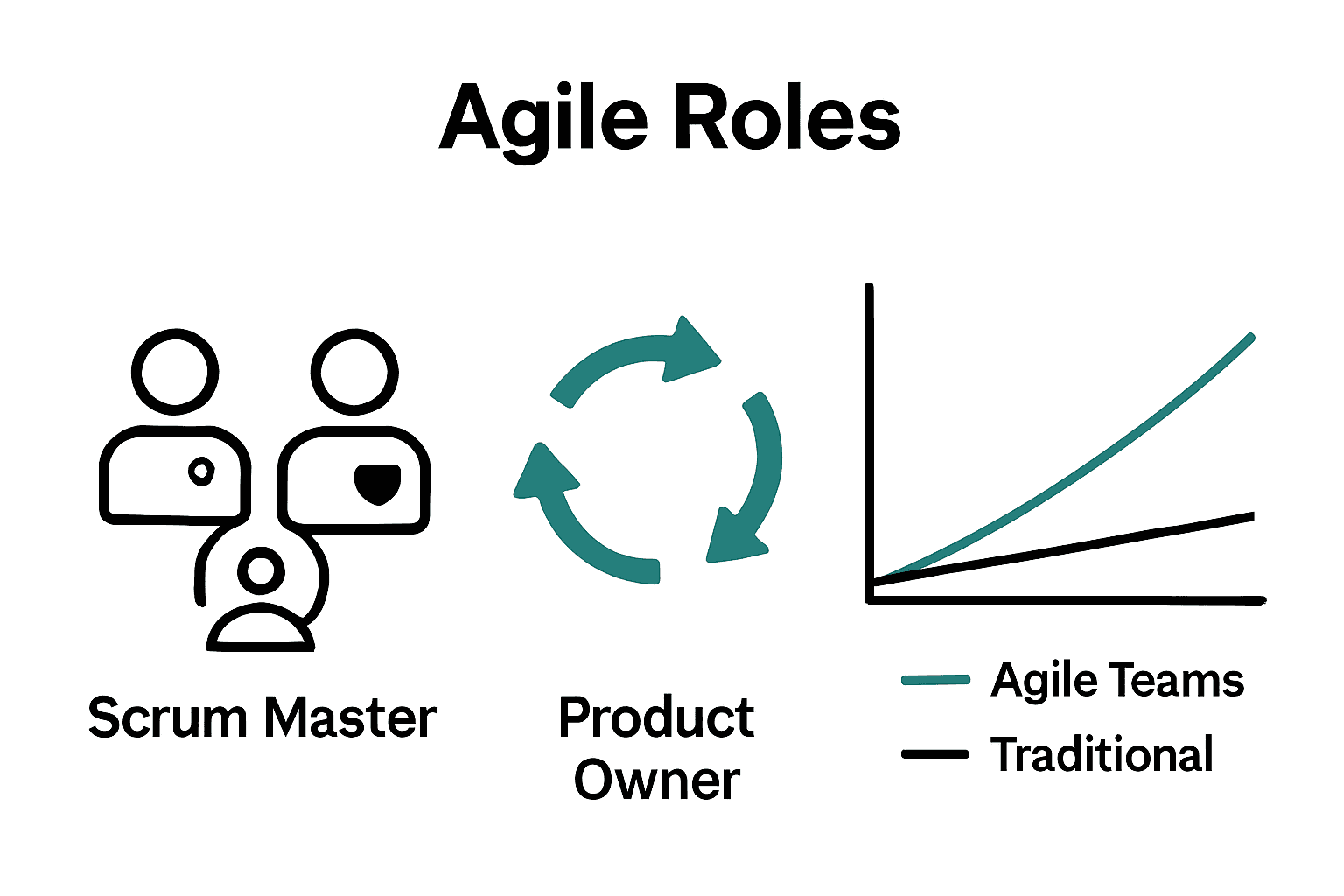
Agile teams require a nuanced approach to leadership that goes beyond traditional organizational hierarchies. According to a quantitative exploration of the 9‑Factor Theory, leadership roles in agile environments are dynamically distributed and evolve as team maturity increases. This means leadership isn’t a static position, but a fluid set of responsibilities that shift based on team needs and individual strengths. Empowering Agile Teams: Competencies for Self-Organization reveals that distinct leadership roles typically emerge within agile frameworks. These roles are not about hierarchy, but about serving different team functions:
Scrum Master: Facilitator and impediment remover
Product Owner: Strategic vision and prioritization expert
Team Member: Self-organizing contributor with leadership potential
Crucial to understanding these roles is recognizing that they are not fixed assignments, but adaptive functions. As teams mature, leadership responsibilities naturally redistribute, with team members progressively taking on more self-management capabilities. The ultimate goal is creating a high-performing, self-organizing unit where leadership emerges organically based on context and need.
Core Responsibilities and Expected Behaviors
Agile team leadership demands a radical departure from traditional management approaches. According to Atlassian’s comprehensive breakdown, each role in an agile team carries distinct yet interconnected responsibilities that collectively drive team performance and organizational success.
The core responsibilities are strategically distributed across three primary roles:
Here’s a comparison of the primary agile leadership roles and their core responsibilities:
Remove impediments
Facilitate meetings
Support self-organization
Development Team
Solution Delivery
Execute work
Make technical decisions
Ensure quality
Agile Coach
Continuous Improvement
Guide transformation
Mentor teams
Promote agile mindset
Team Lead
Technical Guidance
Mentor peers
Provide expertise
Foster collaboration
Product Owner: Defines the product vision, manages the product backlog, and handles stakeholder relationships.
Scrum Master: Facilitates team processes, removes organizational impediments, and supports team self-organization
Development Team: Collaboratively executes work, makes collective decisions, and maintains high-quality deliverables
Building Agile Organizations: The Foundation of Success emphasizes that these roles are not just job descriptions, but dynamic behavioural frameworks. Expected behaviors include maintaining transparency, embracing continuous learning, demonstrating mutual respect, and prioritizing collective achievement over individual recognition. The most effective agile leaders create environments where these behaviors become natural team dynamics, transforming traditional hierarchical structures into adaptive, high-performance ecosystems.
Facilitating Team Performance and Growth
Agile team performance is not a static concept but a dynamic process of continuous improvement and collective development. According to a groundbreaking 2024 qualitative study, leadership effectiveness increases dramatically when leadership emerges organically from team members perceived as representative of the group’s collective identity and aspirations. Transforming Leadership to Support Self-Organized Teams reveals that facilitating team performance requires a multifaceted approach. Key strategies include:
Creating psychological safety
Establishing clear performance expectations
Providing continuous feedback
Supporting skill development
Encouraging collaborative problem-solving
The most successful agile leaders understand that growth isn’t about individual achievements, but about creating an ecosystem where collective intelligence thrives. They focus on removing barriers, amplifying team strengths, and nurturing an environment of trust, transparency, and mutual accountability. By shifting from traditional top-down management to a supportive, adaptive leadership model, teams can unlock unprecedented levels of creativity, productivity, and innovation.
Overcoming Common Leadership Pitfalls
Agile leadership is fraught with potential missteps that can derail team performance and organizational effectiveness. While well-intentioned, many leaders inadvertently create barriers that prevent teams from achieving their full potential, often by clinging to traditional management paradigms that directly conflict with agile principles. Avoiding the Dark Side of Leadership highlights several critical leadership pitfalls that can undermine agile team success:
Micromanagement: Controlling every detail instead of trusting team capabilities
Inconsistent Communication: Sending mixed signals or withholding essential information
Resistance to Change: Maintaining rigid processes that block team adaptability
Blame Culture: Focusing on individual failures rather than collective learning
Neglecting Team Development: Failing to invest in continuous skill enhancement
Successful agile leaders recognize these pitfalls and actively work to create an environment of psychological safety, transparent communication, and continuous improvement. They understand that leadership is not about wielding power, but about empowering teams to solve complex problems collaboratively, learn from setbacks, and continuously evolve their collective capabilities.
Ready to Transform Your Agile Leadership Impact?
Are you struggling to move from traditional management to the adaptive leadership style agile teams need? The article highlighted how fixed hierarchies, micromanagement, and unclear roles can block team growth and collective accountability. If you want to build psychological safety, empower self-organization, and foster shared responsibility, you need strategies that go beyond theory. Explore practical solutions built specifically for your team’s evolving needs at Berriault & Associates, where we enable behavioural change using proven methods such as Five Behaviors™ and Everything DiSC™.
Take the first step toward a stronger, more agile team culture. Visit Berriault & Associates to discover personalized leadership coaching, organizational agility programs, and resources on Empowering Agile Teams. Book your discovery call now. Build the leadership capacity your organization deserves.
Frequently Asked Questions
What is the role of an agile leader in a team?
An agile leader serves as a catalyst and enabler, promoting shared responsibilities, psychological safety, and empowering team members to make collaborative decisions instead of directing every action.
How do agile leadership roles differ from traditional management?
Agile leadership roles are dynamically shared among team members and evolve based on the team’s maturity, contrasting with traditional management that relies on fixed hierarchies and command-and-control approaches.
What are key characteristics of effective agile leaders?
Key characteristics include promoting psychological safety, encouraging transparent communication, removing barriers, facilitating continuous learning, and supporting team autonomy to enhance performance and innovation.
How can agile leaders facilitate team performance and growth?
Agile leaders can facilitate performance by creating psychological safety, establishing clear expectations, giving continuous feedback, supporting skill development, and fostering collaborative problem-solving environments.



 They focus on removing barriers, amplifying team strengths, and nurturing an environment of trust, transparency, and mutual accountability. By shifting from traditional top-down management to a supportive, adaptive leadership model, teams can unlock unprecedented levels of creativity, productivity, and innovation.