More than 60% of American businesses cite team performance as the single most critical driver of organizational success. Every workplace thrives or stumbles based on how effectively its teams collaborate, adapt, and reach common goals. Understanding what defines strong team performance, why it matters, and how to measure it accurately can be the difference between struggling with turnover and achieving sustained growth. This overview guides leaders to recognize the real impact—both seen and unseen—of team performance on long-term results.
Team performance drives organizational success by harmonizing individual talents into a collaborative force essential for achieving meaningful outcomes.
Key Dimensions of Team Success
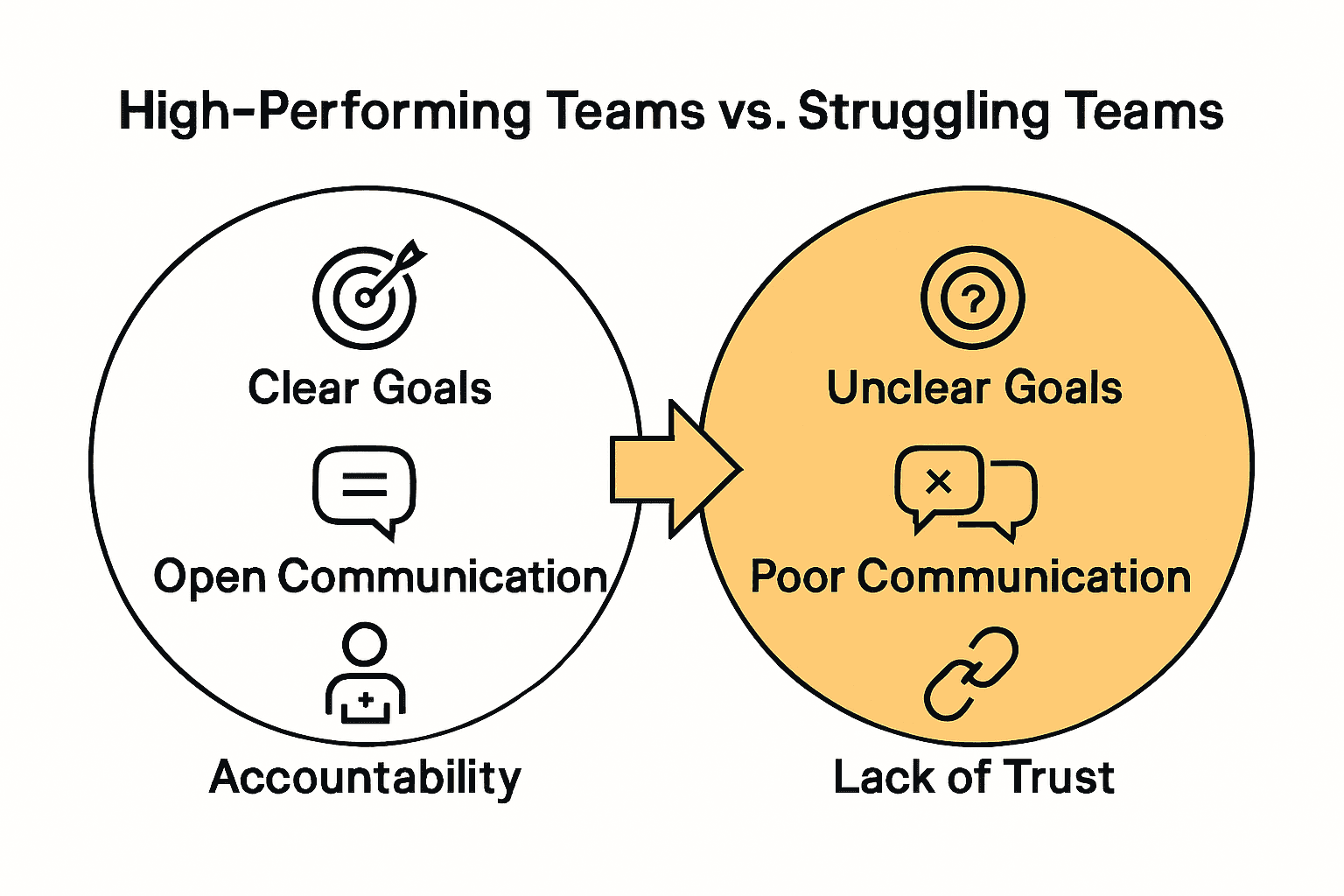
Effective teams necessitate clear goals, strong communication, and mutual accountability, fostering a culture of psychological safety and continuous learning.
Performance Measurement
Assessing team performance requires a blend of quantitative metrics and qualitative insights to ensure a comprehensive understanding of collaboration and innovation.
Common Barriers to Success
Teams risk dysfunction due to unclear goals, poor communication, and weak interpersonal relationships, necessitating proactive strategies to overcome these challenges.
Defining Team Performance and Its Importance
Team performance is far more than a corporate buzzword - it’s the critical engine driving organizational success. Team performance represents a group’s collective capacity to achieve meaningful outcomes, synthesizing individual talents into a powerful collaborative force. According to NCBI, team effectiveness is fundamentally about a team’s ability to achieve its goals, ultimately leading to improved results for both team members and the broader organization.
At its core, team performance encompasses both objective and subjective measurements of collective achievement. BMIJ highlights that performance isn’t just about raw output, but also about the quality and functionality of what teams produce. This nuanced understanding means that high-performing teams aren’t just meeting targets - they’re innovating, adapting, and consistently delivering exceptional value.
Successful team performance involves several critical dimensions:
Clear and aligned goals
Strong interpersonal communication
Complementary skill sets
Mutual accountability
Psychological safety
Continuous learning and improvement
Understanding these dynamics is crucial for leaders seeking to transform their teams. For a comprehensive approach to building high-performing teams, check out our guide on building high-performing teams. By investing in team development, organizations can unlock unprecedented levels of collaboration, creativity, and sustainable success.
Types of Team Performance Metrics and Models
Team performance measurement is a nuanced art that goes far beyond simple numerical tracking. IOSR Journals highlights that comprehensive team performance evaluation encompasses multiple critical dimensions: team effectiveness, efficiency, learning and growth, and member satisfaction, with task accomplishment serving as a foundational indicator.
Effective team performance models typically incorporate both quantitative and qualitative metrics. Organizations can leverage various frameworks to assess team performance, such as:
Balanced Scorecard approach
Key Performance Indicator (KPI) tracking
360-degree feedback systems
Objective and Key Results (OKR) methodology
Behavioural competency assessments
Output quality and consistency measurements
These models recognize that team performance isn’t a one-dimensional concept. Successful measurement requires a holistic view that captures not only what teams produce but also how they collaborate, innovate, and continuously improve. When organizations assess metrics strategically, they can unlock more profound insights into team dynamics and potential.
Modern performance assessment moves beyond traditional top-down evaluations. It embraces collaborative approaches that encourage transparency, mutual accountability, and ongoing development. By integrating multiple perspectives and measurement techniques, organizations can create a more nuanced, supportive environment that drives genuine team excellence and sustainable organizational growth.
Key Drivers Shaping Effective Team Performance
Team performance doesn’t emerge by accident. Harvard Business Library reveals that a strategic combination of clear goals, well-designed tasks, appropriate skills, adequate resources, and supportive coaching fundamentally drives effective team performance. Adaptability emerges as a critical factor, especially in today’s rapidly changing organizational landscapes.
The core drivers of high-performance teams extend beyond mere technical competence. Banotes emphasizes that exceptional teams are distinguished by strong interpersonal relationships, crystal-clear and compelling goals, and communication that fosters deep trust and mutual respect. These elements transform a group of individuals into a cohesive, powerful collaborative unit.
Key drivers shaping team performance include:
Alignment of individual and team objectives
Psychological safety
Continuous skill development
Open and transparent communication
Shared accountability
Emotional intelligence
Resilience and adaptability
Understanding these drivers requires a holistic approach. When organizations invest strategically in team development, they create environments where collaboration isn’t just encouraged—it’s intrinsically motivated. By recognizing and nurturing these critical performance drivers, leaders can transform teams from functional units into extraordinary engines of innovation and achievement.
Assessment Tools and Measurement Strategies
Team performance assessment is a complex process that demands nuanced, comprehensive approaches. IOSR Journals highlights that effective measurement goes beyond simplistic tracking, encompassing multiple critical dimensions including task accomplishment, efficiency, learning and growth, and team member satisfaction. The primary indicator remains task accomplishment, but modern assessment strategies recognize the complexity of team dynamics.
Contemporary measurement strategies leverage a multi-dimensional toolkit to capture team performance holistically:
Quantitative performance metrics
Qualitative behavioural assessments
360-degree feedback mechanisms
Peer and self-evaluation frameworks
Objective and Key Results (OKR) tracking
Behavioural competency evaluations
Psychological safety assessments
Successful assessment requires a balanced approach that combines objective data with nuanced human insights. Technology has revolutionized performance measurement, enabling real-time tracking, advanced analytics, and more sophisticated evaluation techniques. When organizations analyze metrics strategically, they transform raw data into actionable intelligence that drives meaningful team development. Ultimately, the most effective assessment tools are those that view performance as a dynamic, evolving process. They move beyond static evaluations to create continuous feedback loops that foster growth, recognize potential, and align individual contributions with broader organizational objectives. By embracing comprehensive, forward-looking measurement strategies, leaders can unlock their teams’ true potential and create environments of sustained high performance.
Common Barriers and Mistakes to Avoid
Building high-performing teams isn’t just about implementing strategies - it’s equally about avoiding critical pitfalls. Harvard Business Library reveals that team performance can be severely undermined by several fundamental barriers, including unclear goals, poorly designed tasks, mismatched skills, inadequate resources, and a critical absence of supportive coaching, particularly in rapidly evolving environments.
The interpersonal dynamics of teams present another significant challenge. Banotes emphasizes that ineffective teams frequently struggle with fundamental relationship issues, characterized by:
Weak interpersonal connections
Ambiguous or conflicting team objectives
Communication breakdowns
Absence of psychological safety
Blame-oriented culture
Lack of mutual respect
Inconsistent accountability
Leaders must proactively address these barriers to prevent team dysfunction. By strategically improving team performance, organizations can turn potential obstacles into opportunities for growth. The most successful teams aren’t those that never encounter challenges, but those that develop robust mechanisms to recognize, discuss, and constructively navigate interpersonal and structural impediments to their collective success.
Unlock Your Team’s True Potential with Expert Guidance
The article highlights common challenges like unclear goals, weak communication, and a lack of psychological safety that often hold teams back from reaching their full performance. These obstacles can cause frustration and stalled growth despite your best efforts. Imagine transforming those challenges into strengths by building clear alignment, deep trust, and continuous learning within your team.
At Berriault & Associates, we specialize in helping leaders and HR professionals overcome these exact pain points through tailored programs designed to boost collaboration and leadership capacity. Using proven tools like Five Behaviors™ and Everything DiSC™, we create customized learning and coaching experiences that foster sustainable team success in any environment. For insights on how to start this journey, explore how to improve team performance for business success and discover why it is essential to invest in team development.
Ready to turn your team challenges into competitive advantages? Visit https://berriaultandassociates.com today to book a discovery call and begin building the resilient, high-performing teams your organization needs now.
Frequently Asked Questions
What is team performance?
Team performance is the collective capacity of a group to achieve meaningful outcomes by synthesizing individual talents into a collaborative force.
Why is team performance important for organizations?
Team performance is crucial because it directly affects an organization’s ability to meet goals, innovate, and deliver exceptional value, thereby driving overall success.
What are some key drivers of effective team performance?
Key drivers of effective team performance include alignment of objectives, psychological safety, open communication, continuous skill development, and resilience.
How can organizations measure team performance?
Organizations can measure team performance using a variety of metrics, including quantitative performance metrics, qualitative assessments, 360-degree feedback, and OKR tracking.


 Ultimately, the most effective assessment tools are those that view performance as a dynamic, evolving process. They move beyond static evaluations to create continuous feedback loops that foster growth, recognize potential, and align individual contributions with broader organizational objectives. By embracing comprehensive, forward-looking measurement strategies, leaders can unlock their teams’ true potential and create environments of sustained high performance.