Over 70 percent of agile transformations fail to deliver lasting change, often because organizations focus on processes instead of mindsets. In a world where disruption is constant, cultivating an agile culture enables teams to adapt, innovate, and thrive. Understanding the fundamental drivers behind agility opens the door to resilient teamwork, empowered leadership, and continuous improvement that withstands any challenge.
Key Takeaways
Point
Details
Agile Culture Importance
An agile culture emphasizes adaptability, learning, and collaboration, necessitating a shift in organizational mindsets toward valuing experimentation and calculated risks.
Characteristics of Agile Organizations
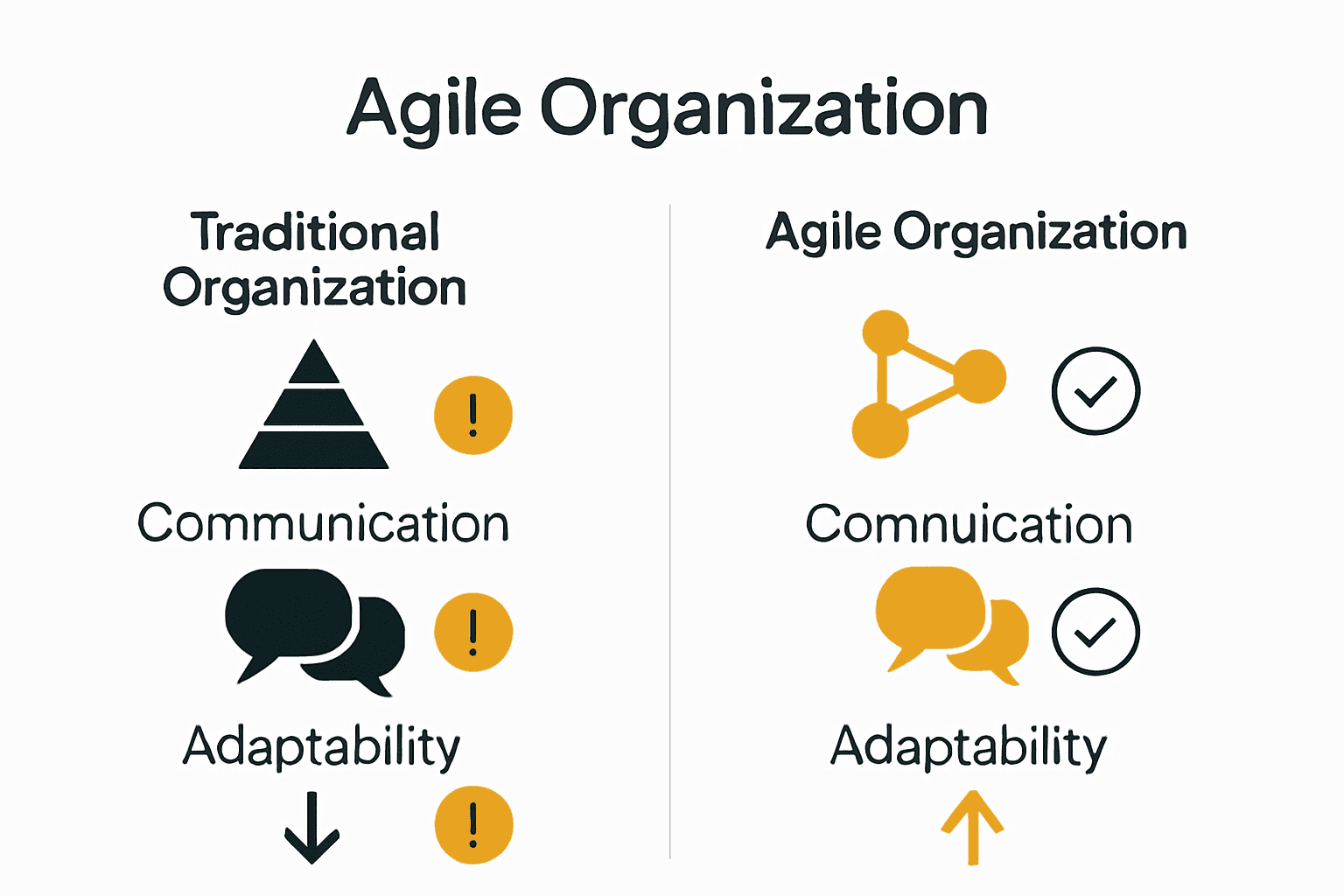
Agile organizations emphasize decentralized decision-making, open communication, and customer-centricity, distinguishing them from traditional hierarchical structures.
Leadership’s Role in Agility
Effective agile leadership involves inspiring vision, removing obstacles, and fostering a supportive culture that encourages team autonomy and continuous learning.
Common Pitfalls to Avoid
Organizations should avoid treating agile as a rigid framework, ensure thorough training, secure executive commitment, and foster interdepartmental collaboration to achieve successful transformations.
An agile culture represents an organizational ecosystem designed to thrive in the face of complexity and change. According to research from the Agile Business Consortium, this culture is fundamentally about creating an environment where flexible, innovative behaviour becomes the norm, powered by three critical drivers: autonomy, mastery, and purpose.
At its core, an agile culture is a comprehensive approach to organizational thinking and behaviour. The Agile Ethos: Building Stronger, More Resilient Teams requires reimagining traditional hierarchical structures and embracing principles that prioritize:
Rapid adaptability
Continuous learning
Collaborative problem-solving
Transparent communication
Iterative progress
Research from the Model of Cultural Agility (MoCA) academic model suggests that cultural values have a significant impact on the implementation of agile methods. This means successful agile transformation isn’t just about adopting new processes, but fundamentally shifting organizational mindsets. Teams must develop a shared understanding that values experimentation, tolerates calculated risks, and views failure as a learning opportunity rather than a setback.
Key Characteristics of Agile Organizations
Agile organizations are fundamentally different from traditional corporate structures. According to research from the Agile Alliance, these organizations are characterized by a holistic approach that prioritizes continuous learning, adaptability, and value-driven performance. The Agile Organizations Guide reveals they operate through interconnected principles that transform how work gets done.
Key characteristics that distinguish agile organizations include:
Here’s a comparison of traditional vs. agile organizations:
Characteristic
Traditional Organization
Agile Organization
Structure
Hierarchical
Rigid roles
Network-based
Cross-functional teams
Decision-Making
Centralized
Slow
Decentralized
Rapid & autonomous
Adaptability
Change-resistant
Rapidly adaptable
Communication
Siloed
Top-down
Open
Transparent
Focus
Efficiency
Short-term goals
Value creation
Long-term vision
Leadership Style
Directive
Control-focused
Catalyst
Empowering
Learning Approach
Infrequent
Error-averse
Continuous
Embraces failure
Catalyst Leadership: Empowering managers who guide rather than control
Continuous Learning: Systematic approach to experimenting and extracting insights
Customer-Centricity: Rapid response to market and customer needs
Flexible Team Networks: Dynamic, cross-functional collaboration
Open Communication: Transparent information sharing across all levels
Research from Business Map highlights that successful agile organizations are creating entire ecosystems designed for rapid innovation. They govern based on long-term value creation, encourage skill mastery, and maintain a shared organizational purpose that acts as a strategic North Star. This approach transforms traditional hierarchical structures into responsive, interconnected networks that can thrive in complex, rapidly changing business environments.
Behaviours and Mindsets Driving Agility
Agile mindsets represent a fundamental approach to organizational thinking and action. According to research from Duke Corporate Education, these cultures are characterized by being ‘actively experimental’, prioritizing learning speed over achieving perfection. The Processes and Behaviours Guide reveals that true agility emerges when teams embrace a dynamic, adaptive perspective.
Key behavioural attributes that drive agile success include:
Psychological Safety: Creating environments where team members can take risks without fear
Autonomous Decision-Making: Empowering individuals to act within defined strategic boundaries
Continuous Learning: Viewing failures as opportunities for growth and insight
Collaborative Problem-Solving: Breaking down silos and encouraging cross-functional engagement
Transparency: Maintaining open communication channels across all organizational levels
Academic research highlights a critical challenge: technical agility (‘doing agile’) must seamlessly align with cultural agility (‘being agile’). Organizations frequently encounter cultural barriers that impede genuine transformation. The most successful teams recognize that agility is less about rigid methodologies and more about cultivating a mindset of adaptability, curiosity, and collaborative innovation.
This approach transforms traditional hierarchical structures into responsive, interconnected networks that can navigate complex and rapidly changing business landscapes.
Role of Leadership in Agile Transformation
Agile leadership represents a fundamental reimagining of organizational management, moving far beyond traditional command-and-control approaches. According to McKinsey research, leaders must transition from seeking certainty to embracing discovery, from wielding authority to building partnerships, and from operating from a scarcity mindset to cultivating abundance. The Changing Face of Agile Leadership demonstrates how this transformation fundamentally reshapes organizational potential.
Key leadership responsibilities in driving agile transformation include:
Inspiring Vision: Creating a compelling narrative for organizational change
Obstacle Removal: Actively dismantling systemic barriers to innovation
Cultural Enablement: Fostering psychological safety and trust
Continuous Learning: Modelling adaptive and experimental behaviours
Strategic Alignment: Connecting agile practices to broader organizational goals
Case studies consistently confirm that executive sponsorship is mission-critical. Successful agile transformations require leaders who don’t merely endorse change but actively participate in reimagining organizational dynamics. This means moving from being directors to becoming catalysts, creating environments where teams can self-organize, experiment, and continuously improve. The most effective agile leaders understand that their primary role is not to control, but to create the conditions where creativity, collaboration, and innovative problem-solving can naturally emerge.
Common Pitfalls and How to Avoid Them
Agile transformations often fail not because of inherent methodology flaws, but due to predictable organizational missteps. According to research from NextUp Solutions, companies frequently stumble by treating agile as a universal, one-size-fits-all framework, rather than a flexible approach tailored to their unique context. The Overcoming Cargo Cultism for Genuine Agility guide illuminates how blindly copying practices without understanding underlying principles can derail transformation efforts.
Key pitfalls organizations must actively navigate include:
Framework Rigidity: Treating agile as a prescriptive checklist instead of an adaptive mindset
Insufficient Training: Implementing changes without comprehensive team education
Leadership Disconnect: Failing to secure genuine executive commitment
Siloed Implementation: Attempting transformation in isolated departments
Premature Scaling: Expanding agile practices before foundational skills are developed
Miro’s comprehensive research reveals that successful agile transformations demand holistic strategies. Organizations must prioritize cultural alignment over mechanical process changes, invest in continuous learning, break down interdepartmental barriers, and foster environments that encourage experimentation and innovation. The most effective approach recognizes that agile is less about following a specific methodology and more about cultivating a collective mindset of adaptability, collaboration, and continuous improvement.
Ready to Build a True Agile Culture That Lasts?
Many organizations struggle to move beyond surface-level agile processes and face setbacks when cultural change does not take root. If you find that framework rigidity and leadership disconnect are slowing your progress, you are not alone. According to the article, true transformation means shifting both mindsets and behaviours. At Berriault & Associates, we help leaders and teams break the cycle of stalled improvement with tailored, people-centred solutions.
Discover how our framework-agnostic approach can empower your leaders, enhance psychological safety, and foster genuine agility across every level. Explore custom training, proven assessments, and real-world coaching designed for your unique context. Visit the Berriault & Associates homepage to discover programs that go far beyond checklists. Want direct guidance on your journey? Book a consultation through our leadership development page or explore practical resources, such as building resilient teams. Start now to unlock the full impact of agile culture and set your organization up for lasting, sustainable growth.
Frequently Asked Questions
What is agile culture?
Agile culture refers to an organizational environment that promotes flexibility, innovation, and adaptability. It emphasizes autonomy, mastery, and purpose, encouraging teams to embrace change and learn continuously.
What are the core principles of agile organizations?
The core principles of agile organizations include rapid adaptability, continuous learning, collaborative problem-solving, transparent communication, and iterative progress, which collectively foster a responsive and innovative workplace.
How can leadership impact agile transformation?
Leadership influences agile transformation by inspiring vision, removing obstacles, fostering psychological safety, promoting continuous learning, and aligning agile practices with the organization’s broader goals.
What common pitfalls should organizations avoid during agile transformation?
Organizations should avoid common pitfalls, such as treating agile as a rigid framework, providing insufficient training, failing to secure executive commitment, implementing changes in silos, and prematurely scaling practices without developing foundational skills.