Most American companies are finding that adaptability is a necessity. In a marketplace where shifts can happen overnight, rigid structures often leave organizations struggling to keep up. More than 65 percent of leaders now believe their success depends on how quickly they can respond to change. This article explains what business agility really means and shares clear principles that help companies move from outdated models to smarter, more flexible ways of working.
Business agility is the ability of organizations to adapt quickly to market changes, emphasizing flexible structures and a culture of continuous learning.
Core Principles of Agility
Successful agile organizations focus on customer needs, promote teamwork, and prioritize rapid innovation to maintain a competitive edge.
Leadership’s Role
Leaders must foster an environment of psychological safety and dismantle hierarchical structures to enable true agility and adaptability.
Challenges to Agility
Common barriers include misconceptions about agility as a one-time implementation rather than a continuous journey, requiring persistent commitment to cultural change.
Defining Business Agility and Core Principles
Business agility represents an organization’s capacity to rapidly adapt, innovate, and respond effectively to complex marketplace changes. It is a strategic approach that transforms how companies operate, compete, and survive in unpredictable business environments. Understanding agile organizational dynamics requires recognizing that traditional, rigid hierarchical structures simply cannot keep pace with today’s dynamic market demands.
At its core, business agility is about creating flexible, responsive organizational systems that prioritize continuous learning, swift decision-making, and customer-centric approaches. This means breaking down traditional departmental silos, empowering teams to make quick decisions, and developing a culture of rapid experimentation and iterative improvement. Adaptability becomes the primary organizational competency, enabling businesses to pivot quickly when market conditions shift or new opportunities emerge.
The fundamental principles of business agility center on several key dimensions: customer focus, continuous innovation, collaborative teamwork, and rapid strategic responsiveness. Successful agile organizations cultivate environments that support adaptive organizational cultures where employees feel empowered to challenge existing processes, propose innovative solutions, and work across traditional organizational boundaries. These principles translate into practical strategies such as implementing cross-functional teams, adopting flexible work structures, investing in continuous learning programs, and developing robust feedback mechanisms that enable rapid course correction.
By embracing business agility, organizations transform from rigid, hierarchical structures into dynamic, responsive networks capable of navigating complex business landscapes. This approach is about creating sustainable competitive advantage through intelligent, human-centred organizational design that values adaptability, collaboration, and continuous strategic evolution.
Distinct Types and Dimensions of Business Agility
Business agility is a complex, multifaceted organizational capability. Research from business process management experts reveals that organizational agility manifests across four critical dimensions: operations, research and development, transformation, and strategic planning. Each dimension represents a unique lens through which companies can assess and enhance their adaptive capabilities.
The operational dimension focuses on how quickly and efficiently an organization can modify its internal processes and workflows. This involves creating flexible systems that enable rapid decision-making, streamlined communication, and swift workforce reallocation. Leadership agility is crucial in this dimension, as leaders must cultivate environments that support rapid pivots and continuous improvement. Technological infrastructure becomes key, enabling teams to respond to market changes with unprecedented speed and precision. According to additional research, the human-centric dimensions of business agility are equally critical. Organizations must develop competencies in quickness, flexibility, responsiveness, and human resource management. This means investing in knowledgeable workers, implementing integrated business processes, and fostering robust internal and external collaboration mechanisms. The goal is to move intelligently, creating adaptive networks that can sense, interpret, and respond to complex marketplace dynamics.
Ultimately, business agility transcends traditional organizational boundaries. It represents a holistic approach to designing responsive, intelligent systems that can navigate uncertainty with confidence. By understanding and developing these diverse dimensions, organizations transform from rigid, static entities into dynamic, resilient networks capable of continuous reinvention and strategic evolution.
Key Characteristics and Enabling Capabilities
Business agility emerges through a complex interplay of organizational characteristics that go far beyond traditional operational metrics. The Disciplined Agile principles underscore that truly agile organizations are built on a foundation of customer delight, continuous excellence, and profound contextual awareness. These principles suggest that agility isn’t a one-size-fits-all approach, but a dynamic, adaptive strategy tailored to each organization’s unique ecosystem.
Key characteristics of business agility include rapid adaptation, sophisticated learning mechanisms, and a culture of transparent, cross-functional collaboration. Organizations must develop robust communication channels that enable seamless information flow and break down traditional departmental barriers. Expanding organizational perspectives becomes critical, requiring leaders to cultivate environments where experimentation is encouraged, failure is seen as a learning opportunity, and innovative thinking is systematically rewarded. Enabling capabilities represent the technological, human, and strategic infrastructures that support agile transformation. This includes implementing flexible technological platforms, developing workforce skills through continuous learning programs, and creating decision-making frameworks that empower teams to respond quickly to emerging challenges. The most successful agile organizations recognize that preventing organizational rigidity requires ongoing commitment to dismantling bureaucratic structures and fostering a culture of proactive, collaborative problem-solving.
Ultimately, business agility is not a destination but a continuous journey of organizational evolution. It demands a holistic approach that integrates human potential, technological innovation, and strategic flexibility. By embracing these key characteristics and enabling capabilities, organizations can transform from reactive, siloed entities into dynamic, responsive networks that thrive in an increasingly complex and unpredictable business landscape.
Examples and Use Cases
Business agility transforms theoretical concepts into tangible organizational success across diverse industries. Scrum frameworks demonstrate how structured approaches enable confident change management, revealing practical pathways for implementing adaptive strategies. Technology companies like Netflix exemplify this principle, continuously reinventing their business model through rapid iteration and customer-focused innovation.
In the healthcare sector, organizations have leveraged business agility to improve patient care and operational efficiency dramatically. Hospitals implementing cross-functional teams and flexible workflow systems can respond more quickly to emerging medical challenges, reallocate resources during crisis periods, and develop more personalized treatment approaches. Leadership agility becomes critical in these environments, where decision speed can directly impact human lives.
The manufacturing and automotive industries provide compelling examples of business agility in action. Companies like Toyota have long pioneered adaptive production methods, creating systems that can quickly reconfigure assembly lines, respond to supply chain disruptions, and integrate new technological innovations. These organizations view agility not as a temporary strategy, but as a fundamental organizational competency that enables continuous improvement and competitive differentiation.
Beyond specific sectors, expanding organizational perspectives reveals that successful business agility transcends industry boundaries. The most effective organizations share common characteristics: they prioritize learning, embrace uncertainty as an opportunity, and create cultures that reward innovative problem-solving. By transforming rigid structures into dynamic, responsive networks, these companies anticipate and shape them.
Challenges, Misconceptions, and Leader Responsibilities
Business agility often suffers from profound misunderstandings that can derail organizational transformation efforts. Leadership misconceptions represent the most significant barrier, with many executives mistakenly believing that agility is simply a set of tools or a quick implementation strategy. Rethinking leadership challenges requires understanding that true agility demands fundamental cultural and behavioural shifts, not superficial process modifications.
Leaders face multiple critical responsibilities in driving business agility. This includes creating psychological safety where teams can experiment without fear of punishment, dismantling rigid hierarchical structures, and developing adaptive communication frameworks. Avoiding the dark side of leadership becomes paramount, as traditional command-and-control approaches directly undermine the collaborative, flexible environments necessary for organizational agility. Successful leaders must transition from being directors to becoming enablers who empower teams and cultivate a culture of continuous learning and rapid adaptation.
Common challenges in implementing business agility include organizational resistance, deeply entrenched bureaucratic systems, and a lack of understanding about what agility truly represents. Many organizations incorrectly view agility as a destination rather than a continuous journey of organizational evolution. Leadership’s role in navigating organizational change becomes critical in overcoming these systemic barriers, requiring persistent commitment, strategic communication, and a willingness to challenge existing paradigms.
Ultimately, business agility is not a technical implementation but a profound cultural transformation. Leaders must recognize that their primary responsibility is to create environments where innovation can flourish, where teams feel empowered to make decisions, and where continuous improvement is not just encouraged but expected. By embracing this holistic perspective, organizations can move beyond superficial agile practices and develop truly adaptive, resilient systems that can thrive in an increasingly complex business landscape.
Transform Your Organization with True Business Agility
Is your leadership team struggling to create a culture that embraces rapid adaptation, continuous learning, and empowered decision-making? The challenges of breaking down silos and fostering adaptive organizational cultures require more than just process changes — they demand a focused shift in behaviour and mindset. At Berriault & Associates, we understand that achieving sustainable business agility means developing your leaders’ ability to navigate complexity and inspire collaboration.
Discover tailored programs designed to accelerate your agile transformation through proven tools like Five Behaviors™ and Everything DiSC™. Our people-centred solutions help you build resilient, responsive teams and foster leadership agility that drives continuous innovation. Visit our website to learn how you can begin this vital journey today. Don’t wait to empower your teams to thrive in uncertainty. Book a discovery call now and take the first step toward dynamic, lasting organizational change.
Frequently Asked Questions
What is business agility?
Business agility is an organization’s ability to rapidly adapt, innovate, and respond effectively to market changes, transforming its operations to thrive in unpredictable environments.
What are the core principles of business agility?
The core principles include customer focus, continuous innovation, collaborative teamwork, and rapid strategic responsiveness, which enable organizations to create flexible, adaptive systems.
What are the dimensions of business agility?
Business agility manifests across four dimensions: operations, research and development, transformation, and strategic planning, each contributing uniquely to an organization’s adaptive capabilities.
How can leaders foster a culture of business agility?
Leaders can foster business agility by promoting psychological safety, dismantling hierarchical structures, encouraging experimentation, and developing adaptive communication frameworks to empower teams.


 According to additional research, the human-centric dimensions of business agility are equally critical. Organizations must develop competencies in quickness, flexibility, responsiveness, and human resource management. This means investing in knowledgeable workers, implementing integrated business processes, and fostering robust internal and external collaboration mechanisms. The goal is to move intelligently, creating adaptive networks that can sense, interpret, and respond to complex marketplace dynamics.
Ultimately, business agility transcends traditional organizational boundaries. It represents a holistic approach to designing responsive, intelligent systems that can navigate uncertainty with confidence. By understanding and developing these diverse dimensions, organizations transform from rigid, static entities into dynamic, resilient networks capable of continuous reinvention and strategic evolution.
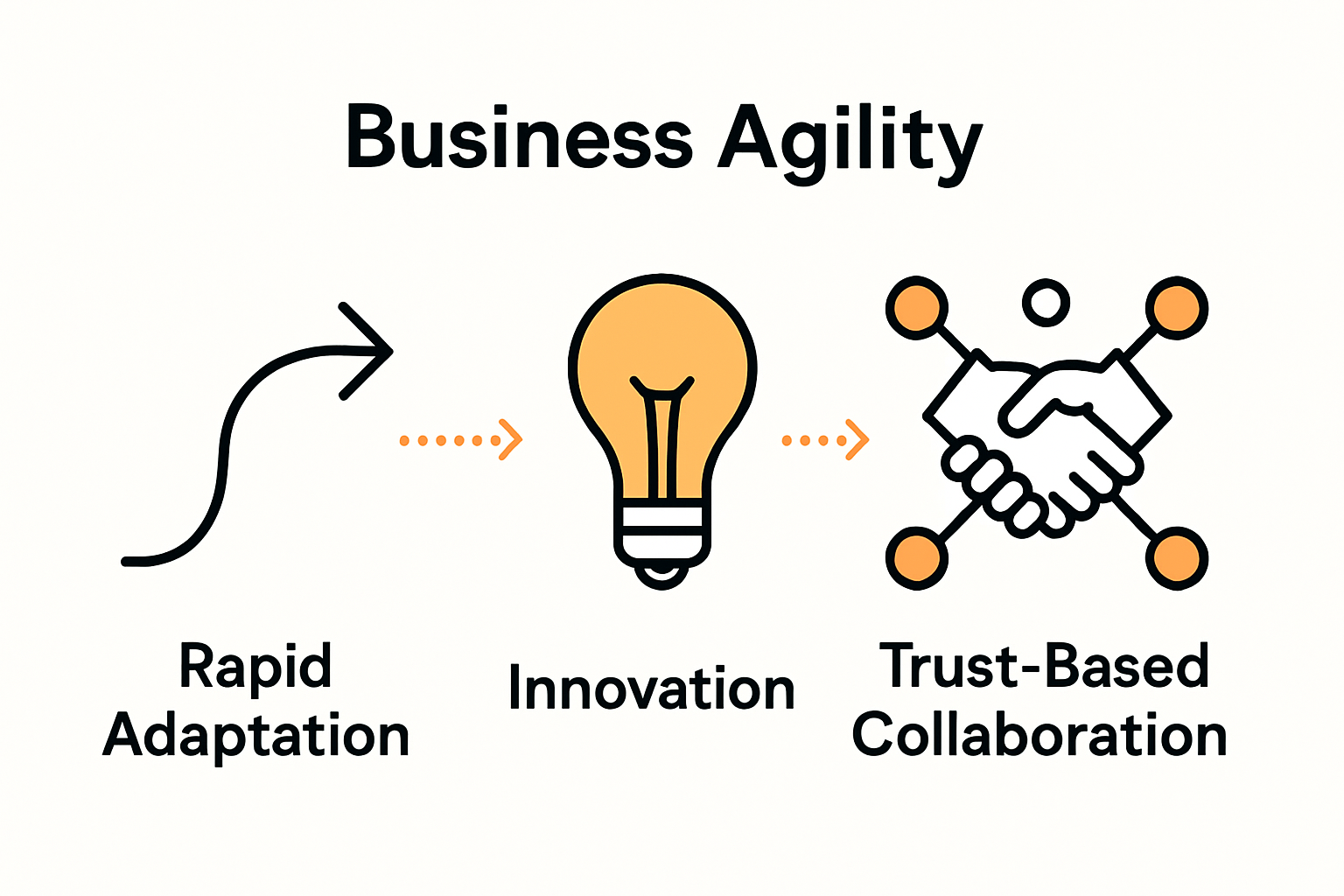 Enabling capabilities represent the technological, human, and strategic infrastructures that support agile transformation. This includes implementing flexible technological platforms, developing workforce skills through continuous learning programs, and creating decision-making frameworks that empower teams to respond quickly to emerging challenges. The most successful agile organizations recognize that preventing organizational rigidity requires ongoing commitment to dismantling bureaucratic structures and fostering a culture of proactive, collaborative problem-solving.
Ultimately, business agility is not a destination but a continuous journey of organizational evolution. It demands a holistic approach that integrates human potential, technological innovation, and strategic flexibility. By embracing these key characteristics and enabling capabilities, organizations can transform from reactive, siloed entities into dynamic, responsive networks that thrive in an increasingly complex and unpredictable business landscape.