Over 80 percent of organizations report higher performance when teams collaborate effectively. In a world where work often feels fragmented, finding that cohesive rhythm can transform scattered efforts into real progress. Knowing what makes collaboration truly effective within a company sets thriving teams apart from those merely going through the motions. This article reveals proven strategies and insights to help you build a culture where every contribution matters and results take center stage.
Effective collaboration requires a deliberate structure, shared rules, and norms for cohesive teamwork toward common goals.
Types of Collaboration
Organizations benefit from understanding various collaboration types, ranging from loose networks to integrated partnerships, to optimize engagement.
Elements of Success
Clear communication, shared accountability, and mutual respect are vital for effective collaboration and depend on building trust within teams.
Overcoming Barriers
Identifying and addressing structural barriers, such as misaligned incentives and rigid hierarchies, is essential for fostering a collaborative culture.
Defining Effective Collaboration in Organizations
Collaboration is the strategic heartbeat of modern organizational success. Effective collaboration represents a deliberate, structured approach where team members intentionally work together to achieve shared objectives, transcending traditional siloed working methods.
According to research from Penn State Berks, effective collaboration fundamentally requires developing shared rules, norms, and structures within an organization. These foundational elements create a cohesive environment where individuals can seamlessly coordinate their efforts and knowledge. The research highlights that collaboration isn’t spontaneous but a carefully designed process involving mutual understanding and aligned operational frameworks.
At its core, collaboration involves strategic interdependence. As identified in research from the National Center for Biotechnology Information, true collaboration means partners meaningfully investing in mutual goals, often requiring significant operational adjustments. This isn’t about superficial teamwork, but deep, transformative engagement where:
Mutual respect and trust form the collaboration’s foundation
Successful organizational collaboration demands more than good intentions. It requires intentional design, continuous communication, and a culture that genuinely values collective achievement over individual performance. The Collaborative Leadership Guide can provide deeper insights into building these critical organizational capabilities.
Types of Collaboration and Key Differences
Collaboration isn’t a monolithic concept but a dynamic spectrum with multiple forms and approaches. Understanding these variations enables organizations to strategically design their collaborative efforts, maximizing effectiveness and achieving the desired outcomes.
According to research from GeoFunders, organizational collaboration can be categorized into several distinct types, each with unique characteristics and levels of formality. These collaborative models range from loose networks to highly integrated partnerships. The key distinctions often revolve around:
Depth of engagement
Organizational boundaries
Shared goals and accountability
Decision-making structures
Lodestar University offers an insightful alternative perspective, outlining ten types of collaboration organized by increasing levels of integration. These range from fundamental issue advocacy to complex, fully integrated programming models. This progression illustrates that collaboration is not a static process but an evolving one that can deepen and transform over time.
Practically speaking, organizations may experience different types of collaboration simultaneously. Some teams might engage in networked collaboration, where members maintain autonomy while sharing information, while others might pursue coordinated collaboration with more structured goal alignment. The How to Improve Team Collaboration for Lasting Results guide offers additional insights into navigating these complex collaborative dynamics, helping leaders choose the most appropriate approach for their specific organizational context.
Essential Elements for Collaborative Success
Successful collaboration isn’t a matter of chance - it’s a deliberate process rooted in strategic design and intentional human dynamics. Organizations that master collaborative success understand it requires more than good intentions.
Research from the University of Iowa Student Life reveals four distinct collaboration models that illuminate the critical elements of effective teamwork: Innovation Mall, Innovation Community, Elite Circle, and Consortium. Each model demonstrates that successful collaboration hinges on carefully structured participation levels and sophisticated governance frameworks.
The foundational elements of collaborative success typically involve:
Clear Communication: Transparent, frequent, and meaningful dialogue
Shared Accountability: Collective ownership of outcomes
Mutual Respect: Valuing diverse perspectives and individual contributions
Aligned Goals: Unified vision that transcends individual or departmental interests
Building genuine collaboration requires a sense of psychological safety and trust. Building Trust in Team Dynamics emphasizes that trust is the critical infrastructure that enables teams to take risks, share vulnerabilities, and perform at extraordinary levels. Without trust, collaboration becomes a performative exercise rather than a transformative process.
Common Barriers and How to Overcome Them
Collaboration may sound simple in theory, but organizations often encounter complex obstacles that can derail even the most well-intentioned teamwork. Understanding these barriers is the first critical step toward creating more integrated and effective collaborative environments.
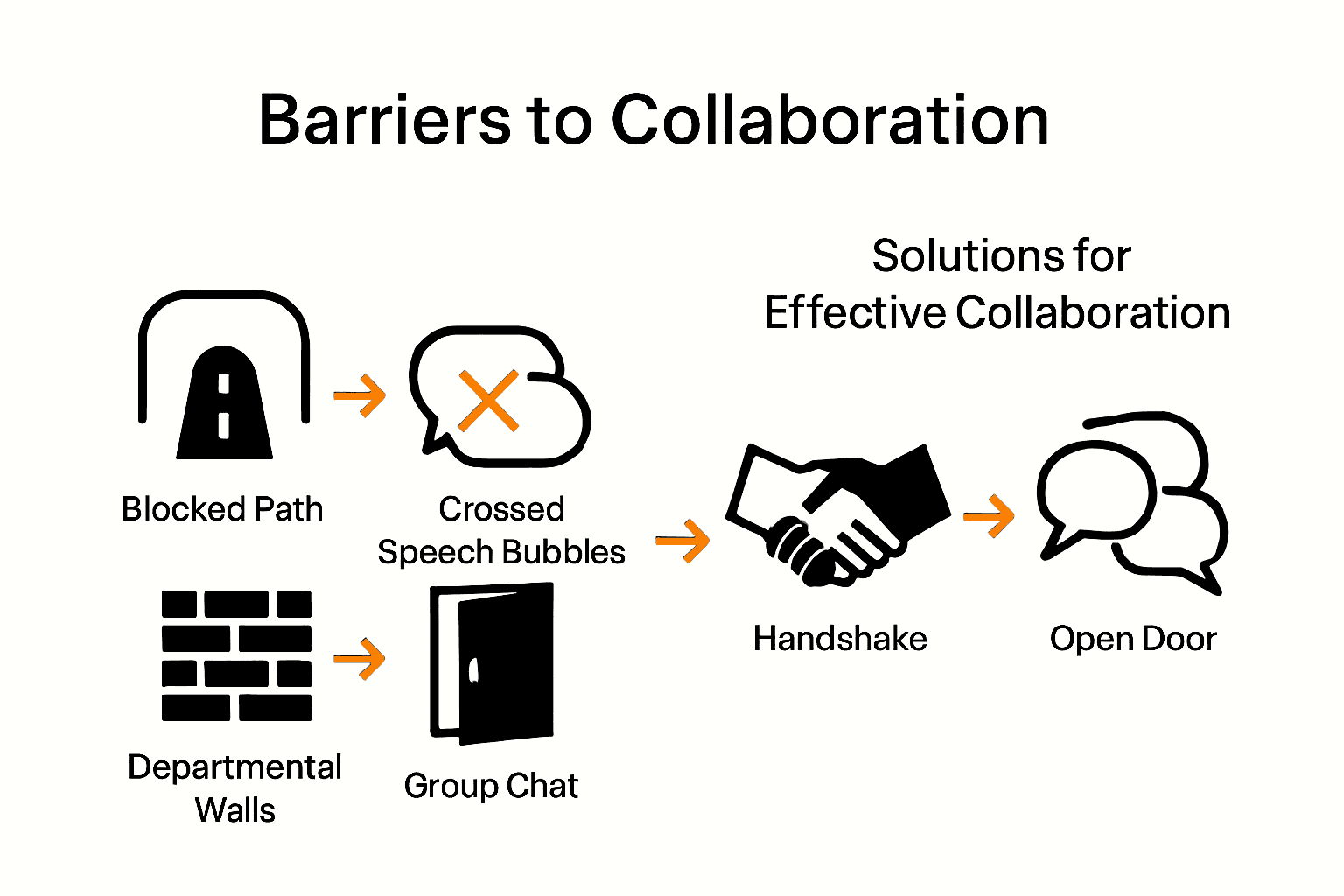
Research from Penn State Berks reveals that structural barriers significantly impede collaboration, with institutional requirements, such as promotion and tenure structures, often creating unintended silos. The study emphasizes the development of shared rules and norms as a strategic approach to breaking down these organizational walls. These systemic challenges can manifest in various ways:
Misaligned individual incentive structures
Competing departmental priorities
Lack of clear communication channels
Rigid hierarchical frameworks
Additionally, the National Center for Biotechnology Information highlights another critical barrier: the potential loss of autonomy that can occur during collaborative efforts. Organizations must carefully balance collective goals with individual agency, recognizing that meaningful collaboration requires significant operational adjustments and substantial investment from all participants. Breaking Down Barriers with Behavioural Insights suggests that addressing these challenges requires a nuanced approach that acknowledges individual perspectives while maintaining a unified organizational vision.
Practical Strategies for Fostering Collaboration
Transforming organizational collaboration requires strategic and intentional approaches that foster meaningful connections across teams and departments.
Research from the University of Iowa Student Life offers compelling insights through four distinct collaboration models: Innovation Mall, Innovation Community, Elite Circle, and Consortium. These frameworks provide organizations a flexible approach to enhance team interactions and break down traditional operational silos.
Practical strategies for fostering collaboration include:
Create Shared Spaces: Both physical and digital environments that encourage spontaneous interactions
Establish Cross-Functional Teams: Mix talent from different departments to solve complex challenges
Implement Transparent Communication Channels: Use tools that enable open, real-time information sharing
Design Collaborative Reward Systems: Recognize and incentivize team-based achievements
7 Ways to Build Team Trust highlights that sustainable collaboration fundamentally depends on psychological safety. Leaders must create environments where team members feel empowered to share ideas, take risks, and support one another without fear of judgment or retribution. This means moving beyond structural changes to cultivate a genuine culture of mutual respect and collective growth.
Unlock True Team Potential with Effective Collaboration
If your organization struggles with creating shared accountability, building trust, or aligning team goals as highlighted in the article, you are not alone. Many leaders face barriers, such as siloed departments and communication breakdowns, that hinder team success. Effective collaboration requires more than just good intentions - it demands a strategic approach to communication, psychological safety, and structured engagement that transforms how teams work together.
Take the next step to break down these barriers today by exploring tailored solutions at Berriault & Associates. Our expert coaching and training programs are designed to foster behavioural change, enhance leadership capacity, and drive organizational agility, all critical to building a culture where collaboration truly thrives. Discover how our proven tools like Five Behaviors™ and Everything DiSC™ can help your teams overcome challenges and achieve lasting results. Visit our website now to schedule a discovery call and start transforming collaboration in your organization.
For insights on building trust as the foundation of team success, check out our guide on Building Trust in Team Dynamics. Discover practical strategies to empower your teams to communicate openly and align with shared goals.
Ready to improve your organization’s collaboration strategy? Visit Berriault & Associates and let us help you create the conditions your teams need to excel together.
Frequently Asked Questions
What is effective collaboration in organizations?
Effective collaboration in organizations refers to a structured approach where team members intentionally work together towards shared objectives, fostering an environment of mutual understanding and coordinated efforts.
What are the essential elements for successful collaboration?
Key elements for successful collaboration include clear communication, shared accountability, mutual respect, and aligned goals that transcend individual interests.
What are common barriers to effective collaboration?
Common barriers to effective collaboration include structural barriers such as competing departmental priorities, misaligned individual incentives, rigid hierarchical frameworks, and inadequate communication channels.
How can organizations foster collaboration among teams?
Organizations can foster collaboration by creating shared spaces, establishing cross-functional teams, implementing transparent communication channels, and designing collaborative reward systems that recognize team-based achievements.