Did you know that only about 10 percent of leaders are truly effective at guiding teams through unpredictable change? Companies everywhere face rapid shifts and rising uncertainty, yet many still rely on outdated leadership tactics that cannot keep up. Leadership agility changes the game by empowering organizations to stay resilient, make fast decisions, and spark innovation even when the future is unclear. Understanding this skill set helps leaders and teams thrive in today’s ever-changing business environment.
Leadership agility is essential for organizations to navigate complex and rapidly changing environments, fostering adaptability and strategic responsiveness.
Core Competencies
Agile leaders must possess humility, adaptability, visionary thinking, and engagement to lead teams effectively through uncertainty and change.
Types of Agility
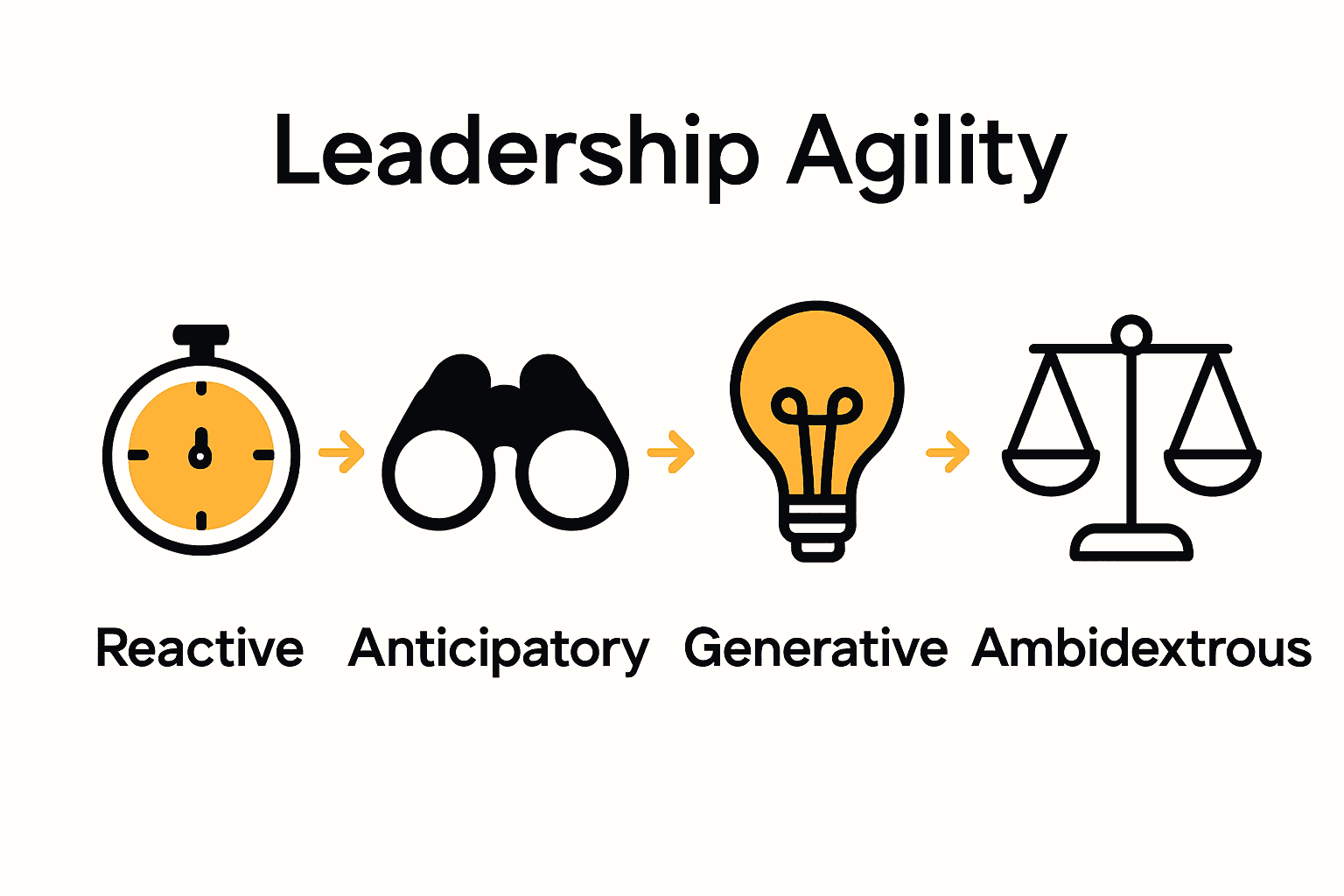
Leadership agility encompasses reactive, anticipatory, generative, and ambidextrous types, each contributing to an organization’s overall adaptability and innovation.
Transformative Benefits
Organizations practicing leadership agility achieve enhanced employee performance, improved customer service, effective crisis management, and better alignment with strategic goals.
Defining Leadership Agility in Modern Organizations
Leadership agility is an organization’s capacity to adapt, learn, and respond effectively in complex, rapidly changing business environments. According to research in organizational development, this approach goes beyond traditional leadership models by emphasizing continuous flexibility and responsive strategic thinking.
At its core, leadership agility is about creating organizational cultures that can simultaneously explore new opportunities while exploiting existing capabilities. An evolution in leadership is upon us, suggesting that agile leaders must cultivate an environment where teams can pivot quickly, embrace uncertainty, and maintain high performance under unpredictable conditions. This requires developing several critical skills:
Rapid decision-making capabilities
Openness to continuous learning
Comfort with ambiguity and complexity
Promoting collaborative and adaptive team structures
Modern agile leadership transcends rigid hierarchical approaches, instead focusing on creating empowered, self-organizing teams that can respond organically to emerging challenges. As organizational research indicates, leaders who successfully implement agility can foster both explorative behaviours that drive innovation and exploitative behaviours that optimize current operational efficiencies. The result? Organizations that are resilient, innovative, and strategically nimble in an increasingly volatile global business landscape.
Core Competencies of Agile Leaders
Agile leadership demands a sophisticated set of skills that go beyond traditional management approaches. According to research by leadership development experts, these competencies are critical for navigating complex, rapidly changing business environments.
Four key competencies define exceptional agile leadership. Agile Leaders’ Behaviours Are Critical For Agile Success highlights these essential capabilities:
Humility: Being open to continuous learning and acknowledging that no single leader has all the answers
Adaptability: Quickly responding to unexpected challenges and embracing change as a constant
Visionary Thinking: Setting clear long-term goals while remaining flexible in execution
Engagement: Maintaining team morale and productivity through transparent communication
Research from organizational development studies emphasizes that agile leaders must make evidence-based decisions while maintaining open communication channels. They create environments where team members feel empowered to experiment, learn from failures, and continuously improve. This approach transforms traditional hierarchical structures into dynamic, collaborative ecosystems where innovation and strategic responsiveness become the norm rather than the exception.
Types and Levels of Leadership Agility
Leadership agility isn’t a one-size-fits-all concept, but a nuanced spectrum of capabilities that organizations can develop and refine. Understanding the different types and levels of leadership agility is crucial to creating adaptive, resilient organizational structures. The Changing Face of Agile Leadership reveals that leadership agility can be categorized into several distinct types:
Reactive Agility: Responding to immediate challenges with quick decision-making
Anticipatory Agility: Proactively identifying potential disruptions before they occur
Generative Agility: Creating innovative solutions that transform existing paradigms
One particularly fascinating type is ambidextrous leadership, which represents the pinnacle of organizational adaptability. This advanced leadership approach enables organizations to pursue both innovation and operational efficiency simultaneously. Leaders practicing ambidextrous leadership can balance exploring new opportunities with exploiting existing capabilities, creating a dynamic organizational environment that can pivot rapidly while maintaining core operational strengths.
Here’s a comparison of the key types and traits of leadership agility:
Type of Agility
Description
Key Behaviours
Reactive Agility
Responds to immediate challenges
Quick decision-making
Immediate action
Anticipatory Agility
Identifies disruptions before they occur
Forward-looking
Proactive planning
Generative Agility
Creates innovative solutions
Breaks paradigms
Drives transformation
Ambidextrous Leadership
Balances innovation and efficiency
Pursues new opportunities
Optimizes operations
The levels of leadership agility progress from individual skill development to organizational transformation. At the most sophisticated level, agile leadership becomes a systemic capability that permeates every aspect of the organization, creating a culture of continuous learning, experimentation, and strategic responsiveness.
Benefits and Real-World Applications
Leadership agility delivers transformative benefits that extend far beyond traditional management approaches. Empirical research demonstrates that organizations embracing agile leadership experience significant performance improvements across multiple dimensions of business operations. What Does It Really Mean to Be an Agile Organization? Highlights the profound impact of leadership agility through practical applications:
Enhanced Employee Performance: Increased work motivation and productivity
Improved Customer Service: More responsive and adaptive service delivery
Crisis Management: Better capability to navigate unprecedented changes
Strategic Alignment: Connecting daily operations to long-term organizational goals
Research from organizational development studies reveals concrete outcomes. Multinational companies that have implemented leadership agility have successfully embedded strategic pillars across leadership teams, enabling more dynamic, responsive organizational structures. By fostering a culture of continuous learning and adaptability, agile leaders create environments where innovation thrives, employee engagement increases, and businesses can quickly pivot in response to emerging market challenges. The result is not just incremental improvement, but a fundamental transformation in how organizations approach leadership, strategy, and operational excellence.
Developing Leadership Agility Skills and Mindsets
Leadership agility is not a fixed trait but a dynamic skill set that can be systematically developed through intentional practices and mindset transformations. Becoming an agile leader requires a commitment to continuous personal growth, self-reflection, and a willingness to challenge existing mental models. Empowering Agile Teams: Competencies for Self-Organization provides insights into cultivating these critical skills:
Emotional Intelligence: Developing self-awareness and empathy
Curiosity: Embracing learning as a continuous journey
Comfort with Uncertainty: Tolerating ambiguity and complexity
Adaptive Thinking: Reframing challenges as opportunities
The journey toward leadership agility involves multiple dimensions of personal development. Leaders must practice active listening, seek diverse perspectives, and create psychological safety within their teams. This means moving beyond traditional command-and-control approaches to fostering environments where experimentation is encouraged, failure is viewed as a learning opportunity, and collaborative problem-solving becomes the norm. By cultivating a growth mindset and remaining open to feedback, leaders can progressively enhance their capacity to navigate increasingly complex and unpredictable organizational landscapes.
Unlock Your Organization’s True Potential with Leadership Agility
Understanding leadership agility is critical to overcoming the challenges of today’s fast-changing business world. If you find your team struggling to adapt quickly, facing difficulty maintaining morale during uncertainty, or searching for ways to balance innovation with operational efficiency, you are not alone. Agile leadership requires embracing flexibility, rapid decision-making, and a growth mindset. Qualities that transform risk into opportunity and foster a thriving, resilient culture.
At Berriault & Associates, we specialize in helping leaders and organizations develop these exact competencies through tailored programs built around proven tools such as Five Behaviors™ and Everything DiSC™. Whether you want to foster ambidextrous leadership, enhance emotional intelligence, or empower your teams for self-organization, our flexible training, coaching, and assessments create sustainable change that aligns strategy with daily operations.
Take the first step toward becoming a truly agile organization starting today. Discover how you can transform leadership challenges into lasting strengths.
Explore our solutions to unlock adaptive leadership skills and catalytic team performance. Ready to evolve your leadership approach and see real impact? Connect with us now at Berriault & Associates and start building the agile future your organization deserves.
Frequently Asked Questions
What is leadership agility?
Leadership agility is an organization’s ability to adapt, learn, and respond effectively in complex, rapidly changing business environments. It emphasizes flexibility and strategic thinking beyond traditional leadership models.
What are the core competencies of agile leaders?
Core competencies of agile leaders include humility, adaptability, visionary thinking, and engagement, which help them navigate challenges and maintain effective team dynamics.
How does leadership agility impact organizational performance?
Leadership agility enhances employee performance, improves customer service, strengthens crisis management capabilities, and aligns daily operations with long-term organizational goals, resulting in significant improvements in business performance.
What types of agility are important in leadership?
Important types of leadership agility include reactive, anticipatory, generative, and ambidextrous leadership, each representing distinct approaches to handling challenges and opportunities in a dynamic environment.


 This approach transforms traditional hierarchical structures into dynamic, collaborative ecosystems where innovation and strategic responsiveness become the norm rather than the exception.
 Ready to evolve your leadership approach and see real impact? Connect with us now at Berriault & Associates and start building the agile future your organization deserves.