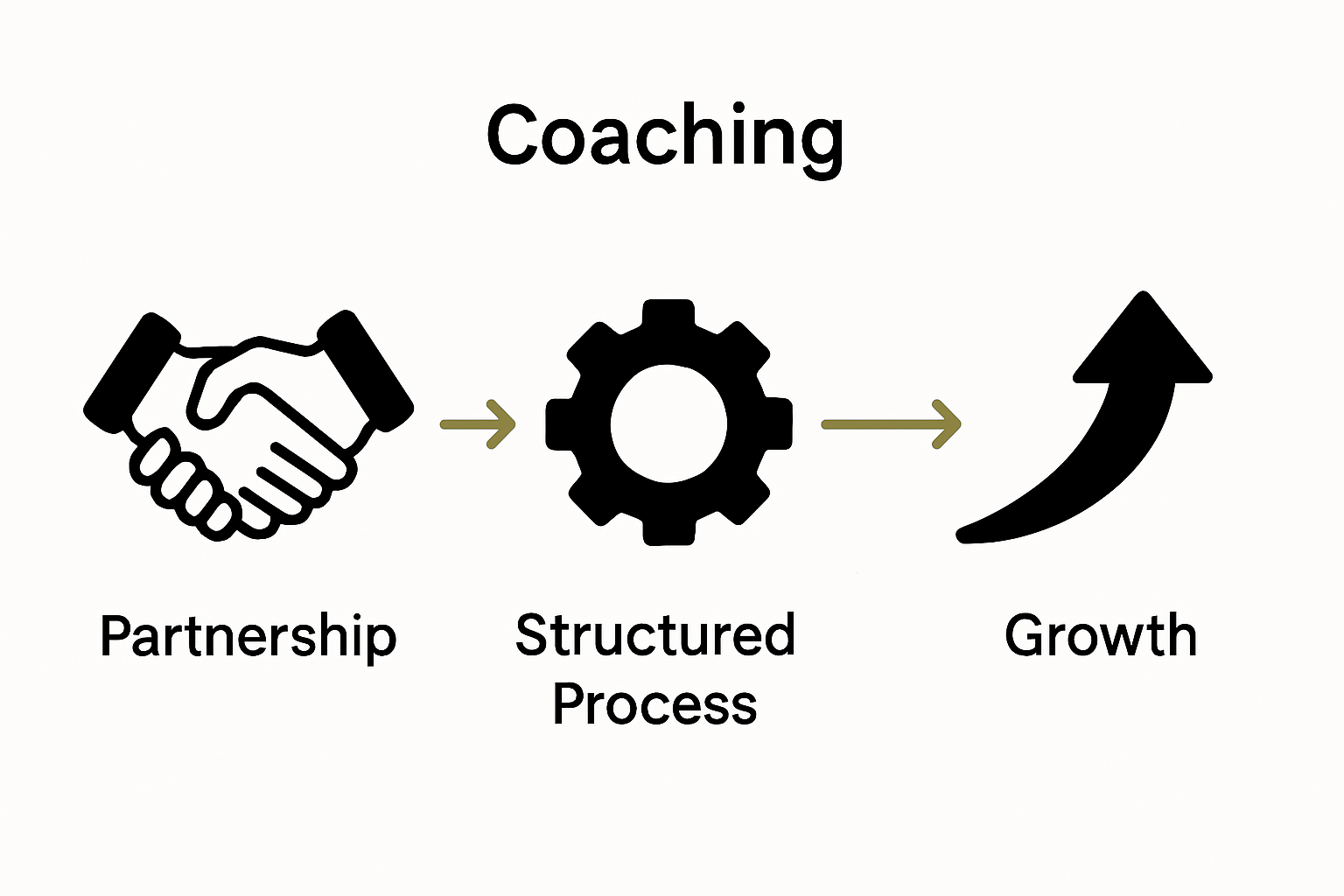
Most professionals want more than just basic advice when chasing personal and career growth. As performance demands increase, the search for truly effective strategies becomes critical. With over 80% of Fortune 500 companies now investing in coaching, understanding what sets professional coaching apart can change how you achieve your goals. Discover how coaching goes beyond simple tips to drive fundamental transformation for individuals and organizations.
A strategic partnership that empowers individuals to unlock their potential and create actionable strategies for personal and professional success.
Types of Coaching
Includes various specializations such as Executive, Career, Performance, Team, and Life Coaching, each tailored to specific developmental needs.
Essential Coaching Skills
Effective coaching requires active listening, emotional intelligence, strategic questioning, trust building, and adaptive communication.
Organizational Benefits
Professional coaching enhances leadership development, performance, change management, and conflict resolution, thereby improving employee engagement and organizational agility.
Defining Professional Coaching and Core Concepts
Professional coaching is a strategic partnership designed to unlock human potential and facilitate transformative personal and professional growth. Unlike traditional mentoring or consulting, coaching focuses on empowering individuals to discover their own solutions and develop actionable strategies for success.
At its core, professional coaching represents a collaborative partnership that leverages an individual’s inherent strengths to foster self-regulated learning, resilience, and positive mindset shifts. Coaches act as skilled facilitators, providing structured support that helps clients identify barriers, challenge existing thought patterns, and create meaningful pathways toward achieving their goals.
The fundamental principles of professional coaching center around several key elements:
Client-Centred Approach: The coaching process prioritizes the client’s unique perspectives, experiences, and objectives
Strengths-Based Methodology: Coaches focus on amplifying existing capabilities rather than fixing perceived weaknesses
Accountability and Action: Coaching transforms insights into concrete plans with measurable outcomes
Confidential and Supportive Environment: Clients receive non-judgmental guidance that encourages honest self-exploration
Professional coaching transcends traditional training models by creating a dynamic, personalized development experience. Instead of prescribing one-size-fits-all solutions, coaches help clients unlock their own potential through powerful questioning, active listening, and strategic reflection. This approach ensures that individuals not only achieve their immediate goals but also develop sustainable skills for continuous personal and professional growth.
Types of Professional Coaching Explained
Professional coaching encompasses diverse specializations designed to address unique developmental needs across personal and professional domains. These specialized coaching approaches provide targeted support that helps individuals navigate complex challenges and achieve transformative growth in specific contexts.
Several key types of professional coaching have emerged to meet varied client requirements, including:
Career Coaching: Supports professionals in career transitions, skill development, and strategic career planning
Performance Coaching: Helps individuals enhance workplace productivity, overcome professional obstacles, and maximize potential
Team Coaching: Concentrates on improving collective team dynamics, communication, and collaborative effectiveness
Life Coaching: Addresses holistic personal development, helping clients achieve balanced life goals and personal transformation
Leadership coaching is a critical subset of professional coaching, offering nuanced strategies for developing organizational talent. Team coaching approaches enable organizations to cultivate adaptive, high-performing teams by addressing systemic challenges and enhancing collective capabilities. Each coaching type shares fundamental principles of client-centred support, yet differentiates through specialized methodologies tailored to specific contexts. Successful coaching interventions recognize that professional growth is not one-size-fits-all and requires customized, intentional approaches that respect the unique dynamics of individuals and organizations.
Essential Skills and Coaching Process
Professional coaching requires sophisticated interpersonal skills and a structured methodology to translate potential into tangible performance outcomes. Core coaching competencies involve creating a dynamic partnership that enables clients to unlock their inherent capabilities and navigate complex personal and professional challenges.
The essential skills of effective coaching center on several critical dimensions:
Active Listening: Deeply understanding client narratives beyond surface-level communication
Emotional Intelligence: Recognizing and navigating subtle emotional landscapes
Strategic Questioning: Crafting powerful inquiries that provoke meaningful self-reflection
Trust Building: Establishing a safe, confidential environment for authentic exploration
Adaptive Communication: Tailoring communication styles to individual client needs
The coaching process itself follows a structured yet flexible framework that emphasizes self-regulated learning and holistic development. Leadership coaching methodologies typically follow a sequence: initial assessment, goal identification, action planning, implementation, and ongoing evaluation. This systematic approach ensures that coaching interventions are not random interactions but purposeful, measurable journeys of personal and professional transformation.
Ultimately, successful coaching transcends the application of mechanical skills. It requires an intuitive blend of technical proficiency and genuine human connection—a delicate dance of supporting clients while challenging them to stretch beyond their perceived limitations. Coaches must simultaneously be compassionate listeners, strategic thinkers, and catalysts for meaningful change.
Organizational Uses and Benefits
Professional coaching has emerged as a strategic intervention that transforms organizational performance by targeting individual and collective human potential. Team development strategies leverage coaching as a powerful mechanism to drive systemic organizational growth and address complex challenges through personalized, adaptive approaches.
Organizations deploy professional coaching across multiple critical domains:
Succession Planning: Preparing emerging leaders for strategic roles
Conflict Resolution: Developing communication and interpersonal skills
The tangible benefits of organizational coaching extend far beyond traditional training models. By investing in targeted coaching interventions, companies can expect significant returns including:
Increased employee engagement and retention
Enhanced organizational agility and resilience
Improved communication and collaboration
More effective decision-making processes
Higher individual and collective performance metrics
Cultural awareness becomes a critical byproduct of comprehensive coaching initiatives, enabling organizations to develop more inclusive, adaptive workplace environments. Successful coaching transforms individual potential into organizational capability, creating a sustainable pathway for continuous improvement and strategic innovation.
Selecting a Professional Coach: Criteria and Pitfalls
Professional coaching requires careful selection to ensure a transformative and meaningful partnership. Understanding critical selection criteria helps individuals and organizations identify coaches who can genuinely drive personal and professional growth.
Key criteria for selecting an exceptional professional coach include:
Verified Credentials: Certifications from recognized coaching institutions
Demonstrated Expertise: Proven track record in your specific domain
Communication Style: Compatibility with your learning and interaction preferences
Ethical Standards: Clear commitment to professional coaching principles
Measurable Approach: Ability to define and track meaningful progress
Critical pitfalls to avoid when selecting a coach involve recognizing potential red flags:
Coaches making unrealistic promises
Lack of transparent methodologies
Absence of verifiable professional references
Generic, cookie-cutter coaching strategies
Minimal understanding of your specific context
Executive coaching approaches emphasize the importance of finding a coach who understands complex organizational dynamics. Successful coaching relationships are built on trust, mutual respect, and a deep commitment to driving meaningful change through sophisticated developmental strategies. The right coach doesn’t just provide guidance—they become a strategic partner in your continuous growth journey.
Unlock Transformative Growth with Professional Coaching and Tailored Organizational Solutions
The comprehensive overview of professional coaching highlights the key challenge many organizations and leaders face today: fostering sustained personal and professional development while enhancing team dynamics and leadership agility. The article emphasizes key pain points, including overcoming productivity obstacles, developing adaptive leadership, and creating accountable action plans within a confidential, supportive environment. These goals demand a strategic, client-centred coaching partnership that drives meaningful change rather than quick fixes.
At Berriault & Associates, we understand these challenges deeply. Our customized programs are designed to complement the principles of professional coaching by focusing on behavioural change, agile transformation, and leadership development. We use proven tools such as Five Behaviors™ and Everything DiSC™ to build trust and cultural awareness and elevate team performance across on-site, remote, and hybrid settings. By combining expert coaching methodologies with a people-centred, framework-agnostic approach, we empower organizations to realize their full potential and create lasting impact.
Ready to transform your organization’s leadership and team effectiveness? Discover how our tailored solutions align perfectly with the coaching concepts discussed in What Is Professional Coaching? Complete Overview.
Take the first step toward empowering your leaders and teams. Visit Berriault & Associates to book a discovery call today and unlock sustainable growth, adaptive leadership, and more potent team synergy through expert coaching and actionable insights.
Frequently Asked Questions
What is professional coaching?
Professional coaching is a strategic partnership that unlocks human potential and facilitates personal and professional growth. It empowers individuals to find their own solutions and develop actionable strategies for success.
What types of professional coaching are available?
There are several types of professional coaching, including executive coaching, career coaching, performance coaching, team coaching, and life coaching. Each type focuses on different areas of personal and professional development.
What skills are essential for effective coaching?
Essential skills for effective coaching include active listening, emotional intelligence, strategic questioning, trust building, and adaptive communication. These skills help coaches provide tailored support and foster meaningful client growth.
How can organizations benefit from professional coaching?
Organizations can benefit from professional coaching through improved leadership development, enhanced performance, effective change management, and better communication. Overall, coaching contributes to increased employee engagement and improved organizational performance.


 Each coaching type shares fundamental principles of client-centred support, yet differentiates through specialized methodologies tailored to specific contexts. Successful coaching interventions recognize that professional growth is not one-size-fits-all and requires customized, intentional approaches that respect the unique dynamics of individuals and organizations.