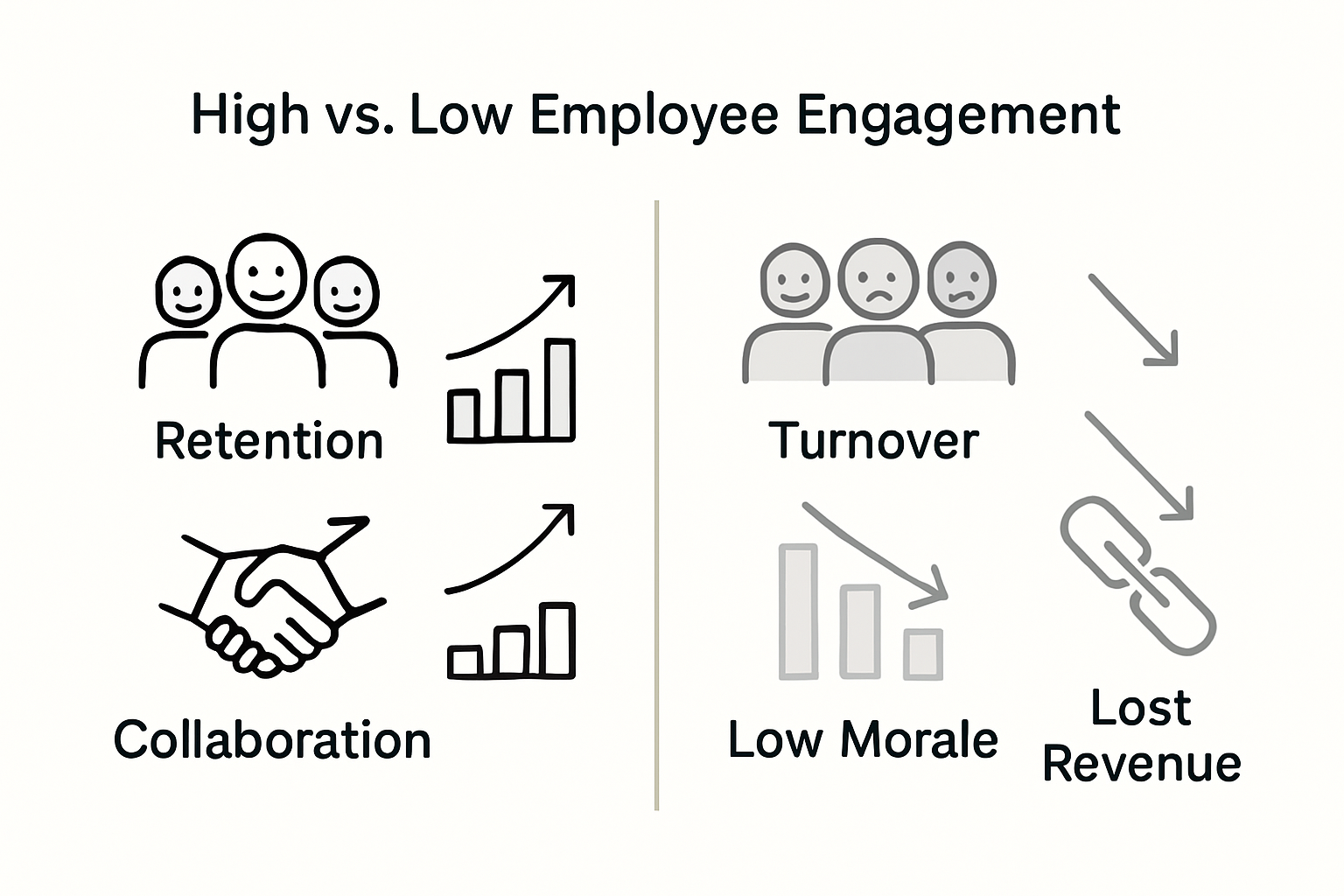
Most businesses underestimate the real cost of disengaged employees, yet companies with highly engaged teams experience a remarkable 21 percent increase in profitability. Employee engagement shapes every aspect of organizational success, from innovation to customer satisfaction. Understanding what drives workers to feel truly connected at work helps leaders foster resilience, boost productivity, and build authentic commitment that fuels lasting business growth.
Employee engagement is an emotional and intellectual commitment that goes beyond mere job satisfaction, involving passion and dedication to organizational success.
Types of Engagement
Engagement can be categorized into emotional, behavioural, and cognitive types, each representing different levels and approaches to commitment in the workplace.
Impact on Business Performance
High levels of employee engagement correlate with increased profitability and productivity, and lower turnover rates, thereby enhancing overall organizational performance.
Risks of Low Engagement
Low engagement can lead to significant economic losses, increased absenteeism, and a decline in workplace culture, threatening organizational effectiveness.
Defining Employee Engagement and Core Concepts
Employee engagement represents a complex psychological connection between workers and their organizational environment, extending far beyond basic job satisfaction or simple compliance. Employee engagement describes the emotional and intellectual commitment an individual brings to their role, characterized by passionate involvement, proactive contributions, and genuine investment in organizational success.
Researchers have developed nuanced frameworks to understand this multidimensional concept. Drawing from academic research, engagement involves three core dimensions: vigour, dedication, and absorption. Psychological commitment to work emerges when employees experience energetic connection, meaningful professional purpose, and deep concentration in their tasks.
At its core, employee engagement transcends traditional transactional employment relationships. Engaged employees demonstrate distinctive characteristics:
Intrinsic motivation to contribute discretionary effort
Alignment with organizational values and mission
Proactive problem-solving and innovation
Sustained performance without external coercion
Understanding engagement requires recognizing it as a dynamic, reciprocal relationship between individuals and their work environment. Organizational culture and leadership practices play critical roles in nurturing environments where employees feel valued, supported, and empowered to deliver their best performance.
Types of Employee Engagement in Organizations
Employee engagement manifests across multiple interconnected dimensions, each representing a distinct form of psychological and behavioural commitment within organizational settings. Researchers have identified distinct engagement types that illuminate the complex ways individuals connect with their work environment. Emotional Engagement represents the deepest level of connection, where employees feel genuine passion and authenticity toward their organization’s mission. This dimension goes beyond transactional work relationships, involving a profound psychological investment in which personal values align with organizational goals. Employees experiencing emotional engagement demonstrate extraordinary discretionary effort, willingly contributing beyond formal job descriptions.
Another critical engagement type focuses on behavioural engagement, which concentrates on observable actions and performance metrics. Organizational commitment and intention to stay are key indicators of an employee’s level of practical engagement. Workers displaying behavioural engagement consistently:
Demonstrate proactive problem-solving skills
Exhibit consistent high-performance standards
Actively participate in team initiatives
Contribute constructively to workplace culture
Maintain professional integrity
Cognitive Engagement represents the intellectual dimension, in which employees strategically invest mental energy in understanding organizational objectives. This engagement type involves critical thinking, innovative problem-solving, and a deep intellectual commitment to professional growth. Workers demonstrating cognitive engagement continuously seek opportunities to expand their skills, challenge existing processes, and contribute meaningful insights that drive organizational innovation.
Key Drivers and Influences on Engagement
Employee engagement emerges from a complex interplay of organizational factors that collectively shape workplace motivation and commitment. High-impact drivers of engagement reveal critical elements that transform workplace dynamics from transactional interactions to meaningful professional experiences. Leadership Quality stands as the most profound driver of engagement. Effective leaders create environments where employees feel valued, heard, and empowered. Organizational culture and workplace learning become instrumental in cultivating engagement through transparent communication, supportive management practices, and opportunities for professional development.
Key engagement drivers include:
Meaningful recognition programs
Clear career progression pathways
Transparent communication channels
Competitive compensation structures
Opportunities for skill enhancement
Inclusive and respectful work environments
Professional growth represents another critical engagement mechanism. Employees seek organizations that invest in their personal and professional development, fostering a symbiotic relationship in which individual aspirations align with organizational objectives. By providing continuous learning opportunities, challenging assignments, and mentorship programs, companies can transform workplace engagement from passive compliance to active, passionate participation.
Business Impact of Employee Engagement Levels
Comprehensive employee engagement strategies translate directly into measurable organizational performance, transforming human capital into a strategic competitive advantage. The correlation between engagement and business outcomes extends far beyond traditional productivity metrics, encompassing financial performance, innovation potential, and sustainable growth. Financial Performance emerges as a critical outcome of robust engagement initiatives. Organizational performance metrics demonstrate that highly engaged workforces can generate significant economic value through reduced turnover, enhanced productivity, and improved operational efficiency. Companies with high engagement levels typically experience:
21% higher profitability
17% higher productivity rates
10% improvement in customer satisfaction scores
41% lower quality defect rates
Substantially reduced recruitment and training expenses
Beyond immediate financial returns, employee engagement drives long-term organizational resilience. Engaged teams demonstrate remarkable adaptability, faster problem-solving capabilities, and a proactive approach to addressing complex business challenges. By cultivating a culture of genuine commitment, organizations can transform their workforce from a cost center into a dynamic, innovative engine of sustainable competitive advantage.
Risks and Costs of Low Engagement
Leadership failures and organizational disengagement create cascading negative consequences that extend far beyond immediate workplace performance. Low engagement represents a systemic risk that can gradually erode organizational effectiveness, transforming potentially dynamic workforces into stagnant, unproductive environments. Economic Impact emerges as the most immediate and quantifiable risk of disengagement. Performance measurement studies reveal substantial financial repercussions, including:
37% higher absenteeism rates
49% more workplace accidents
60% increased employee turnover
18% lower productivity
Significant recruitment and training cost escalations
Beyond financial metrics, low engagement creates profound cultural deterioration. Disengaged teams experience diminished creativity, reduced collaboration, and increased interpersonal friction. Organizations suffering from persistent low engagement become vulnerable to competitive threats, struggle with innovation, and ultimately risk obsolescence in rapidly evolving business landscapes. Proactive engagement strategies represent not just a human resources initiative, but a critical business survival mechanism.
Avoiding Common Mistakes in Engagement Strategies
Engagement strategy failures often stem from superficial approaches that treat employee engagement as a checklist rather than a genuine organizational transformation. Successful strategies require deep, systemic understanding of workforce dynamics and a commitment to authentic cultural change. Strategic Misconceptions frequently derail engagement efforts. Organizations frequently make critical errors such as:
Implementing one-size-fits-all programs
Conducting infrequent or perfunctory feedback sessions
Treating engagement as an HR function instead of a leadership responsibility
Building meaningful engagement requires moving beyond traditional transactional approaches. Cognitive biases in organizational development can significantly undermine engagement strategies, creating blind spots that prevent leaders from understanding the genuine needs of the workforce. Effective engagement demands continuous learning, adaptive communication, and a willingness to challenge existing organizational assumptions about motivation and performance.
Unlock True Employee Engagement to Drive Organizational Success
The article highlights crucial challenges, such as a lack of emotional, behavioural, and cognitive engagement, which lead to low productivity, high turnover, and diminished workplace culture. If your organization struggles with these critical pain points or aims to cultivate meaningful recognition, strategic leadership, and sustainable employee commitment, the path forward is clear. Engagement is not just HR jargon but a dynamic relationship that requires tailored leadership development and team performance strategies.
At Berriault & Associates, we specialize in empowering leaders and teams to break free from disengagement traps by leveraging proven tools like Five Behaviors™ and Everything DiSC™. Our customized coaching and training programs focus on fostering adaptive leadership, enhancing organizational agility, and building a culture where employees feel valued and inspired to contribute their best every day.
Take action now to transform your workforce into a resilient and innovative asset.
Explore how our approach can turn engagement challenges into sustainable growth by visiting our main page. Book a discovery call today to begin reshaping your organizational culture and leadership capacity for lasting impact.
Frequently Asked Questions
What is employee engagement?
Employee engagement is a psychological connection between workers and their organizational environment, encompassing emotional and intellectual commitment to their roles and the organization’s success.
What are the types of employee engagement?
The types of employee engagement include emotional, behavioural, and cognitive engagement, each representing distinct dimensions of commitment and connection to the workplace.
What are the key drivers of employee engagement?
Key drivers of employee engagement include leadership quality, meaningful recognition, clear career progression, transparent communication, competitive compensation, and opportunities for professional growth.
How does employee engagement impact business performance?
High levels of employee engagement are linked to improved financial performance, increased productivity, enhanced customer satisfaction, and a more resilient organizational culture.