

Key Takeaways
| Point | Details |
|---|---|
| Agile Frameworks Enhance Flexibility | Agile methodologies prioritize adaptability and iterative processes, enabling teams to respond quickly to change. |
| Diverse Frameworks for Unique Needs | Different Agile frameworks, such as Scrum, Kanban, and SAFe, cater to specific project requirements and team dynamics. |
| Improved Success Rates | Agile approaches showcase higher project success rates compared to traditional methods, emphasizing their effectiveness in dynamic environments. |
| Mitigating Implementation Challenges | Address common Agile challenges through strategic approaches like clear governance and robust documentation to foster continuous improvement. |
Table of Contents
- Defining Agile Frameworks And Core Principles
- Major Types Of Agile Frameworks Explained
- Comparing Agile To Traditional Project Methods
- Tangible Benefits For Teams And Organizations
- Potential Drawbacks And How To Address Them
Defining Agile Frameworks and Core Principles
Agile frameworks are tools that represent adaptive, collaborative approaches to organizational work, prioritizing flexibility, rapid iteration, and continuous improvement. At their core, these methodologies fundamentally challenge traditional linear, hierarchical work models by emphasizing team empowerment and iterative problem solving. According to research on lean software development, Agile environments are built upon lean manufacturing principles with key strategies like:- Eliminating organizational waste
- Empowering cross-functional teams
- Enabling fast, incremental delivery
- Promoting decentralized decision making
- Daily stand-up meetings
- Regular product reviews
- Continuous retrospectives
- Iterative development cycles
Major Types of Agile Frameworks Explained
Agile methodologies aren’t one-size-fits-all. Like any tool, different frameworks serve unique organizational needs, each with distinctive approaches to collaboration, workflow management, and project delivery. Our insights on enterprise agility emphasize that selecting the right framework depends on specific team dynamics and project requirements. According to research on Agile methodologies, several prominent frameworks stand out:- Kanban: Focuses on visual workflow management and limiting work-in-progress
- Extreme Programming (XP): Emphasizes technical practices like test-driven development
- Lean Software Development: Concentrates on eliminating waste and maximizing value
- Crystal: Provides flexibility for different project sizes and complexities
Here’s what SAFe™ brings to the table for enterprises:
- Keeps multiple Agile teams moving in sync: No more silos—everyone’s playing from the same song sheet.
- Supports coordinated, predictable delivery: Teams can plan, build, and launch together, so nothing falls through the cracks.
- Leverages lean product development: Focus on value, cut the waste, and keep things flowing.
- Promotes systems thinking: Everyone understands how their work fits into the larger puzzle, which is key for sustainable change.
Bottom line: SAFe™ can be a solid fit for organizations with lots of moving parts. As always, the best framework is the one that fits your unique context, culture, and goals.
Each framework brings unique strengths, and the magic happens when organizations thoughtfully match their specific values and challenges with the most appropriate Agile approach.
The goal is about creating a culture of continuous improvement, collaboration, and adaptive problem-solving.
Here’s a structured comparison of major Agile frameworks:| Framework | Core Focus | Key Practices |
|---|---|---|
| Scrum | Iterative teamwork | Sprints Daily stand-ups Retrospectives |
| Kanban | Visual workflow management | Boards WIP limits Continuous flow |
| Extreme Programming | Technical excellence | Test-driven dev Pair programming |
| Lean Software Dev | Value & waste elimination | Value mapping Optimized processes |
| Crystal | Team flexibility | Adaptable roles Tailored work policies |
| Scaled Agile (SAFe) | Scaling agile across the organization | Team alignment Coordinated releases |
Comparing Agile to Traditional Project Methods
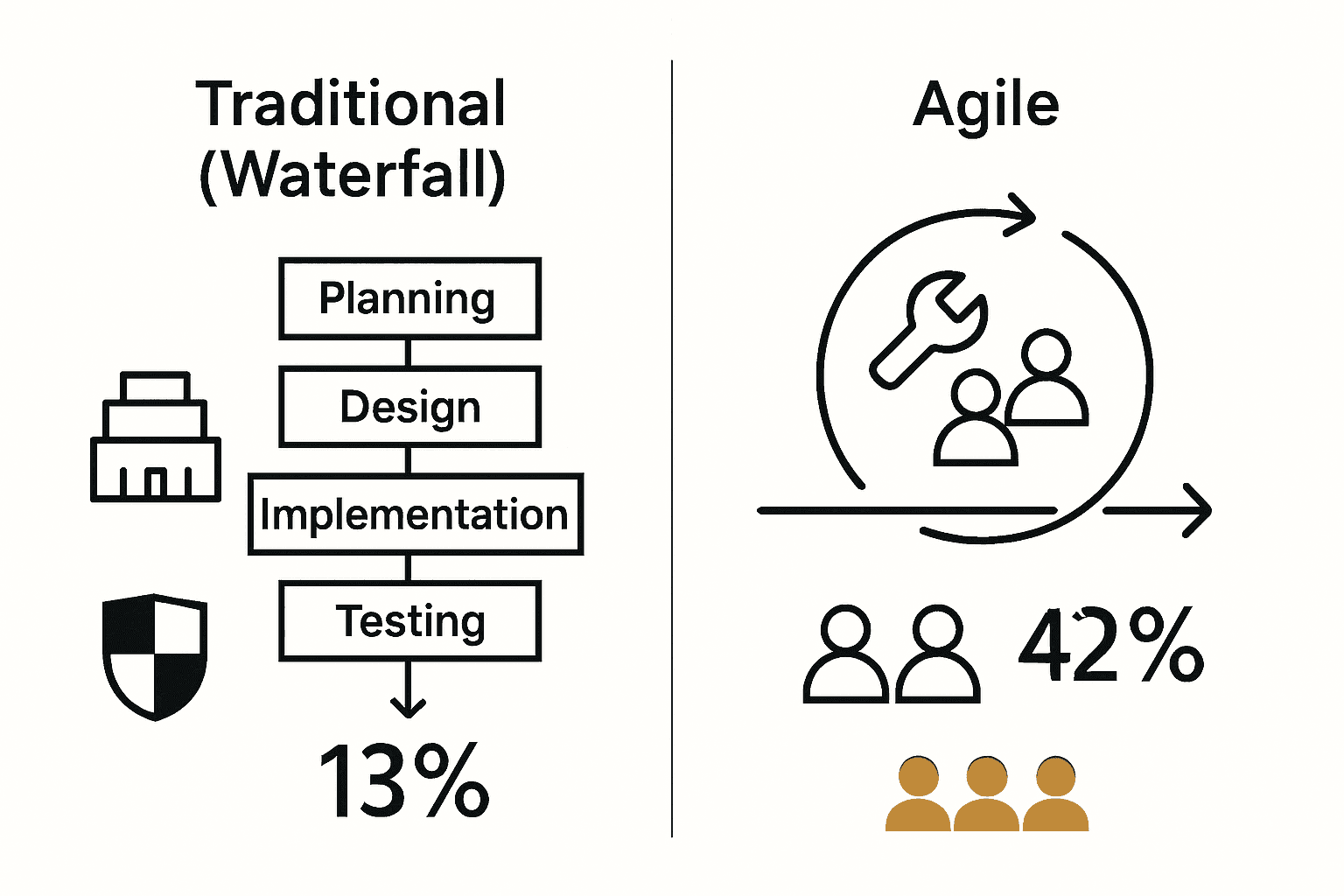
Business environments demand approaches that balance structure with adaptability. Our guide on project governance highlights the critical differences between traditional and Agile methodologies, revealing why more organizations are shifting toward more flexible frameworks. According to research comparing project management methodologies, traditional methods (like Waterfall) and Agile approaches differ fundamentally: Traditional (Waterfall) Characteristics:- Linear, sequential project phases
- Process-centric approach
- Testing occurs at the final project stages
- Limited stakeholder engagement
- High predictability but low flexibility
- Iterative and incremental development
- People-centric approach
- Continuous testing and adaptation
- High stakeholder involvement
- Dynamic and responsive to changes
 Agile represents a fundamental reimagining of how teams collaborate, learn, and deliver results in an increasingly unpredictable business world.
Tangible Benefits for Teams and Organizations
Understanding team dynamics and well-being is crucial when exploring Agile methodologies. These frameworks are about transforming how teams work, collaborate, and deliver exceptional value. According to research on project management methodologies, agile approaches provide significant organizational advantages: Performance Benefits:- More consistent project success rates
- Enhanced adaptability to market changes
- Improved stakeholder value delivery
- Measurable performance gains in complex environments
- Faster feedback and iteration cycles
- Proactive risk management strategies
- Increased team collaboration and transparency
- Higher customer satisfaction rates
- Continuous testing protocols
- Frequent product/service releases
- Flexible collaborative structures
- Rapid response mechanisms
Potential Drawbacks and How to Address Them
Agile methodologies, while powerful, aren’t without challenges. Our insights on budget-friendly team development suggest that proactive strategies can effectively mitigate potential implementation risks. According to research on Agile methodology challenges, organizations frequently encounter several key obstacles: Common Agile Implementation Challenges:- Unpredictable project timelines
- Budget uncertainty
- Insufficient documentation
- Scope creep risks
- Difficulty measuring comprehensive progress
- Establish clear governance frameworks
- Implement robust tracking mechanisms
- Create comprehensive documentation protocols
- Define precise project boundaries
- Regular stakeholder communication
- Strengthen documentation practices
- Enhance stakeholder engagement strategies
- Develop scalable implementation frameworks
- Create transparent reporting mechanisms
Transform Uncertainty Into Sustainable Results With Agile Expertise
Struggling with unclear timelines, unpredictable results, or resistance to change as you adopt Agile frameworks? You are not alone. Many organizations encounter the same hurdles when shifting to a more adaptive, collaborative way of working. Your desire for better team empowerment, faster delivery, and continuous improvement is real, but gaps in structure and support can stall progress. The right guidance and flexible, people-centred solutions are essential to overcoming these pain points and unlocking the full value of agility. Imagine transforming every challenge into growth with a tailored approach that adapts to your unique team and culture. Our expertise at Berriault & Associates brings proven tools like Five Behaviors™ and Everything DiSC™ directly to your organization. We design programs that remove obstacles, increase team trust, and provide practical strategies for sustainable agility. If you are ready to build effective teams, boost leadership, and turn Agile from a buzzword into real business results, schedule your discovery call with us today. Take this next step and move your organization from uncertainty to clarity right now.Frequently Asked Questions
What are Agile frameworks?
Agile frameworks are adaptive, collaborative approaches to project management that prioritize flexibility, rapid iteration, and continuous improvement. They challenge traditional linear work models by emphasizing team empowerment and iterative problem-solving.What are the main types of Agile frameworks?
The major types of Agile frameworks include Scrum, Kanban, Extreme Programming (XP), Lean Software Development, Crystal, and the Scaled Agile Framework (SAFe). Each serves different organizational needs and emphasizes various aspects of collaboration and project delivery.How does Agile differ from traditional project management methods?
Agile differs from traditional methods, such as Waterfall, in that it focuses on iterative and incremental development, high stakeholder involvement, and adaptive processes. Traditional methods follow a linear, sequential approach, often resulting in less flexibility to accommodate changing requirements.What are the benefits of using Agile methodologies?
Benefits of Agile methodologies include improved project success rates, greater adaptability to market changes, better stakeholder value delivery, faster feedback cycles, and higher customer satisfaction. Agility fosters a culture of continuous improvement and collaboration within teams.Recommended
- Why Having One Agile Framework Across An Enterprise May Not Be A Good Thing - Berriault and Associates Consulting Group
- Unlocking the Power of the Agile Practice Guide: Beyond Frameworks - Berriault and Associates Consulting Group
- Agile organizations - Berriault and Associates Consulting Group
- Framework Selection - Berriault and Associates Consulting Group