Over 70 percent of executives report an improvement in work performance after participating in coaching. Leadership in today’s fast-paced environment demands more than technical expertise; it calls for rapid growth, adaptability, and a clear vision. Understanding how executive coaching works can open new avenues for personal development and organizational success, helping leaders turn challenges into measurable progress.
Executive coaching provides a customized approach that focuses on individual strengths and organizational needs, promoting effective development.
Collaborative Process
The coaching relationship requires active participation from both the coach and the client to enhance learning and growth.
Diverse Formats
Various coaching formats (1:1, group, team, virtual, hybrid) allow for tailored interventions suited to specific goals and contexts.
Maximizing ROI
To ensure a successful coaching experience, it is essential to align expectations, set measurable goals, and maintain ongoing feedback mechanisms.
Defining Executive Coaching and Its Core Concepts
Executive coaching represents a strategic and personalized approach to professional development, designed to elevate leadership performance and organizational effectiveness. According to NIH HR, it is a “confidential, tailored, and collaborative one-on-one professional development process aimed at enhancing leadership and management competencies to achieve higher performance.” Executive coaching operates as a targeted intervention that supports individual and organizational growth through focused, intentional dialogue and skill development. Unlike traditional training programs, coaching creates a customized pathway for leaders to explore their strengths, address potential developmental areas, and unlock their full potential. Michigan State describes coaching as a process that “supports the growth and professional learning of an organization and its stakeholders by modelling and facilitating best practices to achieve desired outcomes while providing feedback.”
Key characteristics of executive coaching include:
Personalization: Uniquely tailored to individual leadership styles and organizational context
Confidentiality: Creating a safe space for honest self-reflection and vulnerability
Performance-Oriented: Directly linked to improving measurable leadership and organizational outcomes
Collaborative: Involving active participation from both coach and client in goal setting and strategy development
The core purpose of executive coaching transcends simple skill transfer. It represents a transformative journey of self-discovery, strategic thinking, and intentional personal development. By providing dedicated, expert guidance, coaches help leaders navigate complex professional challenges, enhance emotional intelligence, and develop more adaptive leadership approaches.
Types of Executive Coaching and Delivery Formats
Executive coaching is not a one-size-fits-all approach; rather, it is a flexible discipline with multiple formats tailored to the unique needs of both organizations and individuals. Harvard HR highlights several core coaching offerings, including “individual 1:1 coaching, group executive coaching, new leader coaching, and senior team coaching, tailored to various leadership challenges and goals.”
The diverse delivery formats of executive coaching enable organizations to create targeted interventions that address specific developmental requirements. Headstart emphasizes that “different coaching formats and delivery methods should be chosen based on the specific needs of staff members, as various formats may work differently even within the same program.”
Common executive coaching formats include:
One-on-One Coaching: Personalized, intensive individual sessions focusing on specific leadership skills and personal development
Group Coaching: Collaborative learning environments where leaders share insights and challenges
Team Coaching: Addressing collective leadership dynamics and organizational performance
Virtual/Online Coaching: Flexible digital platforms enabling remote development
Hybrid Coaching: Combining in-person and digital interaction modes
Each coaching format offers unique advantages, enabling organizations to design precise interventions that align with their strategic objectives and individual leader needs. The key is selecting an approach that aligns with the specific developmental goals, learning preferences, and organizational context. Here’s a comparison of common executive coaching formats:
Coaching Format
Core Features
Typical Benefits
One-on-One Coaching
Personalized
Private sessions
Deep self-reflection
Targeted growth
Group Coaching
Peer interaction
Shared experiences
Collaborative learning
Networking
Team Coaching
Focus on collective goals
Team dynamics
Improved alignment
Team cohesion
Virtual/Online
Remote access
Flexible scheduling
Convenience
Broader accessibility
Hybrid Coaching
Mix of in-person & online
Adaptive engagement
Customizable
Enhanced flexibility
How Executive Coaching Drives Leadership Growth
Executive coaching emerges as a powerful catalyst for leadership transformation, providing targeted interventions that unlock profound personal and professional development. Center for Creative Leadership emphasizes that effective leadership coaching is grounded in creating “a safe and supportive environment, facilitating collaboration, and promoting learning from experience to drive leadership growth.”
The strategic approach of executive coaching enables leaders to navigate complex organizational challenges with increased self-awareness and adaptive capabilities. National Center on Education and the Economy highlights that coaching “provides personalized support to strengthen leadership, navigate complex challenges, and drive meaningful, system-wide change, leading to sustained leadership growth.”
Key mechanisms through which executive coaching drives leadership growth include:
Self-Awareness Development: Helping leaders understand their strengths, blind spots, and behavioural patterns
Skill Enhancement: Targeted skill-building in critical leadership competencies
Strategic Thinking: Expanding leaders’ perspectives and decision-making capabilities
Emotional Intelligence: Improving interpersonal relationships and communication skills
Performance Optimization: Creating accountability and goal-oriented development strategies
Ultimately, executive coaching transcends traditional training by offering a personalized, reflective journey that empowers leaders to unlock their full potential. How to Develop Leadership Skills for Lasting Team Impact demonstrates that sustainable leadership growth requires continuous learning, self-reflection, and intentional personal development.
Key Responsibilities of Coaches and Clients
Executive coaching represents a collaborative partnership with distinct yet interconnected responsibilities for both the coach and the client. Michigan State emphasizes that coaches must “understand how to engage adults in learning, build collaborative relationships, and possess specialized knowledge to build organizational capacity,” while clients should remain “open to feedback and committed to continuous improvement.”
The coaching relationship requires a dynamic interaction where both parties actively contribute to the growth process. Coaches are responsible for creating a supportive and non-judgmental environment that facilitates deep personal and professional exploration. Clients, in turn, must demonstrate vulnerability, commitment, and a genuine desire for self-development.
Key responsibilities for coaches include:
Creating Safe Learning Environments: Establishing trust and psychological safety
Asking Powerful Questions: Challenging assumptions and promoting self-reflection
Developing Customized Strategies: Designing personalized development approaches
Maintaining Confidentiality: Ensuring complete privacy and discretion
Client responsibilities complement the coaching process by:
Embracing Vulnerability: Being open to uncomfortable truths
Taking Ownership: Driving personal development initiatives
Practicing Active Listening: Engaging deeply with coaching insights
Implementing Learned Strategies: Translating coaching discussions into actionable changes
Understanding these mutual responsibilities is crucial. Executives Who Resist Coaching reveals that successful coaching requires genuine commitment from both parties, transforming potential resistance into meaningful growth opportunities.
Common Pitfalls and Maximizing Coaching ROI
Executive coaching demands strategic approaches to ensure meaningful organizational impact and substantial return on investment. Center for Creative Leadership emphasizes the critical importance of “creating a balanced environment of support and challenge, working within the coachee’s agenda, and promoting self-awareness and experiential learning” to maximize coaching effectiveness.
The coaching investment requires careful navigation to avoid common pitfalls that can diminish potential outcomes. National Center on Education and the Economy recommends “tailoring coaching to individual goals and challenges, working with experienced coaches, and focusing on action-oriented support” as key strategies to optimize organizational development.
Common pitfalls that undermine coaching ROI include:
Misaligned Expectations: Unclear or unrealistic performance objectives
Lack of Organizational Support: Insufficient cultural or systemic reinforcement
Superficial Engagement: Treating coaching as a transactional rather than transformational process
Insufficient Accountability: No mechanism to track and measure coaching impact
Poor Coach-Client Matching: Incompatible coaching styles or personalities
Comprehensive Measurement: Implementing robust pre and post-coaching assessments
Ongoing Feedback: Creating continuous dialogue between coach, client, and organizational stakeholders
Long-Term Perspective: Viewing coaching as a sustained developmental journey
For leaders seeking to transform potential resistance into meaningful growth, Executives Who Resist Coaching offers critical insights into navigating organizational coaching challenges.
Elevate Leadership Through Tailored Executive Coaching Solutions
Executive coaching is essential for leaders ready to overcome self-doubt, increase self-awareness, and transform challenges into growth opportunities. This article emphasizes the significance of personalized, confidential, and performance-oriented coaching in unlocking leadership potential and driving organizational success. If you recognize the struggle with aligning leadership development to organizational goals or face resistance to coaching efforts, these are precisely the issues that targeted executive coaching can resolve.
At Berriault & Associates, we specialize in customized leadership development programs that emphasize sustainable growth and adaptive leadership. Our people-centred approach utilizes proven tools, such as Five Behaviors™ and Everything DiSC™, to craft coaching experiences that resonate deeply with your organizational culture and leadership style. By integrating emotional intelligence and strategic thinking frameworks, we help leaders and teams bridge gaps highlighted in this guide, turning coaching from a transactional activity into a transformative journey.
Looking to advance your leadership impact today? Discover how our agile, flexible coaching offerings can help your leaders thrive in onsite, remote, or hybrid environments. Unlock your organization’s full potential with expert guidance tailored to your challenges. Book a discovery call now at Berriault & Associates and start transforming your leadership and team dynamics with trusted, strategic coaching solutions. Learn more about developing leadership skills that create lasting team impact, how to develop leadership skills for lasting team impact, and address coaching resistance with insights from executives who resist coaching.
Frequently Asked Questions
What is executive coaching?
Executive coaching is a personalized approach to professional development, designed to enhance leadership performance and organizational effectiveness through tailored one-on-one interactions that focus on skill development and self-discovery.
How does executive coaching differ from traditional training programs?
Unlike traditional training programs, executive coaching offers a customized pathway for leaders to explore their strengths and address areas for development through focused, intentional dialogue and tailored support.
What are the types of executive coaching formats available?
Common executive coaching formats include one-on-one coaching, group coaching, team coaching, virtual/online coaching, and hybrid coaching, each with unique characteristics suited to different developmental needs.
What are the key responsibilities of coaches and clients in executive coaching?
Coaches are responsible for creating a supportive environment, asking powerful questions, and providing objective feedback. Clients, on the other hand, must embrace vulnerability, take ownership of their development, and implement the strategies they have learned.


 Here’s a comparison of common executive coaching formats: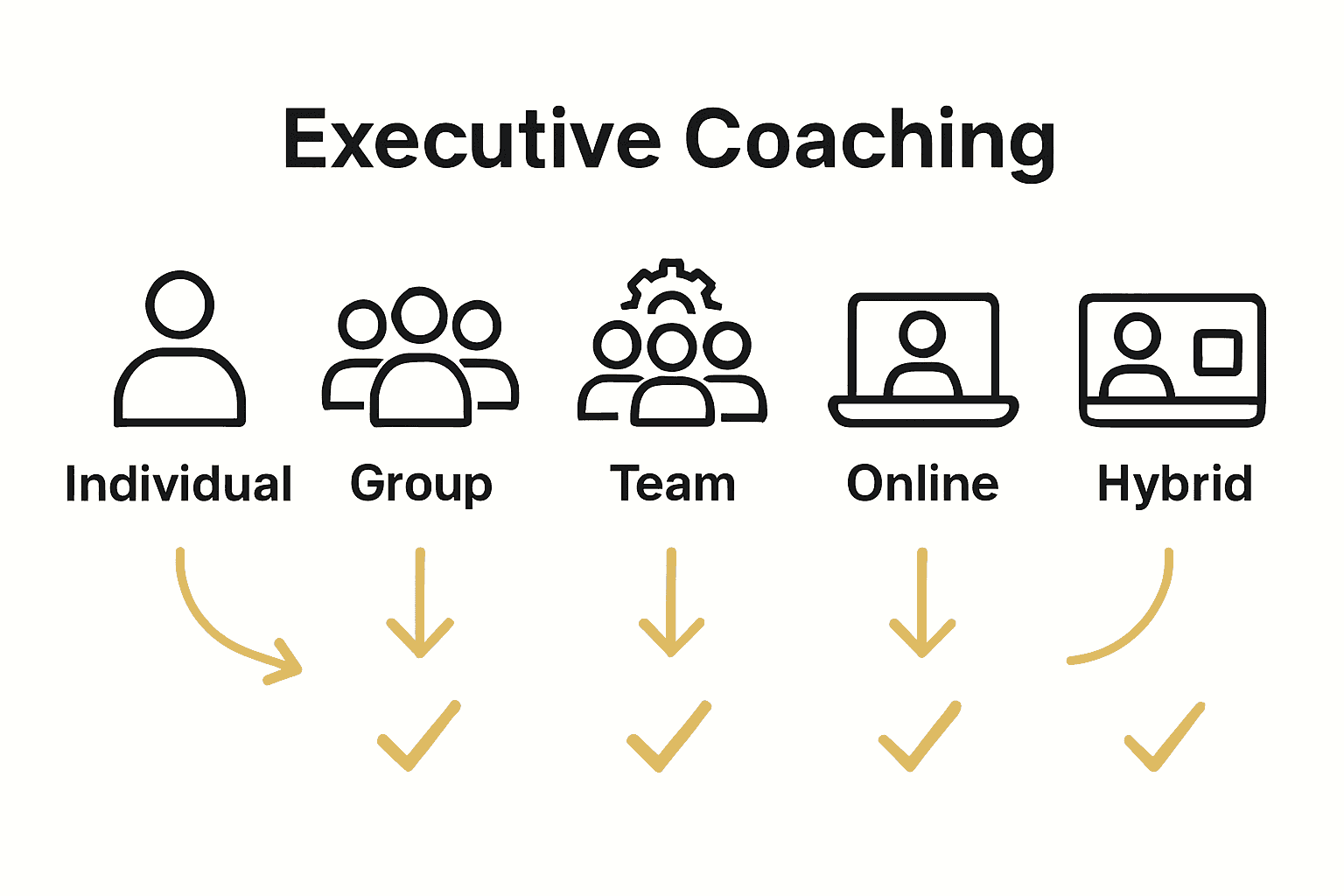
 Unlock your organization’s full potential with expert guidance tailored to your challenges. Book a discovery call now at Berriault & Associates and start transforming your leadership and team dynamics with trusted, strategic coaching solutions. Learn more about developing leadership skills that create lasting team impact, how to develop leadership skills for lasting team impact, and address coaching resistance with insights from executives who resist coaching.