Over 60 percent of organizations now consider team coaching a vital strategy for driving lasting performance gains. Many leaders realize it takes more than individual talent to meet complex goals. Team coaching offers a proven way to strengthen collaboration, boost engagement, and unlock the full potential of every group. This guide explains how targeted coaching transforms ordinary teams into high-performing units through powerful interventions and practical results.
Team coaching aims to improve team effectiveness by enhancing communication, decision-making, and conflict resolution among members.
Types of Coaching
The three main types of team coaching—motivational, consultative, and educational—address different needs and foster diverse developmental outcomes.
Ongoing Development
Successful team coaching is an iterative process involving clear objectives, competent coaches, and organizational readiness to foster a supportive culture.
ROI Measurement
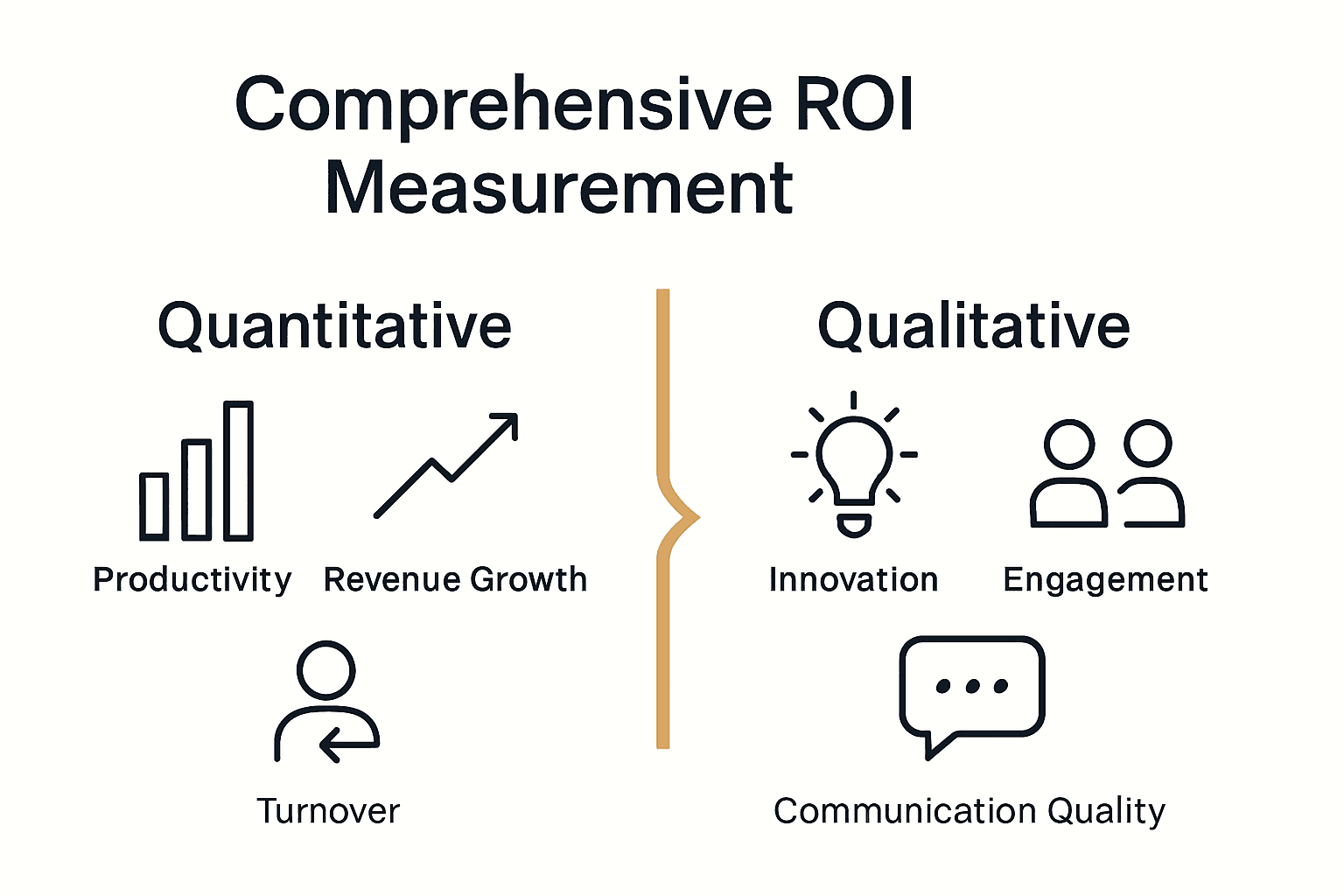
Calculating ROI requires both quantitative and qualitative metrics to assess improvements in productivity, collaboration, and team engagement post-intervention.
Defining Team Coaching and Its Core Purpose
Team coaching is a strategic intervention designed to enhance collective performance and organizational potential by targeting and systemically developing team dynamics and collaborative capabilities. Unlike traditional individual coaching, this approach focuses on elevating the entire team’s effectiveness by addressing shared goals, communication patterns, and interpersonal relationships.
According to research from the Institute of Coaching, team coaching aims to improve team effectiveness by enhancing communication, strengthening decision-making processes, and adopting more constructive conflict-resolution strategies. The core purpose extends beyond mere skill development to creating a holistic environment where teams can unlock their collective intelligence and potential.
At its essence, team coaching is a structured, intentional process in which a professional coach works directly with a team to help them improve performance, collaboration, and overall functioning. Key objectives typically include:
Identifying and addressing team behavioural patterns
Developing a shared understanding of team goals
Improving interpersonal communication and trust
Enhancing collective problem-solving capabilities
Creating sustainable mechanisms for continuous team growth
The Employment Studies research underscores that team coaching is not a one-time event but an ongoing developmental journey. By creating a supportive yet challenging environment, team coaches help groups transcend individual limitations and achieve remarkable collective performance that significantly surpasses what might be possible through individual efforts alone.
Major Types of Team Coaching Explained
Team coaching encompasses diverse approaches tailored to address specific organizational challenges and team developmental needs. MDPI Research highlights three primary categorizations: individual, group, and team-level coaching, each with unique methodological frameworks and targeted outcomes.
According to Employment Studies, team coaching models can be broadly classified into three distinct types:
Motivational Coaching: Focuses on energizing teams, building intrinsic motivation, and aligning individual team member drives with collective goals
Consultative Coaching: Emphasizes strategic problem-solving, providing external perspectives and structured guidance to navigate complex organizational challenges
Educational Coaching: Prioritizes skill development, knowledge transfer, and creating sustainable learning mechanisms within team environments
Each coaching type serves a specific purpose, offering nuanced interventions designed to address different team dynamics and performance requirements. The motivational approach helps teams overcome psychological barriers and build confidence, while the consultative model provides strategic insights and external accountability. Educational coaching ensures continuous skill enhancement and knowledge propagation across team structures.
These diverse coaching methodologies share a common goal: transforming team potential into measurable, sustainable performance improvements. By understanding and strategically applying these approaches, organizations can create adaptive, resilient teams that can navigate complex business landscapes with agility and collective intelligence. For leaders seeking comprehensive team development strategies, how to build high-performing teams offers additional insights into creating exceptional team environments.
Key Benefits for Teams and Organizations
Team coaching delivers transformative advantages that extend far beyond traditional training approaches. Institute of Coaching research reveals critical benefits, including dramatically enhanced communication, more sophisticated decision-making, and substantially improved conflict management, fundamentally reshaping organizational performance.
According to Employment Studies, team coaching contributes to organizational success through several key mechanisms:
Performance Optimization: Systematically improving team productivity and effectiveness
Collaboration Enhancement: Breaking down silos and fostering cross-functional understanding
Adaptive Capacity: Building organizational resilience and flexibility
Talent Development: Creating sustainable mechanisms for continuous learning
Cultural Alignment: Reinforcing shared values and collective vision
The most profound benefits emerge from the holistic transformation of team dynamics. By addressing individual and collective psychological patterns, team coaching creates environments where innovation thrives, communication flows naturally, and performance barriers dissolve. Teams develop emotional intelligence, learn to leverage diverse perspectives, and create synergistic relationships that transcend traditional hierarchical limitations.
Organizational leaders recognize that investing in team coaching is not an expense but a strategic opportunity. Why Invest in Team Development represents a fundamental reimagining of human potential—turning talented individuals into extraordinary collaborative units capable of solving complex challenges with unprecedented creativity and alignment.
Success Factors and Implementation Strategies
Employment Studies research reveals that successful team coaching hinges on several critical success factors, transforming traditional organizational development approaches into dynamic, responsive strategies. The most effective implementations blend systematic methodology with nuanced human-centred approaches that recognize the complexity of team dynamics.
Key success factors for team coaching implementation include:
Clear Objective Setting
Establishing measurable, specific team and organizational goals
Aligning coaching outcomes with strategic business objectives
Creating transparent expectations for all stakeholders
Coach Competency
Selecting coaches with deep organizational understanding
Maintaining ongoing professional development for coaches
Organizational Readiness
Cultivating a supportive, learning-oriented culture
Securing leadership commitment and active participation
Creating psychological safety for team exploration and growth
According to the Institute of Coaching, successful implementation strategies demand continuous alignment between coaching interventions and organizational objectives. This requires a flexible, adaptive approach that can dynamically respond to emerging team needs and shifting business landscapes.
Leaders seeking to optimize their team coaching investments should recognize that implementation is not a one-time event but an ongoing, iterative process. Implementing a Strategic Approach to Leadership Challenges provides additional insights into creating sustainable, high-performance team environments that continuously evolve and adapt.
Comparing Team Coaching With Other Interventions
Team coaching distinguishes itself from traditional organizational interventions through its holistic, systemic approach to performance enhancement. Unlike generic training programs or one-dimensional consulting approaches, team coaching addresses the intricate dynamics of collective performance by focusing on the interconnected relationships, communication patterns, and shared mental models that drive team effectiveness.
Key differences between team coaching and alternative interventions include: Team Training
Focuses on skill acquisition
Typically short-term and event-based
Limited focus on interpersonal dynamics
Standardized curriculum
Team Coaching
Emphasizes adaptive learning and behavioural transformation
Ongoing, contextual intervention
Deep exploration of team relationships and psychological patterns
Customized, dynamic approach
Consulting
External problem-solving perspective
Primarily strategic or operational
Limited engagement with the team’s emotional intelligence
Prescriptive recommendations
The fundamental distinction lies in the depth of engagement.
Team coaching transcends traditional interventions by creating a reflective, adaptive learning environment where teams develop collective intelligence beyond individual capabilities. This approach recognizes that organizational performance is not just about acquiring skills, but about fundamentally transforming how teams think, interact, and solve complex challenges.
Leaders seeking a comprehensive understanding of coaching methodologies can explore the role of coaching in leadership, which provides deeper insights into the nuanced approaches that drive meaningful organizational change.
Calculating Return on Investment in Team Coaching
Calculating the return on investment (ROI) for team coaching requires a comprehensive approach that goes beyond traditional financial metrics. Organizations must consider both tangible and intangible benefits arising from transformative team development interventions, recognizing that true value extends far beyond immediate monetary outcomes.
Key ROI measurement dimensions include: Quantitative Metrics
Productivity increases
Revenue growth
Reduced employee turnover
Decreased conflict resolution time
Performance efficiency improvements
Qualitative Metrics
Team collaboration enhancement
Communication quality
Psychological safety
Innovation capacity
Employee engagement levels
A strategic ROI calculation typically involves tracking specific indicators before and after team coaching interventions. Leaders should establish baseline metrics, implement targeted coaching programs, and systematically measure changes across multiple performance dimensions. This might involve comparing team performance indicators like:
Average project completion times
Error reduction percentages
Cross-functional collaboration effectiveness
Customer satisfaction scores
Internal communication efficiency
Organizations seeking a structured approach to evaluating coaching investments can explore the Value and ROI Pack, which provides comprehensive tools for measuring the multidimensional impact of team development initiatives.
Unlock Your Team’s True Potential with Expert Coaching Solutions
Many organizations struggle with stagnant team dynamics and underperforming collaboration despite talented individuals. As highlighted in the “Complete Guide to Why Invest in Team Coaching,” challenges like ineffective communication, low trust, and unclear goals can significantly hinder collective success. Investing in tailored team coaching addresses these pain points by transforming behavioural patterns and building adaptive leadership that drives sustainable growth.
At Berriault & Associates, we specialize in turning these challenges into opportunities. Our people-centred, flexible coaching programs leverage proven tools such as Five Behaviors™ and Everything DiSC™ to foster deeper trust and improve decision-making skills. Working directly with leaders and teams, we help cultivate resilient, high-performing units tuned to thrive in remote or hybrid environments.
Ready to elevate your team beyond traditional training? Explore how our customized team coaching can unlock communication, collaboration, and innovation within your organization today. Visit Berriault & Associates and learn more about why to invest in team development. Book a discovery call now to start your journey toward extraordinary team performance.
Frequently Asked Questions
What is team coaching?
Team coaching is a strategic intervention that enhances team performance and organizational potential by improving team dynamics, communication, and collaboration.
What are the main types of team coaching?
The main types of team coaching include motivational, consultative, and educational coaching, each with specific focuses such as energizing teams, problem-solving, and skill development.
What are the key benefits of investing in team coaching?
Investing in team coaching can lead to enhanced communication, improved decision-making, optimized performance, stronger collaboration, and greater innovation capacity within teams.
How can organizations measure the return on investment in team coaching?
Organizations can measure ROI in team coaching by evaluating quantitative metrics, such as productivity and revenue growth, alongside qualitative metrics, such as collaboration quality and employee engagement levels.


 By creating a supportive yet challenging environment, team coaches help groups transcend individual limitations and achieve remarkable collective performance that significantly surpasses what might be possible through individual efforts alone.